Discovery of a code that allows molecular motors to select specific mRNAs for subcellular localisation
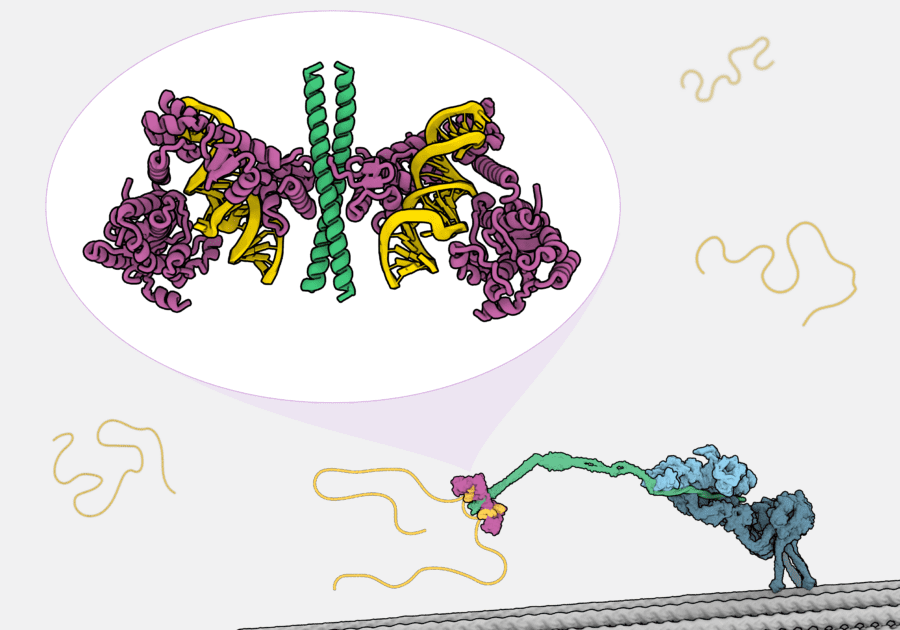
In order to perform their elaborate functions, cells must position the right proteins in the right place at the right time. In many cases, this spatial organisation is achieved by localising the instructions for making proteins – mRNA molecules – to specific sites, thereby ensuring their products are only made and function where needed. It has been recognised for decades that mRNA delivery is mediated by large machines called molecular motors, which translocate along polarised cytoskeletal tracks together with mRNA cargo. However, it has not been clear how motors select specific mRNAs for transport from a much wider pool of these molecules. This is because there are no obvious similarities in the sequences or predicted structures of different localising mRNAs.
A collaborative project between the groups of Simon Bullock and Andrew Carter, in the LMB’s Cell Biology and Structural Studies Divisions, respectively, has revealed that mRNAs are chosen by motor complexes based on a set of shared features that had previously gone unnoticed.
Using electron cryomicroscopy, Kashish Singh, a postdoc in Andrew’s group, was able to visualise the structures of several mRNAs bound by an adaptor protein complex for the microtubule-based motor dynein.
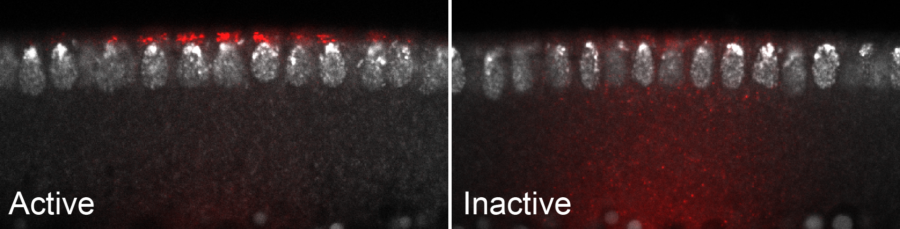
The RNA-binding function of the adaptor complex is provided by a protein called Egalitarian (Egl), which was found to engage targets by assembling multiple, atypical RNA-binding domains around double-stranded RNA stem loops. The structures also revealed that the Egl-binding region in different RNAs adopts a highly similar three-dimensional fold, despite being formed by very different sequences. By studying how mutations that disrupt this fold affect binding to Egl, as well as dynein-mediated mRNA transport in fruit fly embryos, Sabila Chilaeva, a PhD student in Simon’s group, demonstrated that the shape of the stem loop is critical for mRNA recognition.
The team found that association with Egl also depends on the identities of two specific base pairs in the RNA structures, which are spaced a set distance apart in their helical regions. These features are discriminated by side chains of two structurally related domains in the protein, which reach into the RNA’s minor groove. This level of sequence specificity has not previously been demonstrated for proteins that bind double-stranded RNA, expanding our understanding of how molecular recognition can be achieved in RNA biology.
Reinforcing the importance of the identified structural and sequence features, grafting them into an otherwise inactive RNA stem loop was sufficient to generate a fully active localisation signal.
Additional experiments, including reconstitution of mRNA-motor complexes with purified components by Mark McClintock, a senior investigator scientist in Simon’s group, revealed an additional selection criterion: the presence of two Egl-binding structures on the same mRNA molecule. This constitutes a quality control mechanism that ensures only bona fide mRNA cargo is moved by the transport machinery, thereby preventing the potentially damaging accumulation of proteins at ectopic cellular sites.
Collectively, the project has revealed that motors select mRNAs for intracellular transport based on the shape and sequence of individual RNA elements, as well as the presence of multiple analogous signals in the same molecule. By providing a molecular explanation for how diverse localising mRNAs are selected, this work resolves a long-standing question in cytoskeletal transport. It also suggests that similar recognition principles may operate in other processes governed by RNA-binding proteins, including translational control, mRNA decay and RNA silencing.
This work was funded by UKRI MRC, UKRI BBSRC and EMBO.
Further references
Simon’s group page
Andrew’s group page
Related articles
A genome-wide resource for dissecting transport within cells
Cryo-EM reveals first high-resolution structure of the dynein-dynactin complex bound to microtubules
Packaging molecular motors for delivery