DeorphaNN, a new neural network developed using AlphaFold, identifies agonist peptides for orphan GPCRs
Cell communication is reliant on chemical messages, often in the form of peptides which bind to cell surface receptors known as GPCRs (G protein-coupled receptors). GPCRs control several vital bodily functions, including metabolism, nervous system activity and sleep, and are also important drug targets. Much like a lock and key system, specific peptides are needed to activate specific GPCRs. For several GPCRs, the corresponding peptides haven’t been identified – these are known as orphan GPCRs. Finding the correct peptide-receptor pairing is a laborious and costly endeavour, with thousands of possible combinations to test. To solve this problem, William Schafer’s group, in the LMB’s Neurobiology Division, have worked with Isabel Beets, LMB Fellow and Group Leader at KU Leuven, to develop DeorphaNN, a neural network which utilises AI to predict peptide-receptor pairings.
In recent years, AI advancements have proved capable of accurate protein structure prediction and, beyond this, of predicting protein-protein interactions. The exemplary model is AlphaFold, the development of which was awarded the 2024 Nobel Prize in Chemistry. Reasoning that peptide-GPCR connections are themselves a form of protein-protein interactions, Larissa Ferguson, a postdoc in William’s group, set about exploring how AlphaFold’s predictions could be applied to solve the problem of orphan GPCRs.
Whilst AlphaFold can predict protein interactions, a key issue in applying this to GPCRs is that it predicts many peptides as interacting with GPCRs, even when they don’t activate them. In order to be of use, the new system had to be capable of distinguishing agonists (peptides which switch a receptor on) from peptides which do not trigger signalling.
Building an AI model typically requires a huge amount of training data for the AI system to ‘learn’ from. To that end, Isabel and William’s groups previously conducted extensive screening of Caenorhabditis elegans, resulting in a map detailing all peptide-GPCR interactions in the nematode worm. This work provided an ideal foundation to develop novel computational methods to predict peptide agonists for GPCRs.
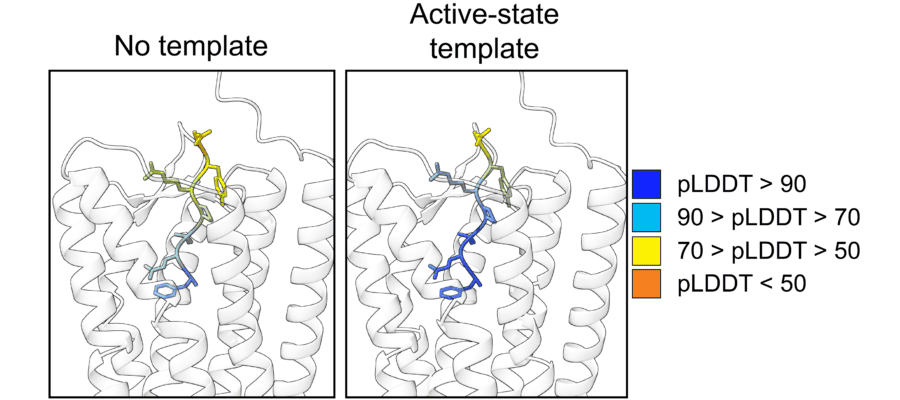
For every possible GPCR-peptide pairing in the C. elegans model, the group used AlphaFold to generate 3D structures to illustrate potential interaction. As GPCRs change shape once activated, they found they could further improve prediction accuracy by also generating structures using the active conformations, as a true agonist peptide is one that promotes this conformation.
In addition to predicted structures, AlphaFold also generates internal numeric summaries known as representations, which implicitly encode biochemical interactions, spatial constraints, and physical relationships. The group extracted this rich source of information to build a graph neural network that identifies agonist interactions, enriching it with structural predictions and interatomic interactions. They named this new network DeorphanNN.
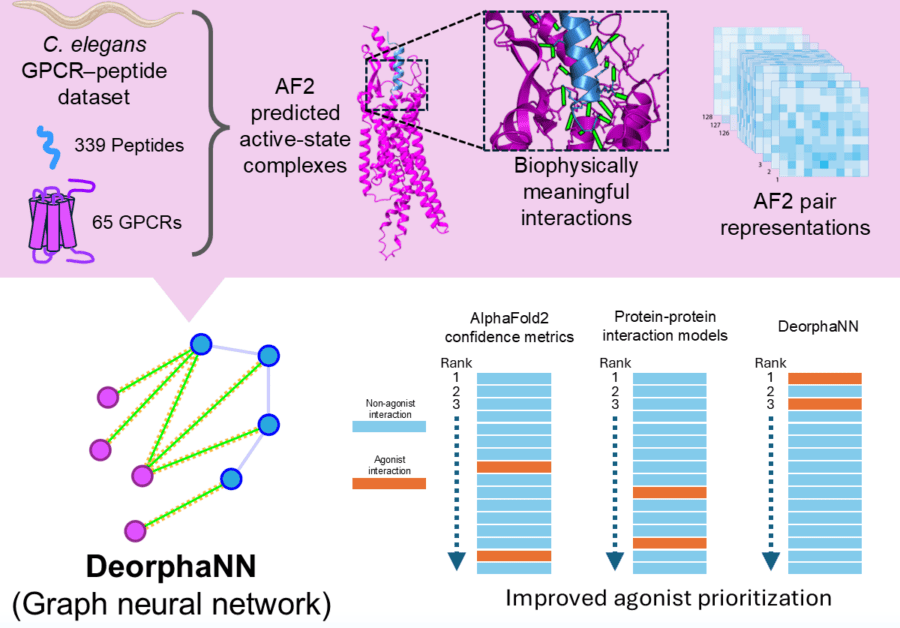
Finally, the group tested DeorphanNN experimentally, choosing the highest ranked predicted agonist pairings and conducting cell-based activation assays. This led to the successful confirmation of two agonists for previously orphan GPCRs.
This study exemplifies how AI models like AlphaFold, trained on vast amounts of data for the task of predicting protein structure, can be harnessed and adapted to solve other long standing questions in biology, including understanding how cells communicate. In creating DeorphaNN to rapidly match signalling peptides to their GPCRs, the group have built a useful tool for accelerating basic biological discovery which ultimately will support the development of future medicines. Although DeorphaNN was trained largely from C. elegans datasets, the group have performed cross-species validation studies, finding it performed well on datasets from other animals, including humans. This opens up the possibility for the new model to be adopted to study signalling systems across biology, helping to uncover important peptide–receptor networks that could guide the development of future medicines.
This work was funded by UKRI MRC, the Max Perutz Fund, the Research Foundation – Flanders, KU Leuven Research Council and the Baillet Latour Fund.
Further references
William’s group page
Isabel Beets – KU Leuven page
Isabel Beets – LMB Fellow page
Related articles
First map of wireless communication in the nervous system
ModelAngelo software expands cryo-EM toolkit with faster atomic model building and identification of novel proteins
Related videos
Using AI to accelerate scientific discovery by Demis Hassabis (2021 Kendrew Lecture – Part 1)
Highly accurate protein structure prediction with AlphaFold by John Jumper (2021 Kendrew Lecture – Part 2)
Structure prediction and design using AlphaFold by Sami Chaaban (2025/26 Solving Problems with Molecular Techniques series)