A novel degradative pathway, antibody-directed xenophagy, protects cells from viral and bacterial infection
In order to prevent infection, mammals have evolved multiple complementary antimicrobial factors which integrate into sophisticated and robust immune systems. One important factor in human immunity is TRIM21, an intracellular protein which binds to antibodies. TRIM21 is an E3 ubiquitin ligase, an enzyme which catalyses ubiquitination, the transfer of the signalling protein ubiquitin onto ‘client’ molecules. Previously, Leo James’s group described how TRIM21 protects from viral infection by binding to antibody-coated viruses in the cytosol of cells, triggering the viruses to be ubiquitinated and degraded. However, the mechanism the cell uses to degrade these intercepted viruses remained elusive.
In a new study led by Tyler Rhinesmith, researchers have now discovered a novel pathway called antibody-directed xenophagy (ADX) which explains how TRIM21 protects cells from infection by diverse pathogens. A postdoctoral scientist in the Leo’s group, Tyler conducted a genome-wide CRISPR/Cas9 knockout screen, individually removing every gene across the human genome and testing how its deletion impacted TRIM21-triggered degradation of viruses. The results were striking, revealing a previously undescribed process by which TRIM21 is able to trigger autophagy of cell-invading viruses.
Autophagy, literally ‘self-eating’, is a conserved cellular process through which the cell delivers damaged or toxic components to acidic organelles for degradation and recycling. While autophagy is crucial for the maintenance of cellular health, its ability to defend against viral infection has not been very well studied. So, the team dissected the ADX pathway in molecular detail.
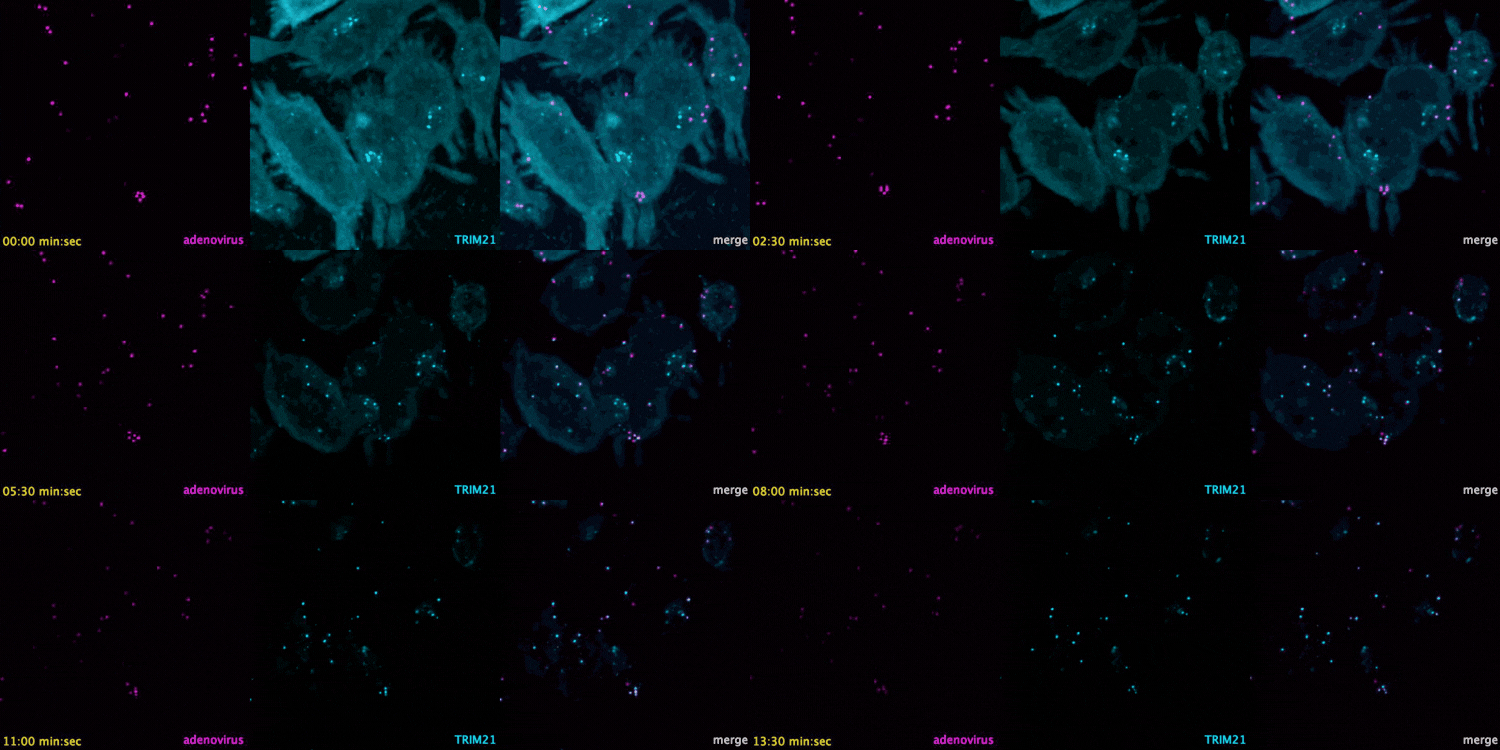
In order to do this, Anna Albecka, a staff scientist in the Leo’s group, developed a high-fidelity confocal microscopy platform which allowed the team to visualise previously unidentified events in the TRIM21 restriction mechanism. For the first time, the researchers could observe binding of TRIM21 to antibody-coated viruses inside cells, in real time. After TRIM21 ubiquitinates the invading virus complex, Anna’s microscopy demonstrated that ubiquitin stimulates the assembly of autophagy components around viruses, including LC3, a marker for membranous compartments called autophagosomes.
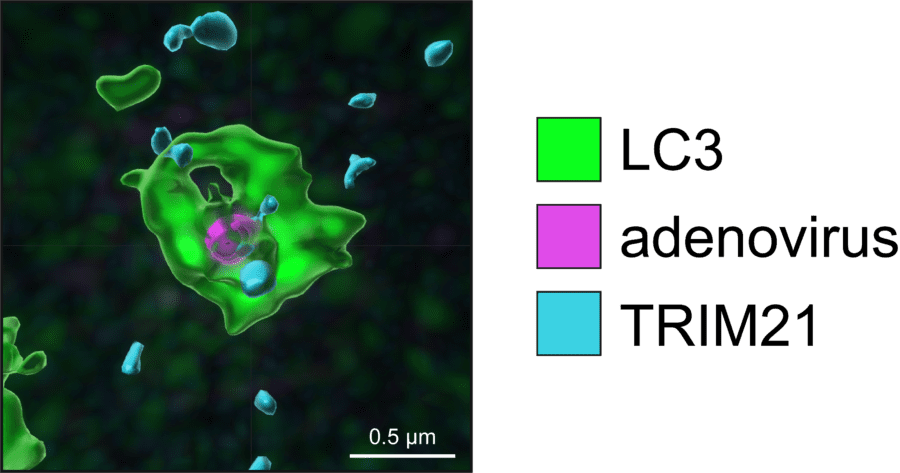
Working with Claudia Puri and David C. Rubinsztein at the UK Dementia Research Institute Cambridge, the team used super-resolution microscopy to visualise the assembly of these autophagosome membranes around individual viral particles coated in antibodies and TRIM21. Together these observations revealed the step-wise process by which incoming virions are incarcerated inside sealed, LC3-positive autophagosomes. Anna was further able to show that these virus-containing autophagosomes are ultimately delivered to acidic lysosomes, resulting in the degradation of each virus into harmless peptides and nucleotides. Significantly, this study shows that antiviral autophagy is a highly effective strategy deployed by cells to protect themselves from infection and provides new tools for investigating this process.
Inspired by the ability for TRIM21 to activate by clustering around clients of very different architectures, the team next sought to understand whether it could also intercept a completely different type of pathogen: bacteria. The team used antibodies and a novel live cell microscopy method to track bacterial growth inside mouse cells. They observed the same ADX pathway that intercepts viral infection also potently restricts growth of intracellular Salmonella. This discovery is significant because it explains how TRIM21 is able to intercept and trigger degradation of invading pathogens of many complex structures and diverse lineages.
By leveraging the intrinsic flexibility of the autophagy pathway, ADX can adapt to and degrade variety of large and difficult targets. This demonstrates that the cell does not require a bespoke defence strategy for every individual pathogen. Instead, it employs a universal strategy, reliant on TRIM21, to redirect the cell’s existing autophagy machinery to any harmful material tagged with antibodies. This adaptability makes ADX clinically important for human immunity and, excitingly, a potential target for therapeutic enhancement.
This work was funded by UKRI MRC, the UK Dementia Research Institute, the Wellcome Trust, and the Cambridge Trust.
Further references
Leo’s group page
Claudia Puri – Cambridge Institute for Medical Research
David Rubinsztein – Cambridge Institute for Medical Research
How cells fight infection from the inside – UKRI News
Related articles
New potential therapy for neurodegeneration removes tau aggregates and improves motor function
Understanding the protein modifications behind Trim-Away protein degradation technology
Classification of human tauopathies based on tau filament folds
Animal research statement
As a publicly funded research institute, the LMB is committed to engagement and transparency in all aspects of its research. This research used mice, in accordance with the UK Animals (Scientific Procedures) Act 1986. This work was conducted under a Project Licence, reviewed and approved by the MRC Laboratory of Molecular Biology (LMB) Animal Welfare and Ethical Review Body (AWERB) committee and the UK Home Office.
The LMB uses the minimum number of rodents necessary to achieve results and only uses animals in research where there are no suitable alternatives, in line with the 3R’s (replace, reduce, refine). We currently work with fruit flies, nematode worms, mice, rats and zebrafish.