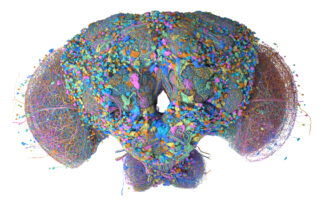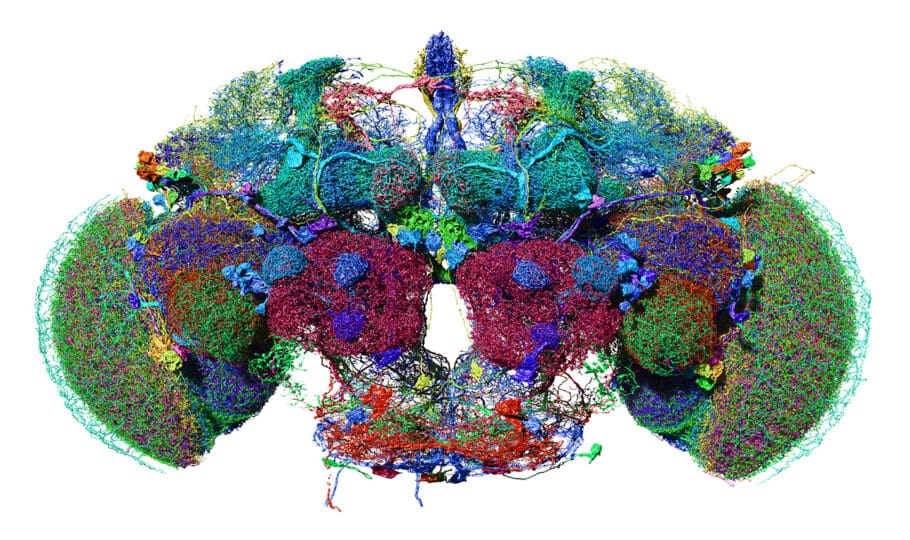
3D colour-coded reconstruction of a fruit fly brain connectome, detailing intricate neuronal networks across distinct regions.

Discovering
how life works
This 3D rendering shows the neural connections in a fruit fly brain, which is less than 1 mm across. Read more about the rendering, Greg Jefferis’s group and the FlyWire Consortium.
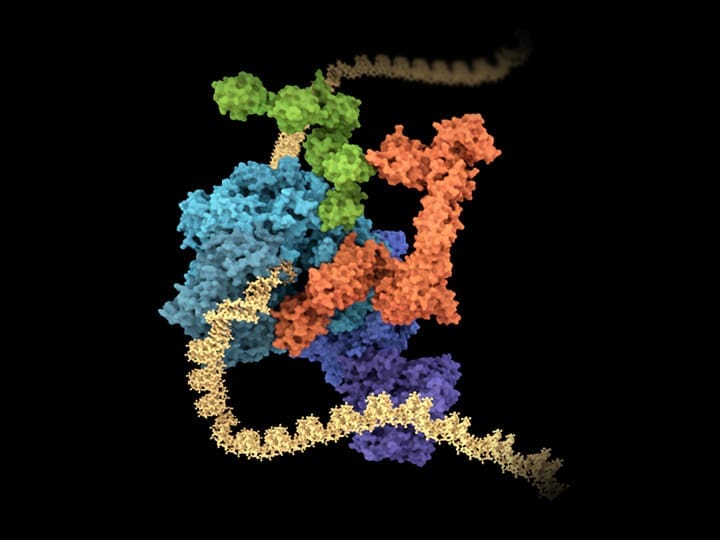
Molecular model of a replisome, a multi-protein complex (colored blobs) actively replicating a DNA double helix (yellow strand).

Research that spans the breadth of biology

The MRC Laboratory of Molecular Biology (LMB) is a research institute dedicated to the understanding of fundamental biological processes at the levels of atoms, molecules, cells and organisms. The knowledge we provide is crucial to solving key problems in human health.

A 3D image of the human replisome, the molecular machinery that copies our DNA, captured using electron cryomicroscopy. Discover more about the research exploring how these complexes work.

Latest News

Three women sit at a table smiling and gesturing during a discussion, with one woman's back to the viewer and notebooks on the table.

An unsurpassed environment for researchers

The LMB comprises over 50 scientific groups pursuing ambitious research, supported by cutting-edge scientific facilities and generous core-funding by the MRC/UKRI. We occupy an inspiring, purpose-built building on the thriving Cambridge Biomedical Campus.
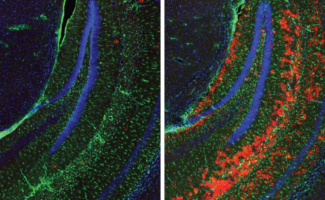
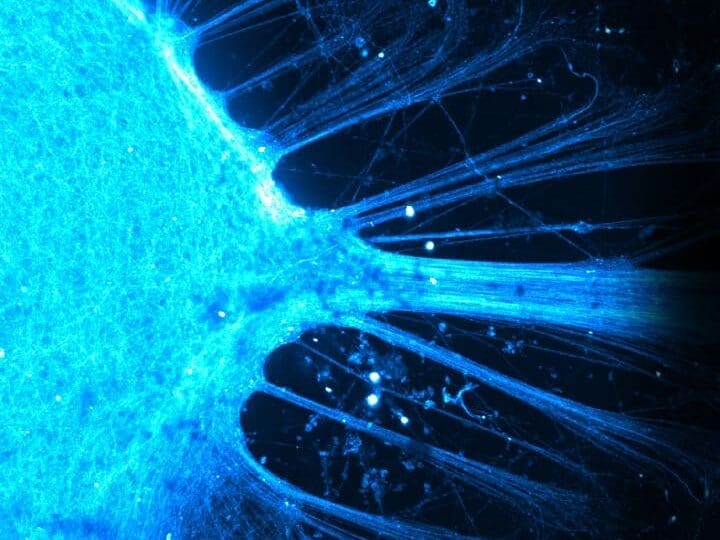
Fluorescent micrograph of a neuronal cell body with numerous radiating filamentous processes.

Progressing science for over 60 years

Since our origins in 1947, the LMB has pioneered the molecular biology revolution and is a world-leading source of new ideas, scientific advances and technology. Our discoveries have led to highly successful commercialisations and medical advances that have improved human life.

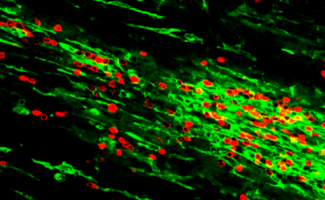
An axon bundle growing from a human brain organoid within a micropatterned device. Read more about research into axon growth and human brain development. 

Latest Publications

The tRNA-Modification Geranyl-2-Thiouridine Enables RNA-Lipid Association. (4th Oct 2026)Singer J, Halter K, Chan CY, Carell TAngew Chem Int Ed Engl • e9140489 • doi: 10.1002/anie.9140489
Taking the heat: Breaking the temperature limits of eukaryotic life. (1st Oct 2026)Kuo YW, Foo S, Baum BCell • 189(20):6212-6213 • doi: 10.1016/j.cell.2026.09.006
ZNFX1, an immunoregulatory RNA helicase and E3 ubiquitin ligase, assembles into pleiomorphic polymers. (1st Oct 2026)Naydenova K, Mund T, Yip MCJ, Harper CM, Leigh KE, Hankinson J, Boyle KB, Heatley A, Otten EG, Lulla V, Modis Y, Randow FMol Cell • 86(19):4018-4031.e4 • doi: 10.1016/j.molcel.2026.09.002
Prion-like transmission of human tau strains in the mouse brain. (30th Sep 2026)Lövestam S, Shimozawa A, Tarutani A, Ohtani R, Masuda-Suzukake M, Hasegawa K, Robinson AC, Saito Y, Murayama S, Yoshida M, Suzuki H, Onaya M, Hasegawa M, Goedert M, Scheres SHWNature • doi: 10.1038/s41586-026-11061-x
Sphingolipids associate with the chlamydial nucleoid and mark developmental transitions in Chlamydia trachomatis. (30th Sep 2026)Rühling M, Wagner F, Epprecht T, Köhling PF, Schumacher F, Sachs S, Kersting L, Fink J, Girndt L, Kleuser B, Sauer M, Seibel J, Weiss GL, Rudel TNat Commun • 17(1) • doi: 10.1038/s41467-026-77974-3
Diverse S-layer anchoring mechanisms create an epiplasmic space in prokaryotic cell envelopes. (29th Sep 2026)Isbilir B, Bharat TA, Alva VCurr Opin Microbiol • 94:102839 • doi: 10.1016/j.mib.2026.102839
Cotranslational membrane protein biogenesis by an EMC-bound translocon. (28th Sep 2026)Rollins MG, Tang J, Wan Y, Sundaram A, Wu H, Li Q, Fedry J, Hegde RS, Ji Z, Keenan RJNat Struct Mol Biol • doi: 10.1038/s41594-026-01889-2
The Interplay of Curvature, Geometry, and Topology Shapes Tissue Organisation in Epithelial Shells. (28th Sep 2026)Morato L, Andrés-San Román JA, Garrido-García J, Gordillo-Vázquez C, Palacios AM, Lidueña-Fernández E, McDole K, Gómez-Gálvez P, Annese V, Escudero LMAdv Sci (Weinh) • e77487 • doi: 10.1002/advs.77487

Loading...