Multidisciplinary approach combining mouse models, novel cell engineering and cryo-ET reveals that RNF213 attaches ubiquitin directly to dysfunctional glycogen to trigger autophagy
Ubiquitylation is a key regulatory process in cells, during which the small protein ubiquitin is attached to a substrate to control its fate. It was once believed that only proteins underwent ubiquitylation, until Felix Randow’s group, based in the LMB’s PNAC Division, demonstrated that cells use the enzyme RNF213 to attach ubiquitin to lipopolysaccharide (LPS), a non-protein component of invading bacteria. This finding established non-protein ubiquitylation as a new mechanism of immune defence and raised the intriguing possibility that other non-protein molecules might also be targeted by ubiquitin. Felix’s group has now discovered that RNF213 also attaches ubiquitin to abnormal glycogen deposits, highlighting the important role that non-protein ubiquitylation plays in maintaining normal physiology in animals.
Glycogen is a large, highly branched polysaccharide made from glucose that cells use to store energy. When branches of glycogen don’t form correctly, it becomes poorly soluble and can amass in deposits called polyglucosan bodies, the accumulation of which causes several serious diseases. How exactly cells identify and remove abnormal glycogen has, so far, not been well characterised.
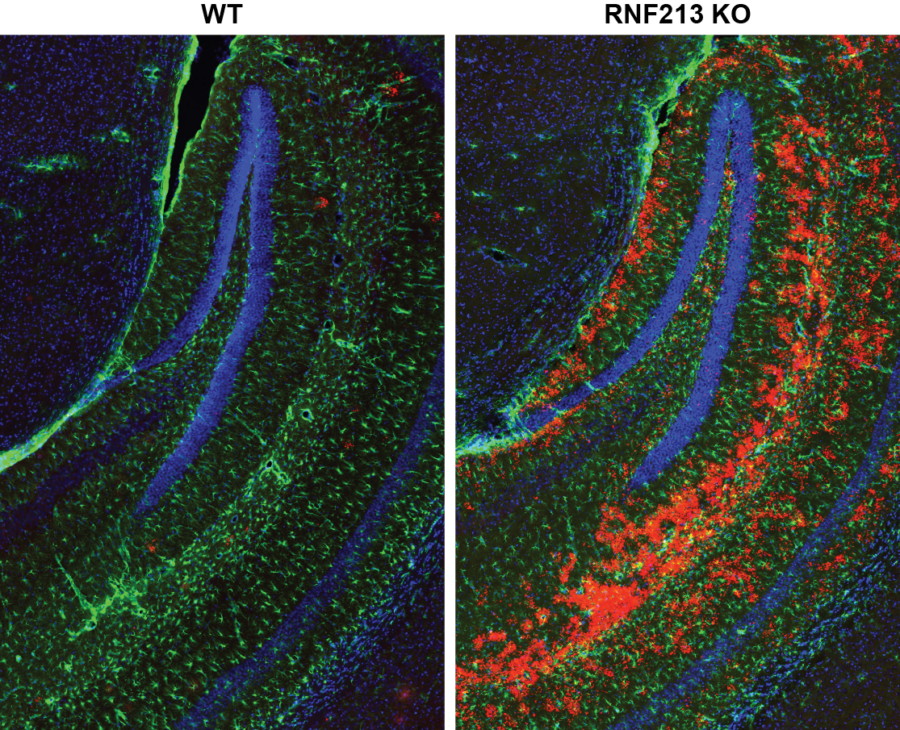
To investigate whether ubiquitylation helps cells recognise abnormal glycogen, Matthew Yip, a postdoc in Felix’s group, asked if the RNF213 enzyme also had an important role in glycogen quality control. Working with Andrew McKenzie’s group, also in the LMB’s PNAC Division, and the LMB’s Transgenics, Genotyping and Biological Services facilities, mice lacking RNF213 were generated and examined over several months. These mice accumulated prominent polyglucosan bodies in specific regions of the brain, demonstrating that RNF213 is required to prevent the accumulation of abnormal glycogen.
To understand the role of RNF213, Matthew devised a new experimental system that switches cells from producing normal, highly branched and soluble glycogen to the poorly branched, abnormal form that accumulates in disease. This system allowed the group to watch glycogen quality control in action. They found that RNF213 specifically accumulates on abnormal glycogen, where it affixes ubiquitin directly, kickstarting the cell’s recycling process, which delivers the abnormal glycogen to lysosomes for disposal.
The team then worked with Wanda Kukulski’s group at the University of Bern to visualise this clearance process inside cells. Using cryo-electron tomography (cryo-ET), they captured polyglucosan enclosed within double-membrane autophagosomes, providing a striking view of how cells package abnormal glycogen for delivery to lysosomes and degradation.
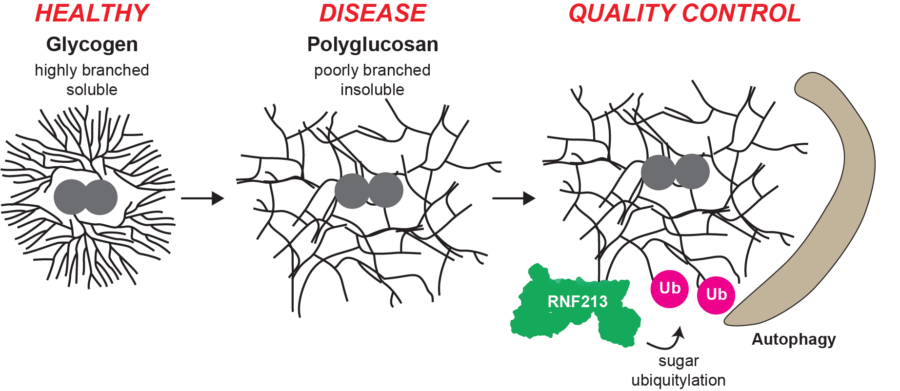
When glycogen is improperly branched, it becomes insoluble, eventually precipitating into pathogenic polyglucosan bodies. To stop this accumulation, the enzyme RNF213 ubiquitylates glucose molecules within polyglucosan, targeting the structures for autophagic clearance.
This study establishes non-protein ubiquitylation as an important mechanism of cellular quality control that helps maintain tissue homeostasis. Ubiquitin not only controls the fate of proteins, organelles and invading pathogens, but can also be attached directly to an endogenous non-protein biomolecule, in this case glycogen, to mark abnormal material for disposal. Together with the Randow group’s previous discovery that RNF213 ubiquitylates bacteria during infection, these findings reveal non-protein ubiquitylation as a broader branch of ubiquitin biology than previously appreciated. Remarkably, RNF213 employs the same fundamental strategy to protect cells against two very different threats: invading bacteria and abnormal glycogen. By uncovering how cells recognise and eliminate abnormal glycogen, the study also sheds new light on serious disorders such as Lafora disease, Andersen disease and Adult Polyglucosan Body Disease, all of which are characterised by the accumulation of polyglucoson bodies.
This work was funded by UKRI MRC, the Wellcome Trust, the Swiss National Science Foundation, the Max Planck Society, EMBO and the Werner-Gren Foundation.
Further references
Felix’s group page
Wanda Kukulski – University of Bern
Related articles
A new way to mark bacterial invaders for destruction
Cytosol-adapted bacterium usurps host defence mechanism to evade LPS ubiquitylation
New pathway for cells to detect bacterial infection
Animal research statement
As a publicly funded research institute, the LMB is committed to engagement and transparency in all aspects of its research. This research used mice, in accordance with the UK Animals (Scientific Procedures) Act 1986. This work was conducted under a Project Licence, reviewed and approved by the MRC Laboratory of Molecular Biology (LMB) Animal Welfare and Ethical Review Body (AWERB) committee and the UK Home Office.
The LMB uses the minimum number of rodents necessary to achieve results and only uses animals in research where there are no suitable alternatives, in line with the 3R’s (replace, reduce, refine). We currently work with fruit flies, nematode worms, mice, rats and zebrafish.