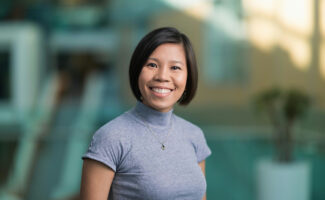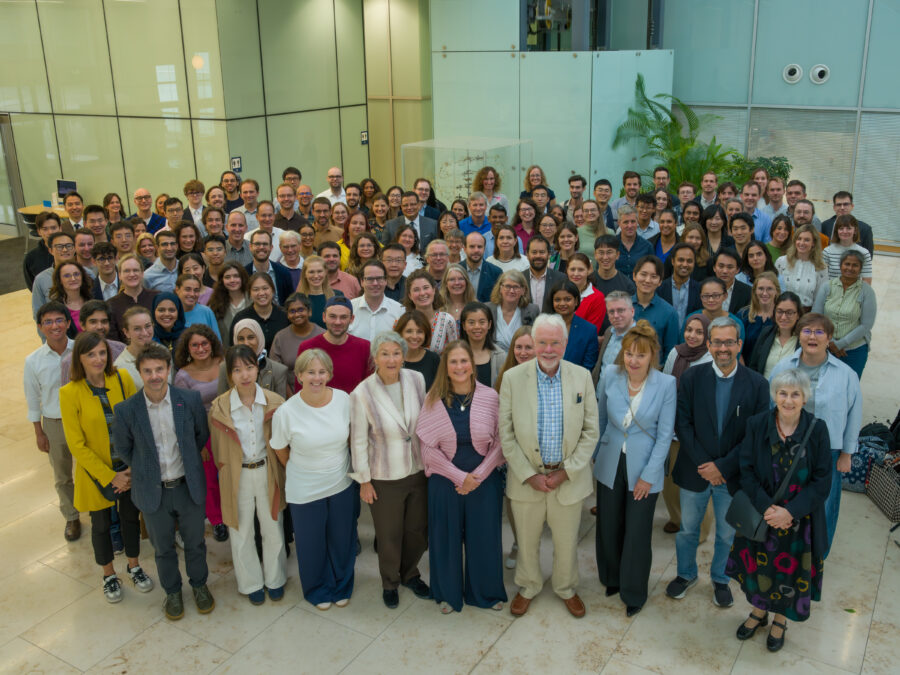
In 2001, Sarah Teichmann established her independent research group at the LMB, focussing on protein domains, the evolutionary building blocks of proteins. During her time at the LMB, Sarah’s group revealed how gene duplication contributed to the evolution of transcription regulatory networks and elucidated the evolution and assembly pathways of protein complexes. To celebrate 25 years of the Teichmann group, Sarah returned to the LMB to host an anniversary meeting themed around key areas of her research: proteins, cells and innovation.
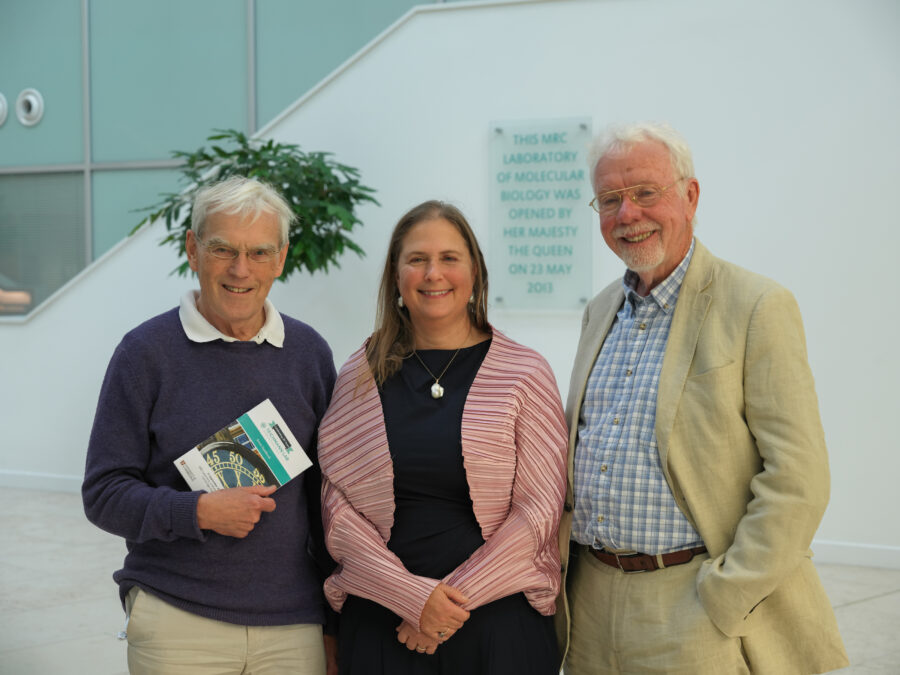
The event began with an opening address from Sarah, reflecting on when she first arrived at the LMB as a PhD student in 1996. Her work with Cyrus Chothia instilled the importance of combining theoretical and computational research with wet lab experiments, a lesson that has guided her career since. Her return to the LMB in 2001 was somewhat serendipitous; Sarah described how she was weighing up an opportunity at Stanford when she bumped into Richard Henderson, then Director of the LMB, who suggested she consider the LMB. The rest, she explained, “is history”.
Another Henderson who shaped Sarah’s career was her inspirational school Chemistry teacher Walter Henderson, now retired, who helped open the event. He shared memories of Sarah’s earliest forays into science at the European School Karlsruhe, Germany, including a notable project on Autumn leaf colour changes, for which she was awarded an EU Contest for Young Scientists Prize.
Sarah’s career has continued to reach new heights; In 2013 she left the LMB to co-found the Sanger-EBI Single Cell Genomics Centre and later founded the Human Cell Atlas project in 2016. In 2024, she returned to the Cambridge Biomedical Campus as Professor and Chair in Stem Cell Medicine at the Cambridge Stem Cell Institute, and works part-time as Vice President at GSK, who supported the symposium. Colleagues, collaborators and friends from across the years joined to discuss their work with Sarah, with many citing how her influence as a mentor have shaped their scientific ambitions and their current research goals.
Since she launched her group at the LMB, Sarah established a central ethos: Be Bold, Be Brilliant, Be Kind. Speakers discussed how this approach to science and leadership has influenced their lives. For instance, M. Madan Babu, Sarah’s first graduate student who joined the LMB on 1st October 2001, the same day Sarah returned to launch her group, described how, worried about his son moving overseas, his father had contacted Sarah to express his concerns. Madan shared a copy of the reassuring email Sarah replied with to allay his father’s apprehensions, which was gratefully received and set the tone for a supportive lab culture.
The event concluded with a video showcase of personal messages from past and current members of Sarah’s group, comments from the L’Oreal UNESCO Women in Science Awards who appointed Sarah as an international laureate earlier this year, and dinner and drinks at Trinity College, Cambridge, the college Sarah joined when she matriculated as an undergraduate to read the Natural Sciences Tripos in 1993. At the end of the dinner, the outgoing Master of Trinity Professor Dame Sally Davies and Professor Dame Carol Robinson gave fitting tributes to Sarah’s work over the last 25 years, celebrating science and friendships.