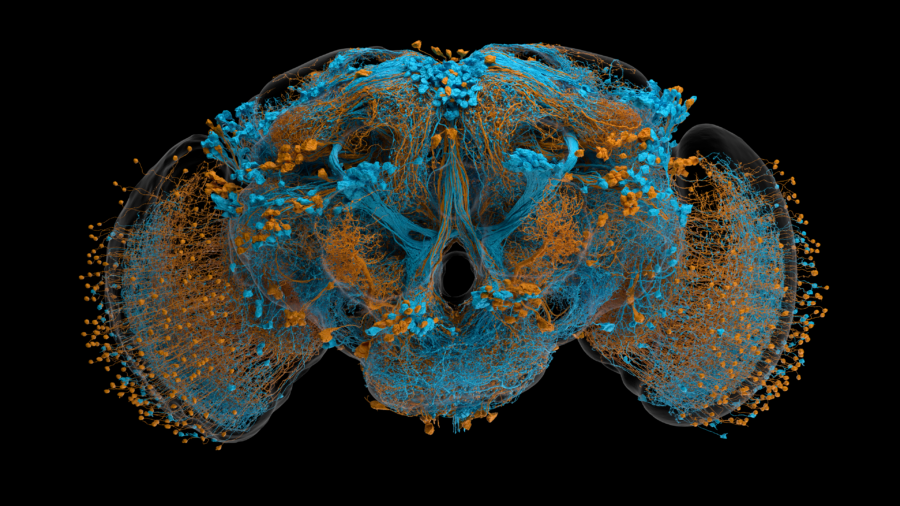
The male fly CNS connectome, one of the most comprehensive neural wiring diagrams ever assembled, reveals how divergent, sex-specific behaviours are rooted in a small portion of neurons
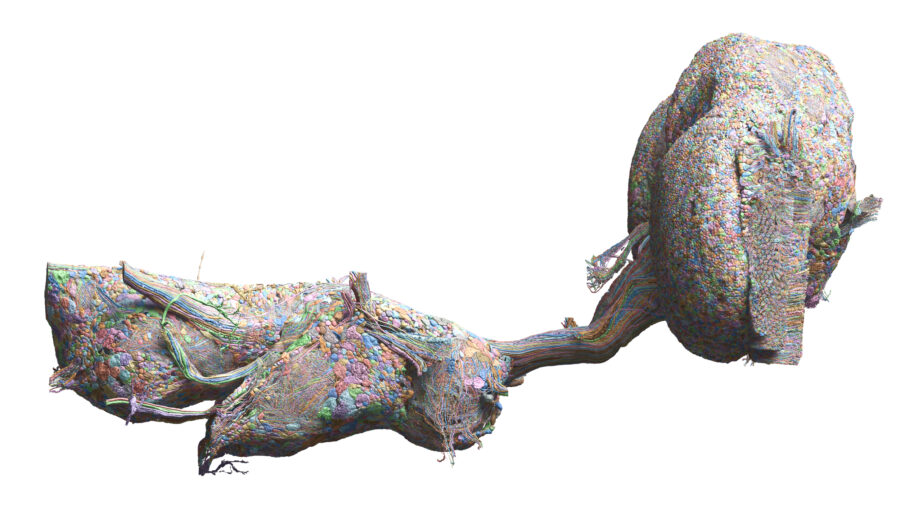
Data by the FlyEM Project Team at HHMI Janelia, the Cambridge Connectomics Group, the MRC LMB and Google Research. Rendering by Philipp Schlegel (MRC LMB and University of Cambridge).
A large, international consortium of researchers, co-led by Greg Jefferis’s group in the LMB’s Neurobiology Division, has published the complete connectome of the Drosophila male central nervous system (CNS). This connectome provides two critical advances to the study of the brain: it is the largest whole-brain connectome to date, including the first fly brain and nerve cord connected through an intact neck, allowing end to end studies of behaviour from eyes to legs. It is also the first example of a male brain. Previous work from the group had mapped the female Drosophila brain, so this new connectome has enabled the first brain-wide, synaptic-resolution comparison across sexes of an adult animal with complex anatomy and behaviours.
They discovered that neural sex differences are not evenly distributed across the nervous system. Whilst sensory and motor neurons are largely shared between male and female fly brains, they found that sex-specific (present in only one sex) and sexually dimorphic (present in both sexes but presenting differently) neurons are concentrated in higher-order brain regions associated with decision making and behavioural control. Here, these neurons form dense, interconnected hubs which reroute sensory information into sex-specific behavioural circuits to drive distinct male and female responses to the same stimuli.
Data by the FlyEM Project Team at HHMI-Janelia, the Cambridge Connectomics Group, the MRC-LMB, and Google Research. Rendering by Philip Hubbard (Janelia Research Campus).
Just under five percent of male brain neurons were found to be sex-specific or dimorphic, compared to fewer than three percent in female brains. Many of these dimorphic neurons express fruitless and doublesex, key sex-determination genes. Despite comprising a small portion of all neurons, they make many connections, so that 12 percent of neurons in the male brain show wiring differences. This highlights how a small fraction of neurons can have a significant impact on brain circuits. For comparison, only four percent of female neurons show wiring differences.
In total, the male CNS connectome contains 166,700 neurons which form 11,710 cell types that can be identified across animals. To compile the map, the group first sliced a male Drosophila CNS into incredibly thin slices, then scanned these using high-resolution electron microscopy to produce millions of images depicting individual nerve cells and their connections. Using a combination of artificial intelligence and manual proofreading, these images were stitched together into a three-dimensional map, reconstructing each neuron and identifying the synapses where they communicate. In total, the equivalent of 44 years of human labour was required for this reconstruction. The entire dataset now exists as a public resource, openly available as a reference for future studies.
Data by the FlyEM Project Team at HHMI-Janelia, the Cambridge Connectomics Group, the MRC-LMB and Google Research. Video by Philipp Schlegel (MRC LMB and University of Cambridge).
Prior to this, studies on sexual dimorphism in Drosophila largely focussed on how individual cell types expressed genes, such as fruitless and doublesex, to impact behaviour and physiology. This study highlights the benefit of whole-brain connectomics to analyse system-wide circuitry and to visualise the wider impact of these previously identified influential cell types.
More than a simple map, the CNS connectome offers a blueprint for understanding how brains generate behaviour, a key question of life. By revealing that most neurons are shared across the male and female connectomes, the work highlights how profound behavioural differences emerge from surprisingly subtle changes in brain wiring, pointing to an elegant evolutionary system which may extend beyond flies to all forms of animal life. Looking ahead, the connectome is a powerful tool which will aid researchers as they continue to probe the activity of these newly identified circuits and explore how complex behaviours arise from the connections between individual neurons.
The LMB was the birthplace of connectomics through pioneering work on the first connectome: the 302 neurons of the nematode worm reported in 1986. In the last decade technical advances have enabled larger connectomes. The LMB co-delivered the first insect connectome (the 3000-neuron fruit fly larva) in 2023, and the first whole brain connectome of animal with eyes and legs (the female Drosophila brain) in 2024. In the future, connectomics will target key model animals for medical research like the mouse and eventually humans. This will have major impacts on our understanding of how we think and remember, on brain health and likely also spur the development of brain-inspired artificial intelligence.
This work was completed as part of a long-term partnership with Janelia Research Campus, the University of Cambridge Department of Zoology and Google Research together with colleagues at the Champalimaud Foundation and the University of Oxford. It was funded by UKRI MRC, the Wellcome Trust, the Howard Hughes Medical Institute, Boehringer Ingelheim Fonds and the Cambridge Commonwealth, European and International Trust.
Further references
Greg’s group page
World-first map of a male fly brain a win for neuroscience – UKRI
Male CNS connectome project page – Janelia FlyEM
Male CNS connectome – HHMI Janelia Research Campus
Completing the Connectome: How Pursuing a Map of the Fly Brain Rewired Neuroscience – HHMI Janelia
Comparison of male and female fly brains is unlocking the secret workings of the mind – University of Cambridge
A connectomics milestone: Mapping the complete male fruit fly brain – Google Research
Related articles
Whole brain connectome of fruit fly is most complex brain ever mapped
Complete synaptic-resolution connectome of an insect larval brain
Fly cell atlas reveals hidden rules of brain development