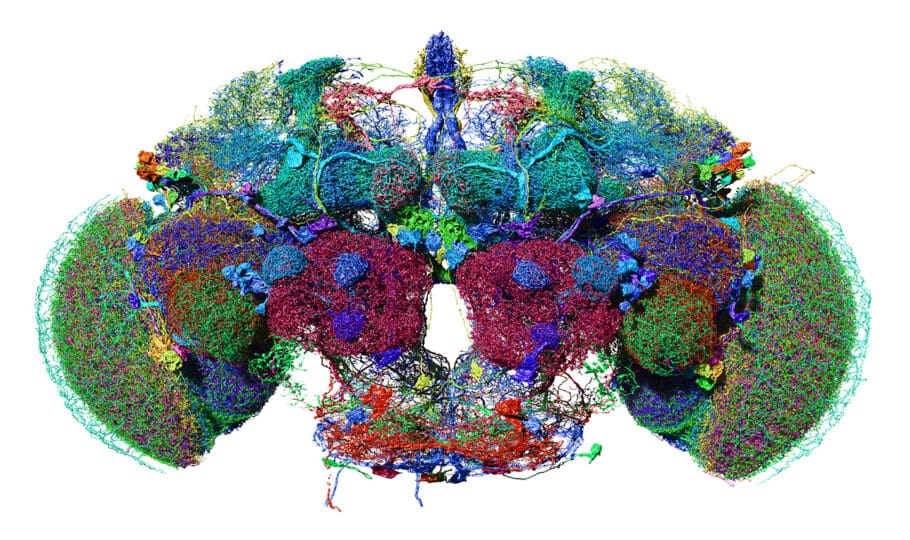
3D colour-coded reconstruction of a fruit fly brain connectome, detailing intricate neuronal networks across distinct regions.

Discovering
how life works
This 3D rendering shows the neural connections in a fruit fly brain, which is less than 1 mm across. Read more about the rendering, Greg Jefferis’s group and the FlyWire Consortium.
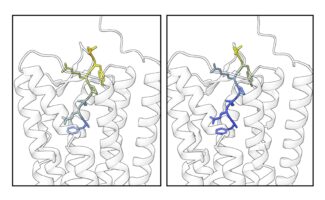
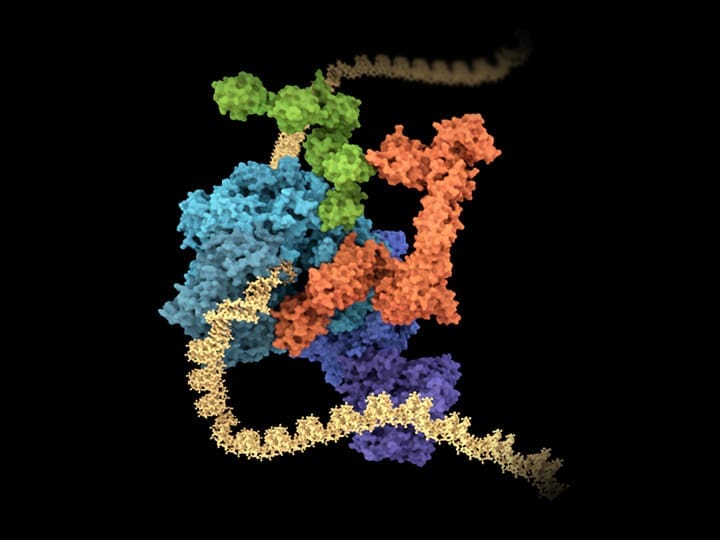
Molecular model of a replisome, a multi-protein complex (colored blobs) actively replicating a DNA double helix (yellow strand).

Research that spans the breadth of biology

The MRC Laboratory of Molecular Biology (LMB) is a research institute dedicated to the understanding of fundamental biological processes at the levels of atoms, molecules, cells and organisms. The knowledge we provide is crucial to solving key problems in human health.

A 3D image of the human replisome, the molecular machinery that copies our DNA, captured using electron cryomicroscopy. Discover more about the research exploring how these complexes work.

Latest News

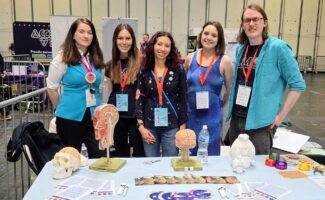
Three women sit at a table smiling and gesturing during a discussion, with one woman's back to the viewer and notebooks on the table.

An unsurpassed environment for researchers

The LMB comprises over 50 scientific groups pursuing ambitious research, supported by cutting-edge scientific facilities and generous core-funding by the MRC/UKRI. We occupy an inspiring, purpose-built building on the thriving Cambridge Biomedical Campus.

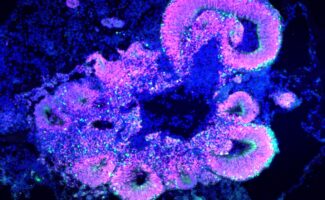
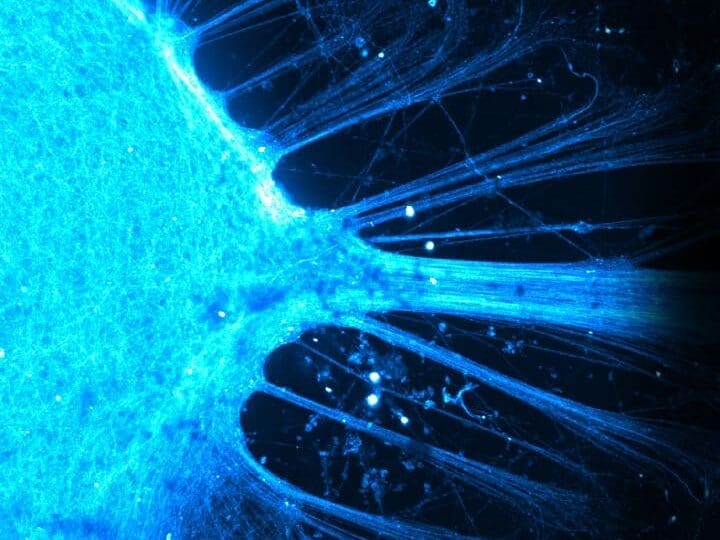
Fluorescent micrograph of a neuronal cell body with numerous radiating filamentous processes.

Progressing science for over 60 years

Since our origins in 1947, the LMB has pioneered the molecular biology revolution and is a world-leading source of new ideas, scientific advances and technology. Our discoveries have led to highly successful commercialisations and medical advances that have improved human life.

An axon bundle growing from a human brain organoid within a micropatterned device. Read more about research into axon growth and human brain development

Latest Publications

Characterizing dynamics of productive dynein stepping by MINFLUX. (26th Aug 2026)Slivka J, Gleave-Hanford ES, Golcuk M, Wijewardena DP, Canty JT, Selvin PR, Gur M, Carter AP, Yildiz ANat Struct Mol Biol • doi: 10.1038/s41594-026-01873-w
Response of the replisome to araA and araC suggests a mechanism for arabinosyl nucleoside tolerance. (27th Aug 2026)Orrin H, Yeeles JTPEMBO J • doi: 10.1038/s44318-026-00901-1
Sequential restriction of SNARE-mediated fusion by the COPII inner coat and SNARE chaperones. (26th Aug 2026)Mackey EJ, Takenaka T, Miller EA, Merz AJMol Biol Cell • mbcE26080357T • doi: 10.1091/mbc.E26-08-0357-T
The proteasome promotes cytokinetic abscission by relieving an Aurora B-dependent inhibition of ESCRT-III dynamics. (24th Aug 2026)Dibsy R, Advedissian T, Custot C, Baum B, Echard ACurr Biol • doi: 10.1016/j.cub.2026.07.073
RNA polymerase II removal: transcription quality control and gene regulation.Haworth B, Abyaneh P, Tufegdžić Vidaković ATranscription • 17(2):129-162 • doi: 10.1080/21541264.2026.2698182
Ten years of Integrative Carbohydrate Structure Validation with Privateer. (22nd Aug 2026)Schofield L, Dialpuri J, Bagdonas H, Holland L, Pham PT, Wang S, Cook W, Agirre JGlycobiology • doi: 10.1093/glycob/cwag068
Anchoring of perforin-2 via the transmembrane domain is required for antigen escape into the cytosol. (19th Aug 2026)Laub M, Chatterjee R, Kozik PEMBO J • doi: 10.1038/s44318-026-00903-z
Ion transport as a determinant of membrane fusion and fission. (19th Aug 2026)Levin-Konigsberg R, Grinstein S, Freeman SANat Struct Mol Biol • doi: 10.1038/s41594-026-01860-1

Loading...