Lori Passmore
Molecular machines that regulate gene expression

Cells are defined by the genes they express, and rapid changes in gene expression allow cells to respond to their environments. Our group uses biochemical reconstitution, structural biology and functional studies to gain mechanistic insights into mRNA processing, mRNA stability and genome integrity – fundamental processes that affect gene expression in all eukaryotes.
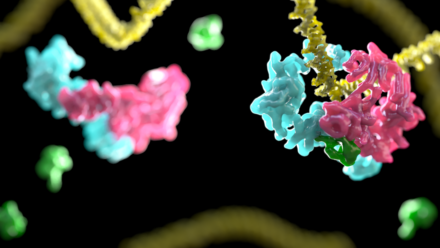
The 3’ ends of mRNAs are generated through pre-mRNA cleavage and the addition of a poly(A) tail. This is highly controlled to determine the exact 3’ end of the mRNA, defining which sequences are included in the mature transcript. mRNA 3’ end formation is mediated by a fascinating complex called cleavage and polyadenylation factor (CPF or CPSF). We are studying how the enzymes of CPF are coordinated and coregulated with each other and with transcription to control mRNA processing.
Poly(A) tails of mRNAs are required for efficient translation and mRNA stability. Shortening of poly(A) tails in the cytoplasm by Ccr4-Not and Pan2-Pan3 therefore controls mRNA fate. But how is this regulated? We aim to understand the mechanisms of poly(A) tail removal (deadenylation), how specific transcripts are targeted for decay and the roles of poly(A) binding proteins.
DNA must be passed on faithfully from cell to cell and across generations to maintain gene expression. We are studying how the Fanconi anaemia DNA repair pathway contributes to genome integrity. This includes mechanistic studies of a multiprotein, megadalton E3 ubiquitin ligase and the FANCD2-FANCI DNA clamp.