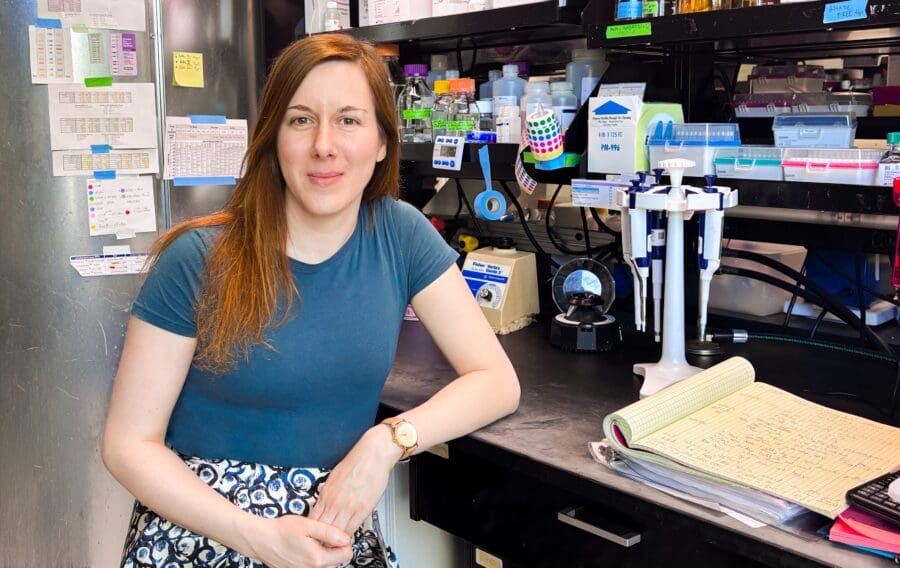
The LMB is delighted to announce that Ivana Bukvin has been appointed as a Group Leader in the LMB’s PNAC Division. Beginning in January 2027, Ivana’s group will focus on co-translational folding and misfolding, with the ultimate goal of establishing a comprehensive structural and mechanistic understanding of how proteins fold during biosynthesis in cells.
Commenting on her appointment, Ivana said, “How proteins fold in our cells has fascinated me for many years, and I think we are now reaching a really exciting point where advances in instrumentation and computing are beginning to make it possible to study this fundamental process in much greater depth and increasingly in the context of the cell itself. Being able to pursue this research at the LMB feels particularly fitting given its long tradition of supporting ambitious, long-term projects and its unique history in both ribosome biology and protein folding research. I am honoured and excited to start my lab at the LMB.”
Although protein folding is a fundamental cellular process, it is still unclear how folding, translation kinetics and interactions with ribosome-associated factors are coordinated within the crowded cellular environment to determine the fate of a newly synthesised protein. Ivana’s group will address this gap in knowledge, harnessing a novel platform to monitor co-translational folding and misfolding in real time.
Specifically, Ivana seeks to utilise a single-molecule Förster Resonance Energy Transfer (smFRET) platform which works by using a photophysical mechanism to transfer energy from a donor molecule to an acceptor molecule, allowing for high-resolution, real-time analysis of nascent chain conformational changes and interactions. Using smFRET to monitor co-translational folding will allow Ivana to bridge structural detail, kinetic resolution and cellular context. Beyond gaining new insights in vitro, Ivana also aims to broaden application to in vivo studies, to better understand how protein folding happens in the more complex cellular environment.
Whilst offering key insights into a significant process of life, Ivana’s research programme also holds wider clinical implications as aberrant translation and protein misfolding are defining characteristics of several diseases, including neurodegenerative diseases, which currently lack effective treatment. Therefore, knowing how and why protein folding and misfolding occurs is crucial to the future development of new interventions.
Ivana began her career with a BSc in Biochemistry from the University of Belgrade, Serbia. She followed this with an MSc at University of Tübingen, Germany, during which she completed part of her thesis work as a visiting scholar at University College London, where she first began investigating co-translational folding, developing a force-based translational assay to monitor the process in vitro and in cellulo. She later received her PhD from University College London in 2023, where she worked with John Christodoulou to establish biochemical and NMR methods to investigate ribosome-nascent chain complexes. Since then, Ivana has been a postdoctoral scholar at Stanford University, USA, where she has worked with Judith Frydman to investigate the role of translation dynamics in Huntington’s disease. With the support of the Huntington’s Disease Foundation postdoctoral fellowship, she has begun establishing the smFRET approach to characterise the conformational landscape of nascent huntingtin on the ribosome.
Ivana’s recruitment to the LMB was supported by the Global Talent Fund, a £54 million government investment, shared between 12 UK organisations including the LMB, designed to attract leading researchers and their teams to the UK.
Further references
Ivana’s group page
Protein and Nucleic Acid Chemistry (PNAC) Division