Ivana Bukvin
De novo protein folding

Ivana will join the LMB in January 2027.
Protein folding is the fundamental process by which a polypeptide chain acquires its native conformation, yet the principles governing how it occurs in vivo remain poorly understood. All proteins are synthesised by the ribosome, one amino acid at a time, and can begin to fold co-translationally as the nascent chain is extruded into the ribosome exit tunnel in a vectorial manner. We now know that the ribosome actively modulates co-translational protein folding, that the energetics of de novo protein folding is distinct from that of protein refolding, and that the nascent chain can explore partially structured intermediates on the ribosome, but many questions remain unanswered. How does translation kinetics modulate the folding landscape and engagement with ribosome-associated factors, including chaperones and quality-control machinery? Is the thermodynamics of protein folding determined by the nascent chain itself, by the ribosome, by chaperones, or have all of these actors co-evolved to guide the newly synthesised polypeptide to its native fold?
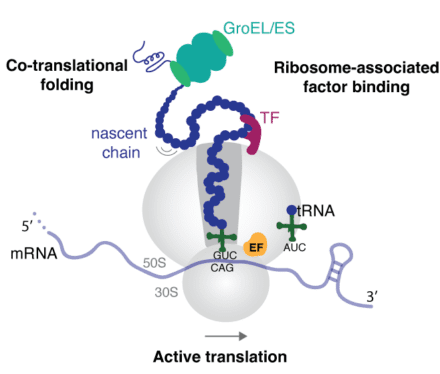
Our group aims to answer these questions and dissect the network that shapes de novo protein folding. To this end, we are developing integrative approaches that combine single-molecule fluorescence and molecular dynamics simulations, supported by and validated against NMR and cryo-EM, to achieve quantitative high-resolution structural characterisation of nascent chains and resolve translation kinetics during biosynthesis on the ribosome. Our long-term goal is to uncover the fundamental principles that govern de novo protein folding in cells, and to understand how this process fails in disease and ageing.