A newly discovered small catalytic RNA (ribozyme) suggests how simple molecules could have self-replicated to kickstart life
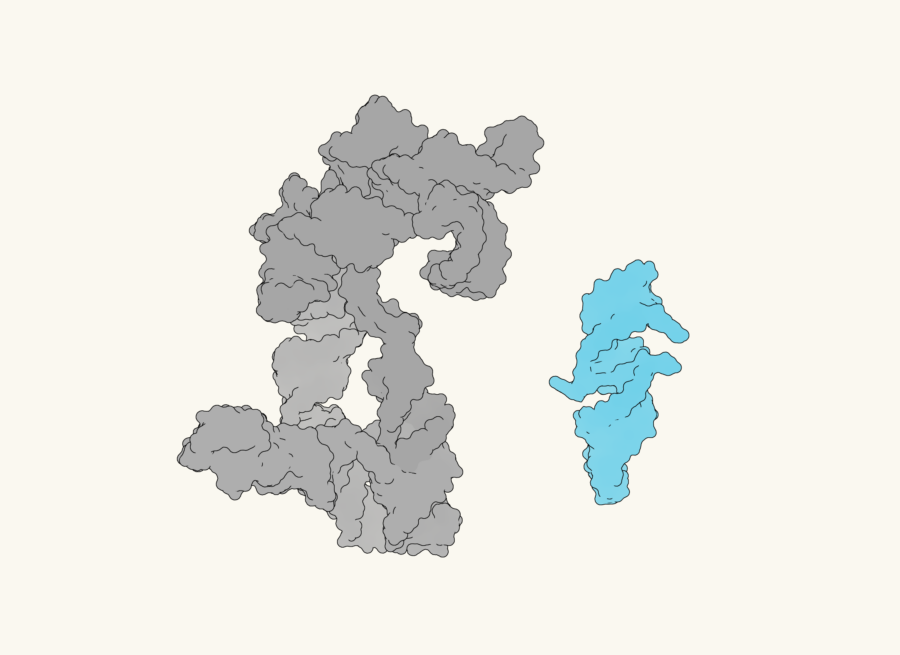
How life arose from simple chemical building blocks remains one of science’s greatest unanswered questions. Early life would have required a way to store and transmit genetic information without the complex molecular machinery used by modern organisms. RNA has long been proposed as a central player in this process because it can act both as a catalyst and as an instructive template for replication. This dual function of RNA potentially enables both heredity and replication within a single molecule, a prerequisite for the evolution of more complex forms. According to the “RNA World” hypothesis, such RNA molecules may have formed spontaneously in a primordial soup, eventually acquiring the ability to self-replicate and evolve. However, most known catalytic RNAs, or ribozymes, discovered so far are too large and too complex to either replicate themselves or to plausibly arise spontaneously. A recent study from Philipp Holliger’s group in the LMB’s PNAC Division addresses this problem by identifying a new small polymerase ribozyme that may overcome these fundamental limitations.
RNA self-replication is defined as the ability of an RNA molecule to copy both itself and the information encoded in its complementary strand, i.e. its template. Over the past 25 years, ribozymes that can copy RNA (polymerase ribozymes) have been identified but they are generally large and structurally complex, making self-replication reactions difficult. Because no shorter ribozymes with this activity have been found, it has been widely assumed that it is only large and complex RNAs that can catalyse RNA copying reactions. This assumption leads to a paradox regarding the origin of the first self-replicating RNA: it would need to be large and complex enough to catalyse its own replication, yet that very size and complexity hinder self-replication and make its spontaneous origin highly unlikely. As such, if this catalytic activity can be found in smaller, simpler RNA molecules, this paradox could be resolved, with important implications for the earliest steps in the origin of life.
Led by Investigator Scientist Edoardo Gianni, the group applied in vitro selection to renew the search for active ribozymes in pools of short, random RNA sequences. The process was repeated several times to enrich the active sequences. In the end, they identified three small, unrelated RNA sequences that exhibited polymerase ribozyme activity. These RNAs underwent further laboratory-based evolution to improve their catalytic activity, resulting in an unexpectedly small ribozyme of 45 nucleotides with robust RNA polymerase activity, named “Quite Tiny 45” (QT45).
To further characterise QT45, the group evaluated its capacity to copy a range of RNA sequences distinct from its own, thereby assessing its generality across multiple RNA templates. QT45 demonstrated the ability to copy RNA templates of increased length and structural complexity. Notably, it successfully copied another ribozyme known as the Hammerhead ribozyme. To date, such a complex synthesis has been reported only for large and complex ribozymes. Furthermore, QT45 was shown to be able to use a range of different RNA substrates for its copying reaction. This observed promiscuity in the substrates and RNA templates copied by QT45 indicates that RNA replication can likely occur within a chemically diverse prebiotic environment.
Once the generality of QT45 was established, the group investigated its ability to synthesise both itself and its complementary strand. The synthesis of itself uses the ribozyme’s complementary strand as the template, whereby the synthesis of the complementary strand uses the ribozyme itself as the template – exploiting the dual function of RNA acting as both a template strand and as a catalyst. The experiments confirmed that QT45 could carry out both syntheses in two separate reactions, individually completing the two steps of a self-replication cycle.
Ultimately, identification of this small ribozyme has shown that catalytic RNAs with polymerase function can be much simpler and are likely much more abundant than previously anticipated. This lends support to the spontaneous emergence and self-replication of RNA at the dawn of life.
This work was funded by UKRI MRC, Volkswagen Foundation, Herchel Smith, Cambridge Trust and the Royal Society.
Further references
A small polymerase ribozyme that can synthesise itself and its complementary strand. Gianni, E., Kwok, S.L.Y., Wan, C.J.K., Goeij, K., Clifton, B.E., Colizzi, E.S., Attwater, J., Holliger, P. Science.
Cryo-microscopy reveals nano-sized copy machine implicated in origin of life
Chemists recreate how RNA might have reproduced for first time