
Contact
Facilities
Electron Microscopy
The Electron Microscopy facility provides scientists access to a world-class suite of electron microscopes, enabling cutting-edge structural biology research at the molecular level.
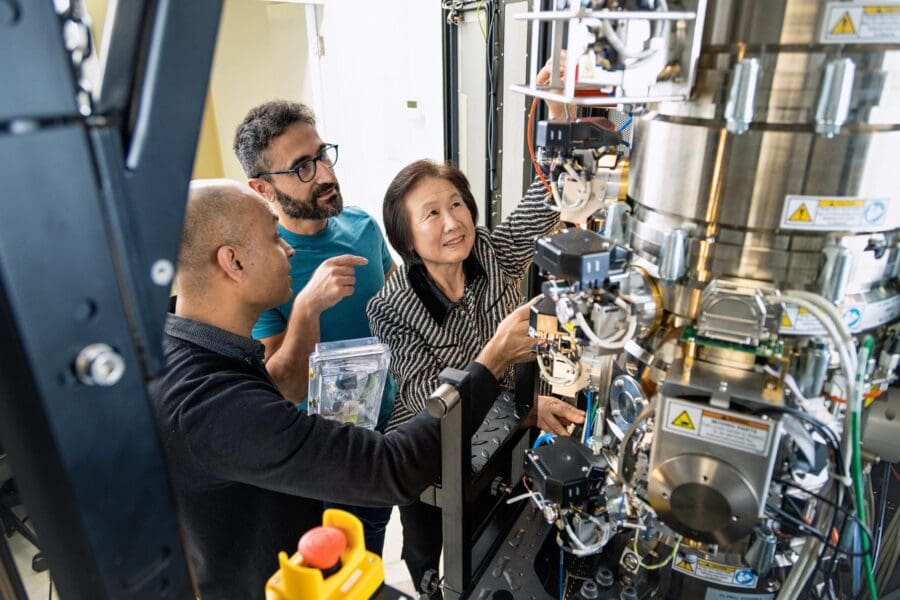
The importance of cryo-EM in modern structural biology was highlighted by the 2017 Nobel Prize in Chemistry, awarded for its revolutionary impact on structural biology. LMB scientists have played pivotal roles in shaping this field, contributing to the development of key technologies, including direct electron detectors, such as Falcon detectors, powerful image processing software like the MRC package and RELION and innovative sample supports like UltrAuFoil® and HexAuFoil. These contributions have helped advance the frontier of cryo‑EM to allow more routine determination of high-resolution structures.
The facility is equipped with state-of-the-art cryo-EM instruments such as four Krios TEMs (including a cold-FEG Krios G4) equipped with Selectris X or BioQuantum energy filters and Falcon 4i or K3 direct electron detectors for high-resolution data collection. Multiple focussed ion beam (FIB)-SEMs and plasma FIB-SEMs, including Arctis, Aquilos 2 and Zeiss CrossBeam, are available to support a broad range of cryo-lamella preparation, correlative and volume imaging applications. Members of the LMB can also access low-voltage FEG Tundra cryo-TEM and Hydra plasma FIB-SEM instruments. In addition to in-house capabilities, the facility helps to organise the access to external facilities, such as the eBIC: the National Cryo-EM Facility.
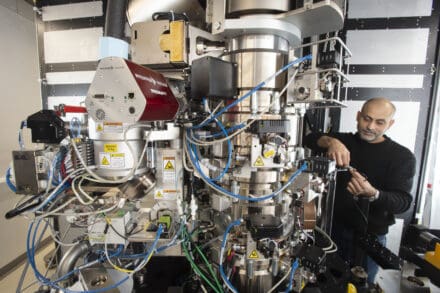
The facility offers comprehensive hands-on training and expert support, from specimen preparation and microscope operation to optimised strategies for high-resolution, high-throughput data collection. Facility staff also help coordinate and contribute to the LMB cryo-EM courses, organising workshops and participating in research projects.