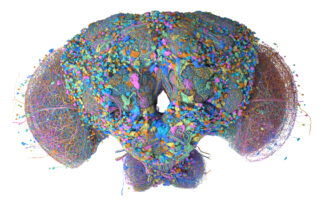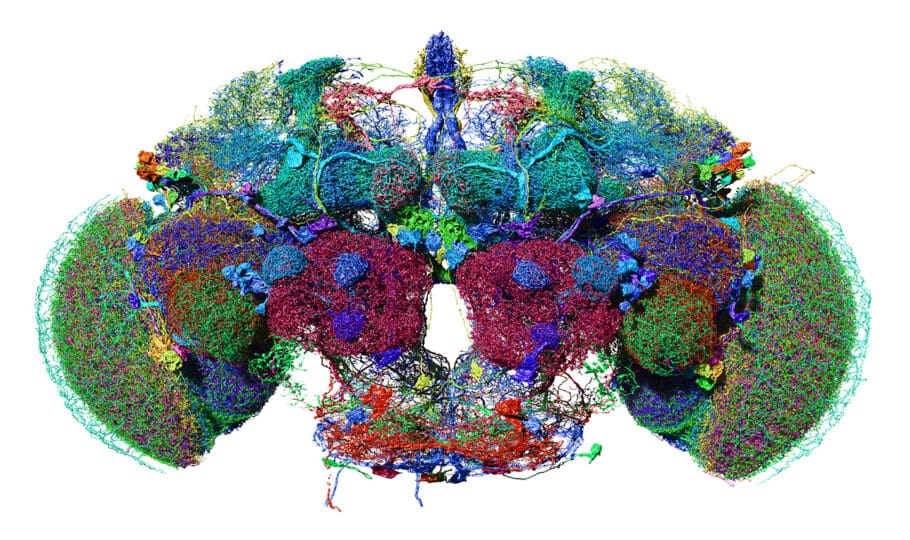
3D colour-coded reconstruction of a fruit fly brain connectome, detailing intricate neuronal networks across distinct regions.

Discovering
how life works
This 3D rendering shows the neural connections in a fruit fly brain, which is less than 1 mm across. Read more about the rendering, Greg Jefferis’s group and the FlyWire Consortium.
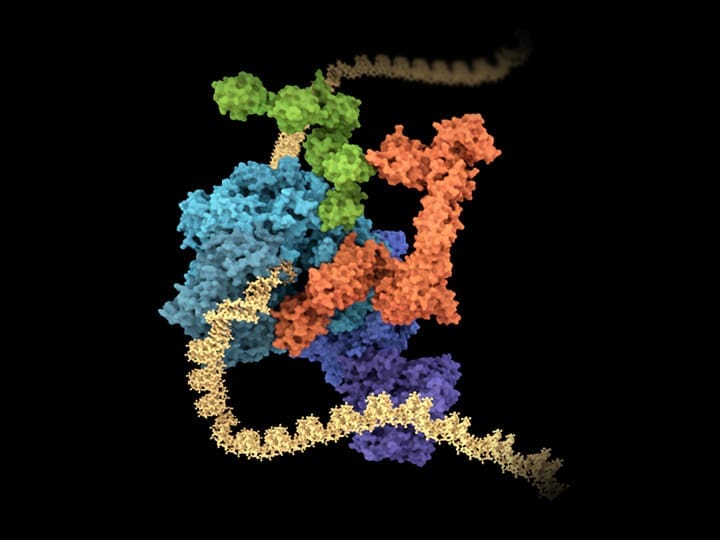
Molecular model of a replisome, a multi-protein complex (colored blobs) actively replicating a DNA double helix (yellow strand).

Research that spans the breadth of biology

The MRC Laboratory of Molecular Biology (LMB) is a research institute dedicated to the understanding of fundamental biological processes at the levels of atoms, molecules, cells and organisms. The knowledge we provide is crucial to solving key problems in human health.

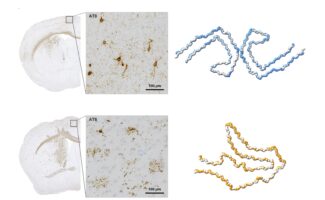
A 3D image of the human replisome, the molecular machinery that copies our DNA, captured using electron cryomicroscopy. Discover more about the research exploring how these complexes work.

Latest News

Three women sit at a table smiling and gesturing during a discussion, with one woman's back to the viewer and notebooks on the table.

An unsurpassed environment for researchers

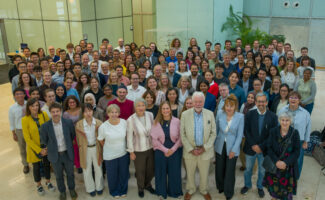
The LMB comprises over 50 scientific groups pursuing ambitious research, supported by cutting-edge scientific facilities and generous core-funding by the MRC/UKRI. We occupy an inspiring, purpose-built building on the thriving Cambridge Biomedical Campus.
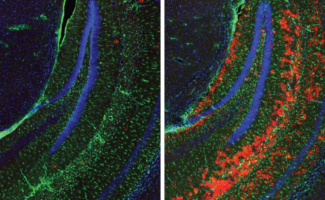
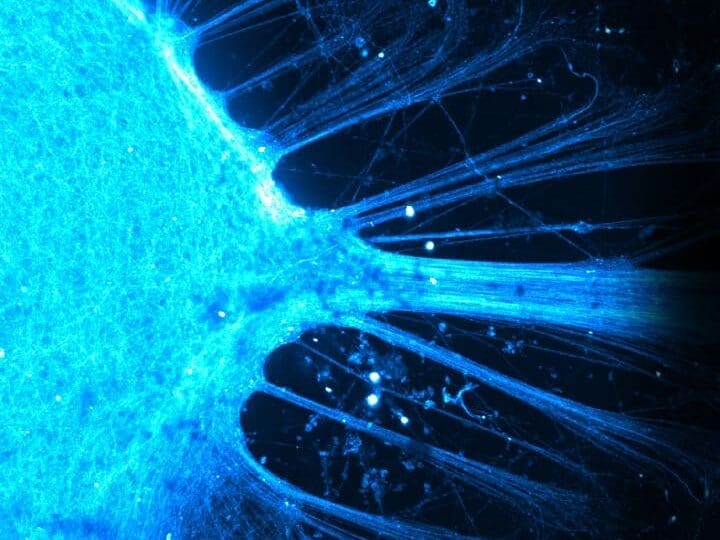
Fluorescent micrograph of a neuronal cell body with numerous radiating filamentous processes.

Progressing science for over 60 years

Since our origins in 1947, the LMB has pioneered the molecular biology revolution and is a world-leading source of new ideas, scientific advances and technology. Our discoveries have led to highly successful commercialisations and medical advances that have improved human life.

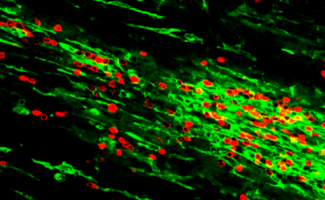
An axon bundle growing from a human brain organoid within a micropatterned device. Read more about research into axon growth and human brain development

Latest Publications

Design principles of human membrane protein topology. (3rd Aug 2026)Wu H, Hegde RSJ Cell Biol • 225(8) • doi: 10.1083/jcb.202604059
Small Molecule Activators of Protein Phosphatase 2A Exert Global Stabilizing Effects on the Scaffold PR65. (25th May 2026)Naqvi MM, Zacharopoulou M, Saha S, Banerjee A, Yilmaz SZ, Sunderlikova V, Johnson CM, Kumita JR, Yang SH, Gordon R, Ohlmeyer M, Tans SJ, Gur M, Bahar I, Itzhaki LSJACS Au • 6(5):2753-2765 • doi: 10.1021/jacsau.6c00003
A novel RAB5 binding site in human VPS34-CII that is likely the primordial site in eukaryotic evolution. (28th May 2026)Spokaite S, Ohashi Y, Bourguet M, Dessus AN, Williams RLElife • 15 • doi: 10.7554/eLife.110040
A human corticospinal organoid-slice connectoid model informs enhancer strategies for post-injury axon regrowth. (26th May 2026)Gibbons GM, Fuchsberger T, Abdelgawad M, Giandomenico SL, Szebényi K, Petrova V, Wenger LMD, Olschewski DN, Chabros J, Muresan L, Feord RC, Asif M, Fawcett JW, Mierau SB, Paulsen O, Lancaster MA, Lakatos ACell Rep • 45(6):117399 • doi: 10.1016/j.celrep.2026.117399
Subcellular chemical mapping using correlated cryogenic electron and mass spectrometry imaging. (25th May 2026)Ochner H, Isbilir B, Blasche S, Scheidweiler D, Zhang Y, Wang Z, Smith T, Franco C, Bradley R, Patil KR, Bharat TAMNat Methods • doi: 10.1038/s41592-026-03109-7
Intracellular potassium levels orchestrate circadian rhythmicity and cell division. (22nd May 2026)Gil Rodríguez S, Hansen LL, Fraser OJP, Chew YP, Spangler RK, Grünewald E, Beale AD, Rabbitts BM, Stangherlin A, O'Neill JS, Partch CL, Crosby P, van Ooijen GNat Commun • doi: 10.1038/s41467-026-73351-2
The amyloid packing difference: A pairwise comparison metric for amyloid structures. (22nd May 2026)Scheres SHWStructure • doi: 10.1016/j.str.2026.04.014
The Golgi vesicle tether p115/USO1 can bind directly to the ER exit site organiser Sec16A. (22nd May 2026)Yakunin I, Gillingham AK, Pereira C, Gershlick DC, Munro SJ Cell Sci • doi: 10.1242/jcs.264894

Loading...