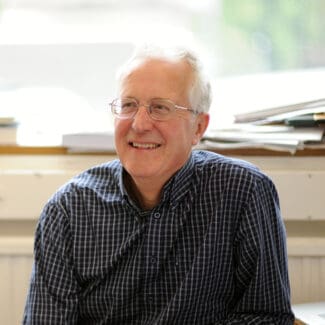
I began my research career as a DPhil student solving the crystal structure of phosphoglycerate kinase at the University of Oxford at a time when protein X-ray crystallography was much slower than it later became. Following my chemistry degree, DPhil and a short postdoc in Oxford, I moved to the LMB in 1976 to work on a classic allosteric enzyme, bacterial phosphofructokinase. Over 15 years, with a series of crystal structures and biochemical studies, we defined the structural mechanism of its cooperativity and allosteric regulation. Following a collaboration with Kiyoshi Nagai in his early work on protein-RNA complexes, I studied methylmalonyl-CoA mutase with Peter Leadlay, solving the first structure of an enzyme that uses coenzyme B12, adenosylcobalamin. From the late 1990s, we worked on the structure and function of proteins involved in vesicle trafficking and endocytosis, with Harvey McMahon and David Owen. This included proteins that help to impart sharp curvature to the membranes during the formation of vesicles, for instance the banana-shaped BAR domains, and proteins that embed amphipathic helices into membranes. With David Owen, we determined the structure of a number of key players in clathrin-mediated endocytosis and related cell trafficking systems, notably a largely complete structure of the heterotetrameric AP2 adaptor complex.
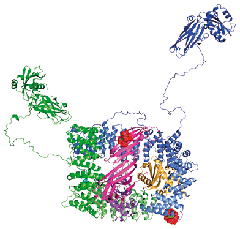
As a crystallographer, I always found it valuable to collaborate with other groups with complementary expertise in biochemistry and cell biology, since the structure alone is not sufficient to understand function. Since retirement in 2016, I have continued my long-term interest in software development for X-ray crystallography, mainly in the initial processing of diffraction data, and have been involved in the UK-wide and international crystallographic software collaboration CCP4 since its inception in 1979.
I was elected a member of EMBO in 2001 and a Fellow of the Royal Society in 2005.