Group Leader

Sjors Scheres

Structural biology of neurodegeneration

Sjors Scheres
Group Members
  • Chloe Fisher
  • Kiarash Jamali
  • Simon Knoblauch
  • Sofia Lövestam
  • Alexey Murzin
  • Bogdan Toader
  • Kai Yi
  • Dongqi Zhang

Almost all cases of neurodegeneration are characterised by the abundant presence of filamentous protein aggregates, or amyloids, in the brain. But how amyloid filaments form in the brain and how their presence relates to disease remains a mystery.

We develop new image processing methods for atomic structure determination of biological macromolecules by cryo-EM and cryo-ET. We implement these methods in our open-source computer programme RELION, which is used by cryo-EM labs all over the world.
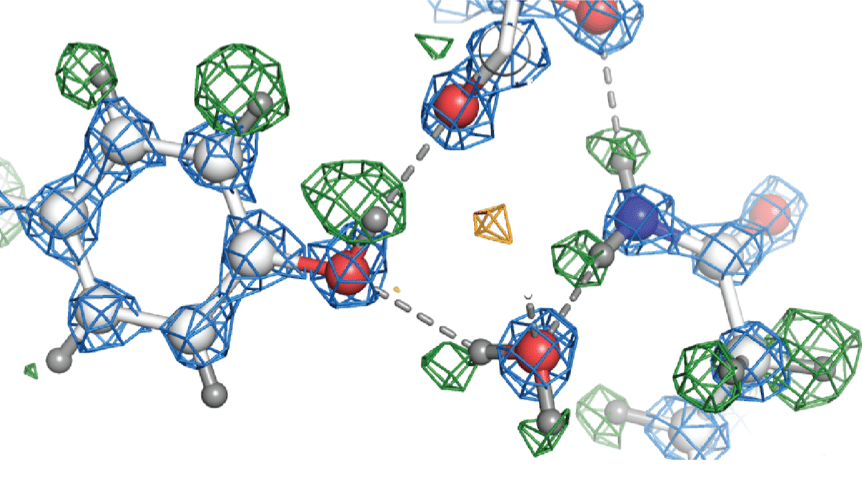
Molecular structure showing atomic models (spheres, sticks) embedded in electron density maps (blue, green wireframes), with hydrogen bonds.
Close-up of a cryo-EM map of apoferritin that was reconstructed in RELION to atomic resolution (1.2 Å). Carbon, oxygen and nitrogen atoms are visible as individual blobs in the reconstructed density (blue mesh); hydrogen atoms are visible in difference maps with an atomic model (green mesh).

Our methods unlocked the possibility to study the atomic structures of amyloid filaments, and we now use these methods on filaments from human brains with neurodegenerative disease. This work has shown that a given protein may adopt many different amyloid structures. For example, tau forms filaments in more than 20 neurodegenerative diseases and our work has revealed that different tau folds characterise distinct diseases. Our ongoing efforts aim to understand how and why this happens. This line of research is carried out in close collaboration with Michel Goedert’s group.
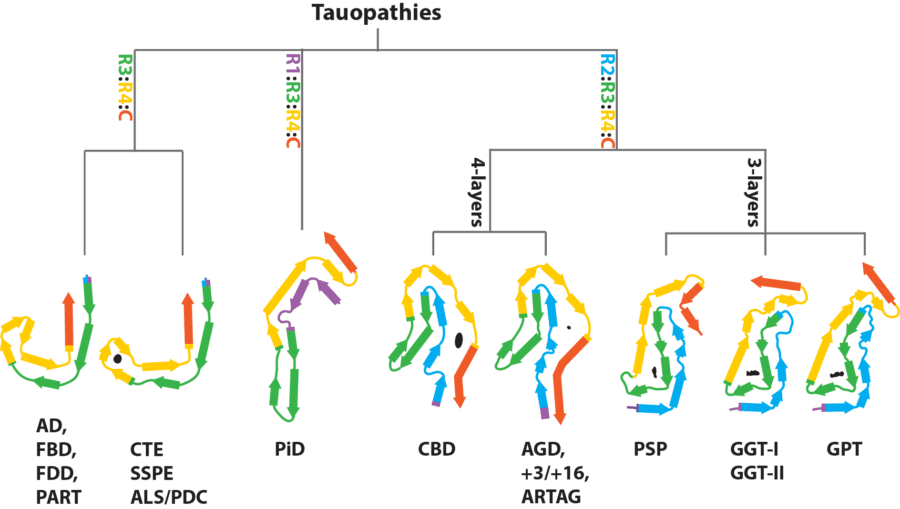
Tauopathies are classified by tau isoform composition (3R, 4R, mixed) and distinct fibril conformations, linking unique protein structures to various neurodegenerative diseases.
Neurodegenerative diseases that are characterised by the aggregation of tau in the brain (tauopathies) can be classified based on the atomic structures of their tau filaments.

Selected Publications

Automated model building and protein identification in cryo-EM maps.Jamali K, Käll L, Zhang R, Brown A, Kimanius D, Scheres SHWNature 628(8007): 450-457 (2024)
Disease-specific tau filaments assemble via polymorphic intermediates.Lövestam S, Li D, Wagstaff JL, Kotecha A, Kimanius D, McLaughlin SH, Murzin AG, Freund SMV, Goedert M, Scheres SHWNature 625(7993): 119-125 (2024)
Molecular pathology of neurodegenerative diseases by cryo-EM of amyloids.Scheres SHW, Ryskeldi-Falcon B, Goedert MNature 621(7980): 701-710 (2023)
Single-particle cryo-EM at atomic resolution.Nakane T, Kotecha A, Sente A, McMullan G, Masiulis S, Brown PMGE, Grigoras IT, Malinauskaite L, Malinauskas T, Miehling J, Uchański T, Yu L, Karia D, Pechnikova EV, de Jong E, Keizer J, Bischoff M, McCormack J, Tiemeijer P, Hardwick SW, Chirgadze DY, Murshudov G, Aricescu AR, Scheres SHWNature 587(7832): 152-156 (2021)