Gut infections send CD4+ T cells to the brain, providing defence against future infections
The brain may appear separate from the rest of the body, but it is far from isolated. Surrounding the brain are the meninges, protective membranes containing an extensive network of blood vessels connecting it to wider circulation, alongside a diverse community of immune cells. In particular, the outermost membrane, the dura mater, sits at the interface between the bloodstream and the brain, allowing immune cells to monitor for potential threats while also providing a possible route for microbes to reach the central nervous system (CNS). Although the brain has mechanisms to defend itself against blood-borne infections, it is less clear how infections elsewhere in the body influence this immune environment, how long-term immune defence is established and what impact this may have on brain health. To investigate this, Menna Clatworthy’s group in the University of Cambridge’s Molecular Immunity Unit, housed at the LMB, used mouse models to study how intestinal infection influences the immune connection between the gut and brain.
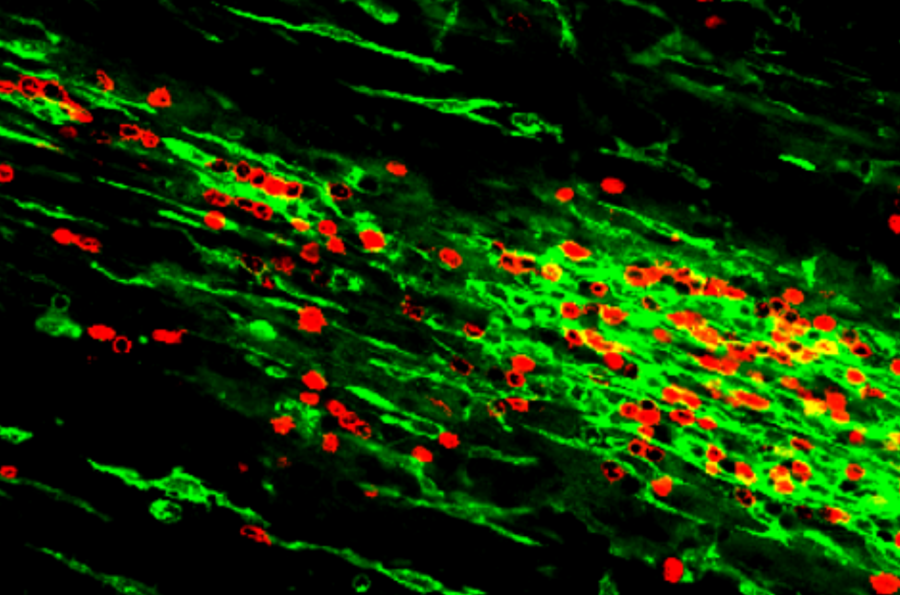
Spearheaded by PhD students Aaron Fleming and Karen Neish, the study set out to investigate how gut infection can shape immune responses beyond the site of infection. They began by infecting mice with a range of gut pathogens and found that each infection triggered a distinct type of CD4+ T cell response. CD4+ T cells are immune cells that can take on different roles depending on the type of infection they encounter, helping to coordinate the body’s immune response. Using further flow cytometry and imaging techniques, the researchers found that the type of gut infection not only shaped the CD4+ T cell response in the gut, but also changed the immune cells found in the meninges and brain – tissues far from the original site of infection.
To understand how gut infection was influencing the immune environment around the brain, the researchers then used single-cell RNA sequencing to examine which signals were driving the T cell response and which other cells might be involved. They found that macrophages, another type of immune cell, were present in the dura mater and produced a chemical signal called CXCL16. Following gut infection, CD4+ T cells began displaying the receptor for CXCL16 on their surface, allowing them to detect the signal and follow it towards the dura mater. Once there, the T cells remained in the tissue long after the gut infection had been cleared. To confirm whether CXCL16 was directly responsible for this migration the researchers chemically blocked its signalling. When CXCL16 signalling was disrupted, the CD4+ T cells could no longer migrate to the dura mater, demonstrating that this signal plays a crucial role in directing T cells from the gut to the brain’s protective membranes.
Finally, to understand what role the CD4+ T cells might play in the meninges and brain once localised there, the researchers challenged the mice with bacteria directly in the bloodstream – a route through which pathogens can reach the brain and cause infections such as meningitis. Strikingly, mice that had previously encountered the same bacteria during a gut infection mounted a faster and stronger immune response when the bacteria later entered their bloodstream. The CD4+ T cells that had migrated to the meninges and brain were able to respond rapidly to the invading bacteria, helping to prevent the pathogen from spreading into the brain. These findings suggest that an infection in the gut can leave behind a population of immune cells at the brain’s borders, providing a form of local immune protection against future infections.
The discovery of this gut-brain immune connection has important implications for both infection biology and broader research on brain health. It’s known that gut bacteria can enter the bloodstream and reach the brain and the researchers’ findings suggest that gut infections can establish a local population of CD4+ T cells in the meninges and brain, providing a primed defence against future infection. Understanding this process could potentially open new avenues for therapies that enhance immune protection at the brain’s borders. The findings may also help explain how gut inflammation can influence brain function. People with inflammatory bowel diseases such as Crohn’s disease and ulcerative colitis have an increased risk of anxiety and depression. By releasing cytokines that are known to influence nerve cells, gut-derived CD4+ T cells in the brain could potentially contribute to this connection, providing a new avenue for understanding the gut-brain link.
This work was funded by UKRI MRC, the Wellcome Trust, NIHR, Cambridge Institute of Therapeutic Immunology and Infectious Diseases (CITIID), National Council of Science and Technology (CONACYT) of Mexico and Gates Cambridge.
Further references
Menna’s group page
Animal research statement by the University of Cambridge
Related articles
Why do infectious and autoimmune diseases result in joint pain or inflammation?
How immune responses differ between asymptomatic cases and people with severe COVID‑19