Epigenetic changes subtly push pluripotent stem cells towards different embryonic identities, but a chemical reset can restore their ability to generate diverse tissues
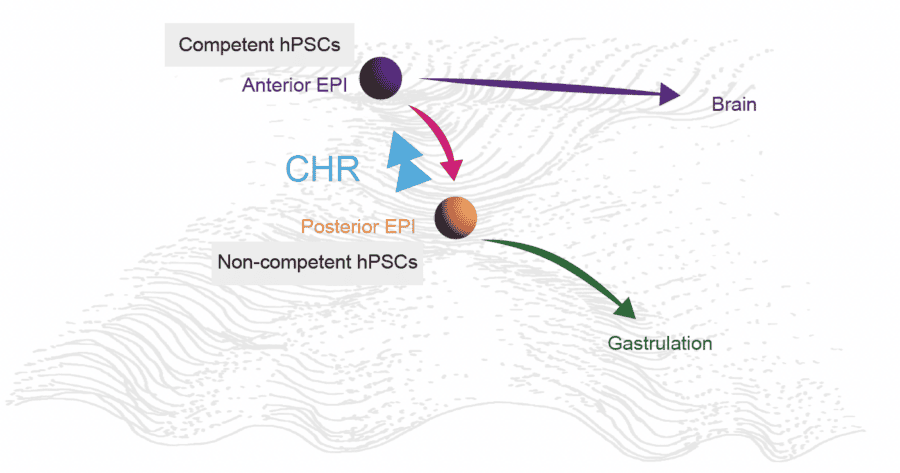
Human pluripotent stem cells (PSC) have proved indispensable for studying development, modelling disease and generating specific tissues for regenerative medicine applications. However, a longstanding challenge is that some cell lines fail to produce specific cell types, even when they satisfy the standard criteria for pluripotency. Madeline Lancaster’s group in the LMB’s Cell Biology Division have identified that this discrepancy is driven by epigenetic changes which cause stem cells to subtly shift into the ‘wrong’ developmental state. The study, which was led by Research Support Manager Magdalena Sutcliffe, also developed a treatment which restores broad specialisation potential in these stem cells.
The issue of inconsistent differentiation when using pluripotent stem cells is intimately familiar to Madeline’s group, who conduct much of their research using brain organoids which are particularly sensitive to the quality of the starting stem cell line. Investigating why this is, the group worked with Eugenia Wong and Stefan Schoenfelder at the Babraham Institute to compare ‘competent’ PSC lines, which reliably produced the desired brain tissue, with ‘non-competent’ lines which predominantly produced non-neural tissues.
This comparison involved analysis of which genes were active in each PSC line and examination of epigenetic marks, chemical tags which help control gene activity. The group found that PSCs with poor developmental potential had lost a balanced pattern of epigenetic marks at key developmental genes, pushing them towards a more posterior stage of embryo development linked to body formation. Conversely, competent PSC lines retained these balanced epigenetic marks, with their gene expression signalling a shift towards the anterior region, which is not yet committed and can still form the brain in developing embryos.
Having identified the cause, the researchers next asked whether the process could be reversed. The group developed a chemical treatment designed to reset the cells’ chromatin, the package of DNA and proteins which carry epigenetic marks. Following administration of this chromatin restoration (CHR) treatment, PSC lines which had previously struggled to generate brain organoids regained differentiation competence, successfully exhibiting the correct morphology, marker expression and developmental progression. To confirm that the CHR treatment didn’t just enhance neural differentiation, the team also grew kidney and intestinal organoids with treated PSCs, chosen because, alongside cerebral organoids, these tissues represent all three embryonic germs layers. Molecular analyses confirmed that the treated cells adopted a more anterior, developmentally competent state with restored epigenetic balance, as seen in naturally high-performing PSC lines.
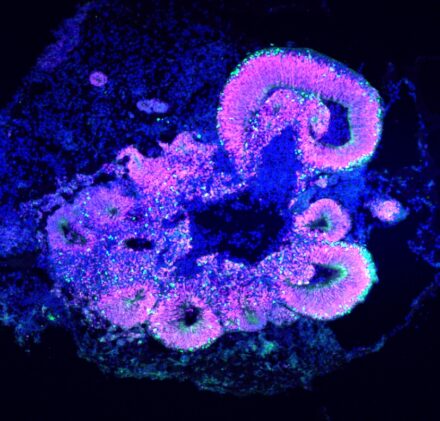
This study provides a mechanistic explanation for why two stem cell lines that both appear pluripotent at first can generate dramatically different results when differentiated into specific tissues. Pluripotency was once seen as a single state, but this research adds to the growing evidence that pluripotency exists as a spectrum of states. This highlights that cells can remain pluripotent whilst already showing signs of anterior or posterior patterning, representing the earliest stages of organisation that give rise to the future embryonic head or tail regions. Simply put, pluripotency and embryonic patterning are not mutually exclusive and differentiation bias may begin much earlier than previously thought.
Importantly, by demonstrating that CHR treatment can restore the differentiation ability of poorly performing PSCs, this study goes beyond identifying the problem by also offering a practical solution. This has the potential to help standardise stem cell lines used in research, where reproducibility is vital for generating reliable and comparable results. It may also have wider applications in improving the manufacturing of cells for regenerative medicine.
This work was funded by UKRI MRC, the Babraham Institute and UKRI BBSRC.
Further references
Madeline’s group page
Schoenfelder Group – Babraham Institute
Related articles
New 3D embryonic stem cell culture sheds light on gastrulation mechanism
How timing in early brain development sets humans apart from apes