Tanmay Bharat
Role of surface molecules in microbial multicellularity

Our group uses cryo-ET to study how surface molecules allow microorganisms such as bacteria and archaea to form multicellular communities. We develop novel correlative imaging and image processing techniques to support our inquiries. Surface molecules play key roles in mediating cell-cell interactions, which underpin the formation of biofilms and microbiomes.
While the structural biology of many cell surface molecules reveals fundamental information about bacterial and archaeal cell-cell interactions, our work has clear biomedical relevance. For example, surface molecules allow pathogenic bacteria such as Pseudomonas aeruginosa and Mycobacterium tuberculosis to evade antibiotics by forming biofilms during infection.
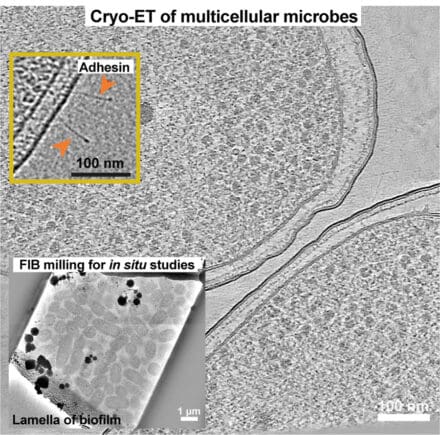
Through our fundamental work, our goal is to unravel general principles governing multicellular interactions in microbes to understand how emergent properties such as antibiotic tolerance arise within multicellular communities of prokaryotes. We have used the fundamental molecular mechanisms revealed in our work to develop approaches to disrupt pathogenic microbial biofilms, which we are developing in collaboration with clinicians.