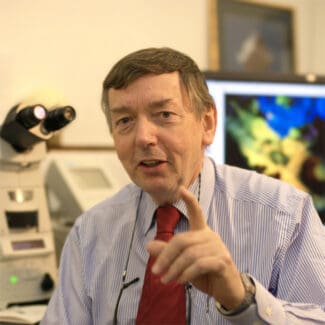
I am a biologist, microscopist and designer of optical instruments. In the contractile organelle of the protist Vorticella, I discovered that the dominant component was a 20,000 molecular weight calcium-binding protein closely similar to centrin, which is found in all cells. In 1981, I moved to the LMB, and helped John White, Michael Fordham and Richard Durbin to develop a laser-scanning confocal microscope, which was soon in use worldwide. I was seconded by the MRC to the manufacturer Bio-Rad for 17 years and designed new confocal models and the production jigs for their manufacture. John White and I were the first to demonstrate the use of a Ti-sapphire laser for two-photon imaging using a prototype laser built by Allister Ferguson at the University of Strathclyde, which was later universally accepted as the best laser source for this purpose.
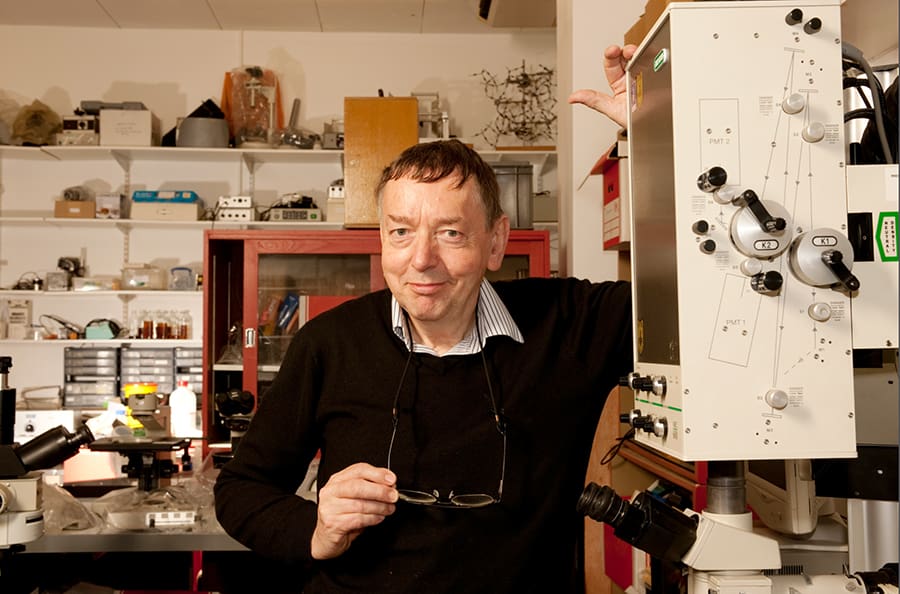
In 2003, I founded and ran a course in advanced optical microscopy in the Plymouth Laboratory of the Marine Biological Association for 13 years. This now continues at the University of Strathclyde, where I have been working part-time as an Emeritus Fellow with support from the Leverhulme Trust. At Strathclyde, I work with Gail McConnell’s group on the Mesolens, a new type of microscope objective that can image, without stitching smaller images, every cell in a larval or adult Drosophila in subcellular detail. Since retiring in 2010, I have been collaborating on published work on nonlinear optics and novel lasers and, recently, the manufacture of lenses by 3D printing. I am now developing a new, improved model of the Mesolens (Mk3) in Cambridge.
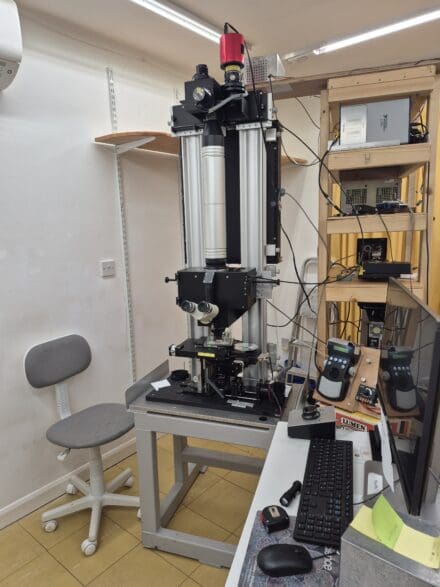
While teaching optics, I became interested in gem faceting and developed a method for measuring the refractive index of gemstones in materials such as diamond where the index is too high for measurement in standard equipment.