Group Leader

Benjamin Ryskeldi‑Falcon

Pathological protein assembly in neurodegenerative diseases

Benjamin Ryskeldi-Falcon
Group Members
  • Heidy Chen
  • Ashling Giblin
  • Fred Hawkings
  • Suman Mishra
  • Nikhil Varghese
  • Mark Walker

Neurodegenerative diseases are characterised by the pathological assembly of specific proteins into filaments within the central nervous system. Genetic studies have established a causal role for assembly in neurodegeneration. Our goal is to understand the molecular mechanisms of pathological protein assembly in motor neuron diseases (including amyotrophic lateral sclerosis) and frontotemporal dementias, two related groups of neurodegenerative diseases. We anticipate that this work will reveal strategies to target assembly for the diagnosis and treatment of these devastating diseases.
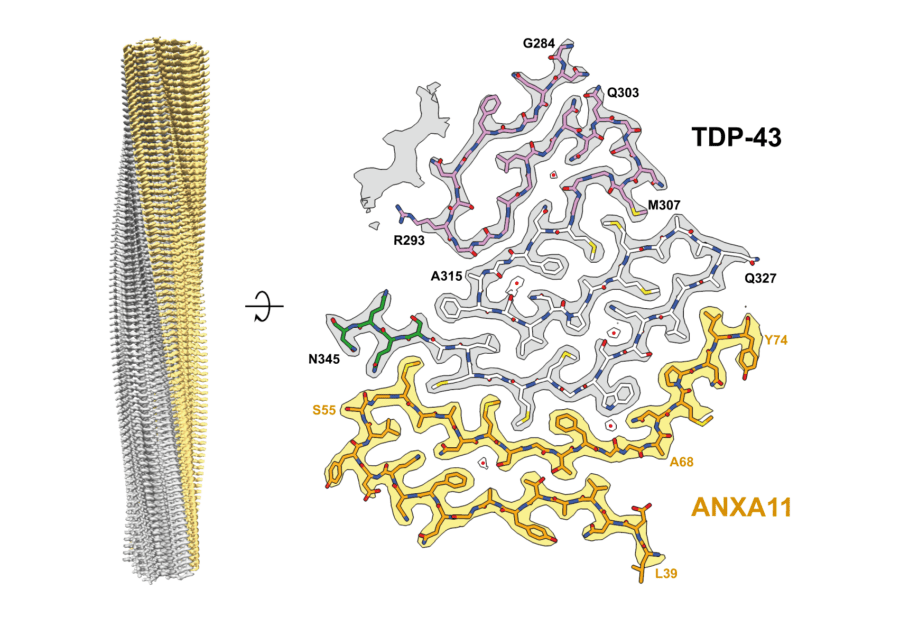
TDP-43 forms heteromeric amyloid filaments with a second protein, annexin A11, in frontotemporal lobar degeneration type C
Cryo-EM structure of heteromeric filaments of TDP-43 and annexin A11 in frontotemporal lobar degeneration type C (Arseni et al., Nature, 2024).

We determine the structures of pathological protein assemblies in neurodegenerative diseases using electron cryomicroscopy (cryo-EM). We have shown that TAR DNA-binding protein 43 (TDP-43) forms distinct amyloid filament structures in different diseases. We have discovered previously unknown pathological assemblies, including amyloid filaments of TATA-binding protein-associated factor 15 (TAF15) and heteromeric filaments of TDP-43 and annexin A11. These findings have transformed our understanding of the molecular basis of several neurodegenerative diseases and introduced new targets for diagnosis and therapy.
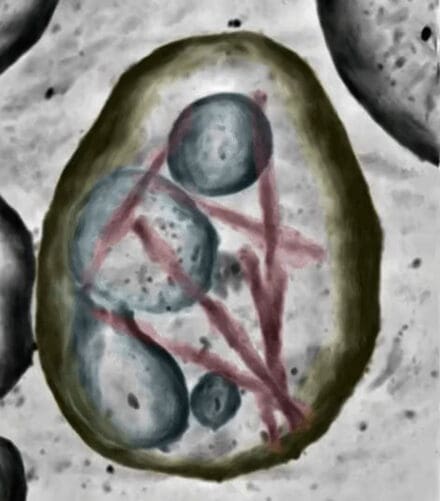
Denoised tomographic volume and segmentation from electron cryotomography of a brain extracellular vesicle from an individual with Alzheimer's disease, showing tau filaments tethered to the luminal side of the limiting membrane. The vesicle also contains internal vesicles
Cryo-ET of a brain extracellular vesicle from an individual with Alzheimer’s disease containing tau filaments (magenta) tethered to the limiting membrane (yellow). Internal vesicles are shown in cyan (Fowler, Behr et al., Nature Neuroscience, 2025).

We study pathological protein assembly in its cellular and tissue contexts using molecular-resolution electron cryotomography (cryo-ET) and targeted proteomics. This has revealed unexpected molecular environments and interactions that may play important roles in assembly and neurodegeneration. We are using the knowledge gained through these studies to develop model systems that recapitulate disease-characteristic filament structures. Such models are required to further investigate the molecular mechanisms of neurodegenerative diseases.

Selected Publications

Tau filaments are tethered within brain extracellular vesicles in Alzheimer’s disease.Fowler SL, Behr TS, Turkes E, O’Brien DP, Cauhy PM, Rawlinson I, Edmonds M, Foiani MS, Schaler A, Crowley G, Bez S, Ficulle E, Tsefou E, Fischer R, Geary B, Gaur P, Miller C, D’Acunzo P, Levy E, Duff KE, Ryskeldi-Falcon BNat Neurosci 28(1): 40-48 (2025)
Heteromeric amyloid filaments of ANXA11 and TDP-43 in FTLD-TDP type C.Arseni D, Nonaka T, Jacobsen MH, Murzin AG, Cracco L, Peak-Chew SY, Garringer HJ, Kawakami I, Suzuki H, Onaya M, Saito Y, Murayama S, Geula C, Vidal R, Newell KL, Mesulam M, Ghetti B, Hasegawa M, Ryskeldi-Falcon BNature 634(8034): 662-668 (2024)
TAF15 amyloid filaments in frontotemporal lobar degeneration.Tetter S, Arseni D, Murzin AG, Buhidma Y, Peak-Chew SY, Garringer HJ, Newell KL, Vidal R, Apostolova LG, Lashley T, Ghetti B, Ryskeldi-Falcon BNature 625(7994): 345-351 (2024)
Structure of pathological TDP-43 filaments from ALS with FTLD.Arseni D, Hasegawa M, Murzin AG, Kametani F, Arai M, Yoshida M, Ryskeldi-Falcon BNature 601(7891): 139-143 (2022)