LMB scientists came together at the 2026 Cambridge Festival to share their research through interactive microscope-based activities.
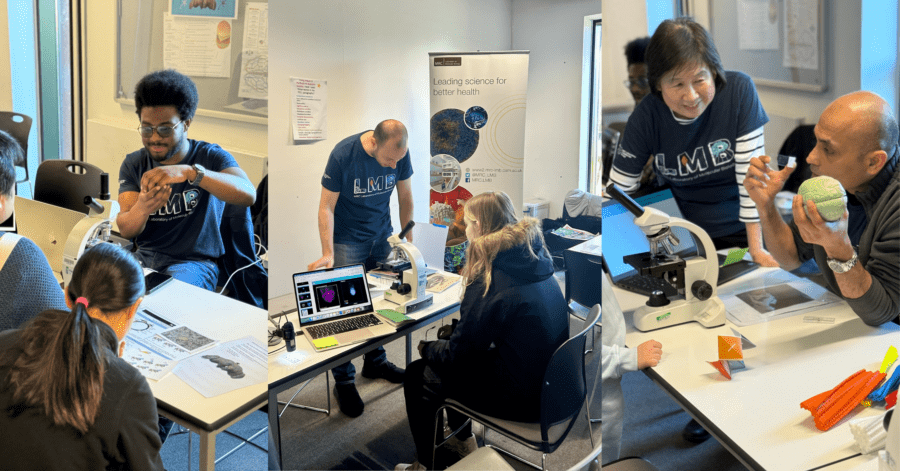
On Saturday 21st March, the LMB took part in the Cambridge Festival once again, showcasing how microscopes reveal the hidden beauty and intricate complexity of biology.
Around 330 visitors of various ages took part in the LMB activity, which featured a two-part experience designed to suit different age groups. Younger children and their families became ‘Science Detectives’, using stereoscopes to examine real biological specimens, including fruit flies, beetles, flowers and seeds. Each stereoscope had a matching game using cropped microscope images, encouraging participants to identify the correct specimens while teaching them the concept of biological scale and the tools scientists use to investigate it.
Attendees commented:
“This makes me feel like I could’ve gone into science!”
“The way the scientists talk to children is amazing. They learn so much – it opens different windows in their brains!”
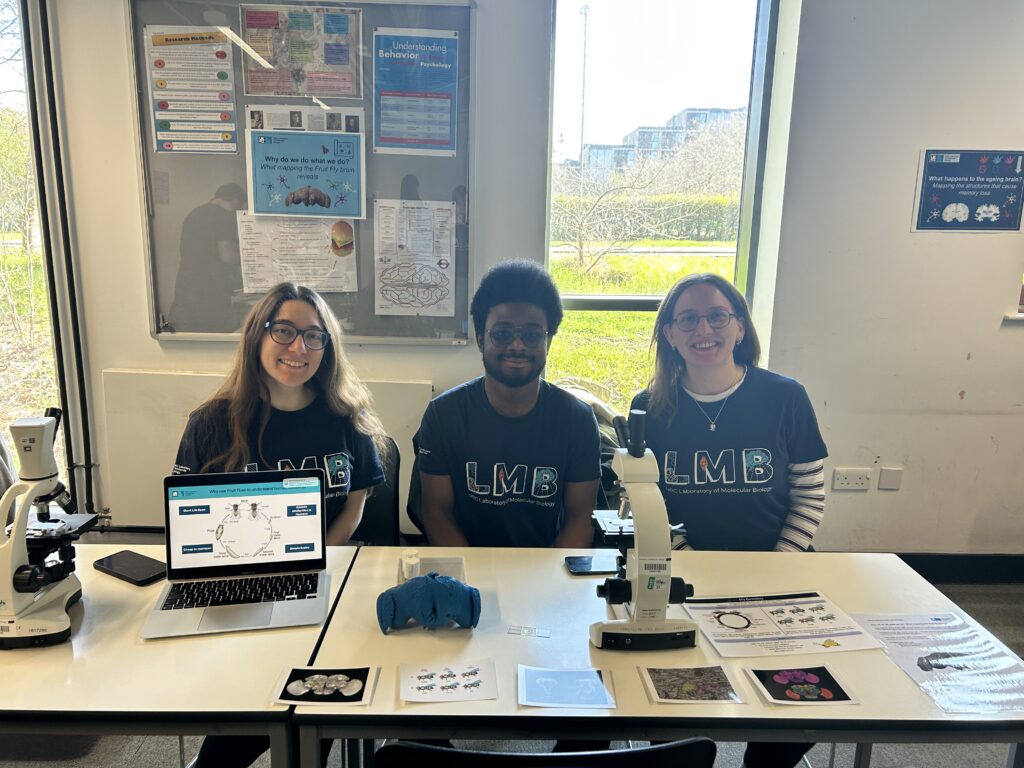
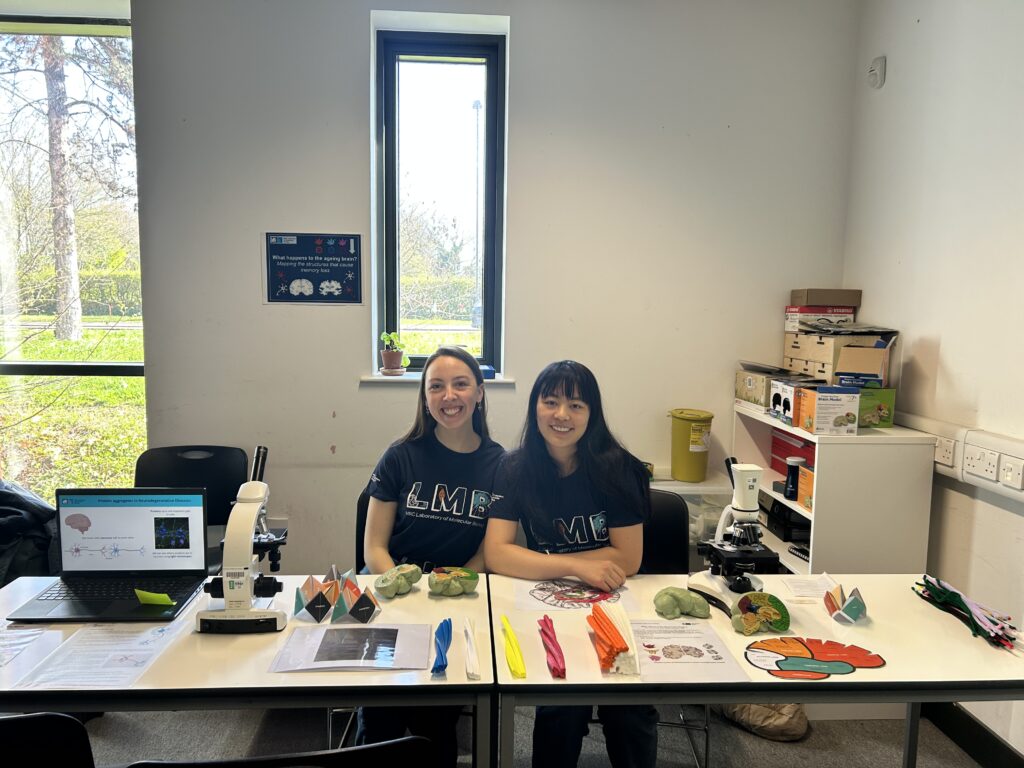
Alongside this, visitors of all ages had the opportunity to explore the cutting-edge research taking place at the LMB. Three stations were set up, each focusing on a different research area: embryo development, connectomics and behaviour, and ageing and neurodegeneration. At every station, participants could use a compound microscope to view real samples, including mouse embryos at different stages, fruit fly brains and tissue slices taken from mouse models of Alzheimer’s Disease. The samples were accompanied by physical models and digital resources and, most importantly, expert LMB scientists who could explain their research and answer any questions the participants had.
When asked what new thing they’d learnt, some of the youngest participants answered:
“Electron microscopes are 4 metres tall!”
“There are different types of dementia.”
“Cells can divide!”
“Fruit flies have 140,000 neurons in their brain”
“Embryos from different animals look very similar!”
The event provided a fantastic opportunity to highlight how scientists at the LMB endeavour to understand how life works at the microscopic level. The ‘Science Detectives’ activity was delivered by volunteers Tomás Azevedo, Aymen al-Rawi and Romina Koiffman. The compound microscope activities were led by several researchers across the different topics. Marta Shahbazi, Nanami Satoh, Rina Sakata, Viviane de Souza Rosa, Sonia Agüera Gonzalez and Guillermo Serrano Najera shared their embryo development research. Myrto Mitletton, and Lidia Ripoli Sanchez, Aiden Blay and Anastasia Bouchorikou (all University of Cambridge) talked to visitors about connectomics and behaviour. Ashling Giblin, Suman Mishra, Yuening Li, Bilal Ahsan and Shaoxia Chen showcased how electron cryomicroscopy (cryo-EM) is helping us understand ageing and neurodegeneration. They were coordinated by the Public Engagement team and Tomás Azevedo from the LMB Light Microscopy Facility.
The Public Engagement team played an additional role in the Cambridge Festival on Wednesday 25th March, as part of the Cambridge Biomedical Campus tour. Two tours of the campus were held, featuring visits to campus institutes including the Milner Institute and AstraZeneca. During the stop at the LMB, Public Engagement team members delivered a brief introduction to the LMB’s history and current research activities, helping to highlight the cutting-edge discovery science being carried out here.