
Contact
Facilities
NMR
NMR spectroscopy is a powerful method for characterising the structure, dynamics and interactions of proteins and nucleic acids in solution, at atomic resolution. It is particularly adept at revealing changes in mobility within a protein in response to mutation, post-translational modification or ligand binding. The NMR facility works collaboratively to support integrated structural biology projects at the LMB, helping to bridge the gap between biophysical measurements and structure determination.
The team draws on its diverse scientific expertise to provide high level insight into experiment design, sample preparation, data collection and analysis. Recent work has focussed on the consequences of post-translational modification (phosphorylation/ ubiquitination), signalling pathway regulation and the structure and dynamics of intrinsically disordered proteins or regions, often in the context of their wider biological interactions.
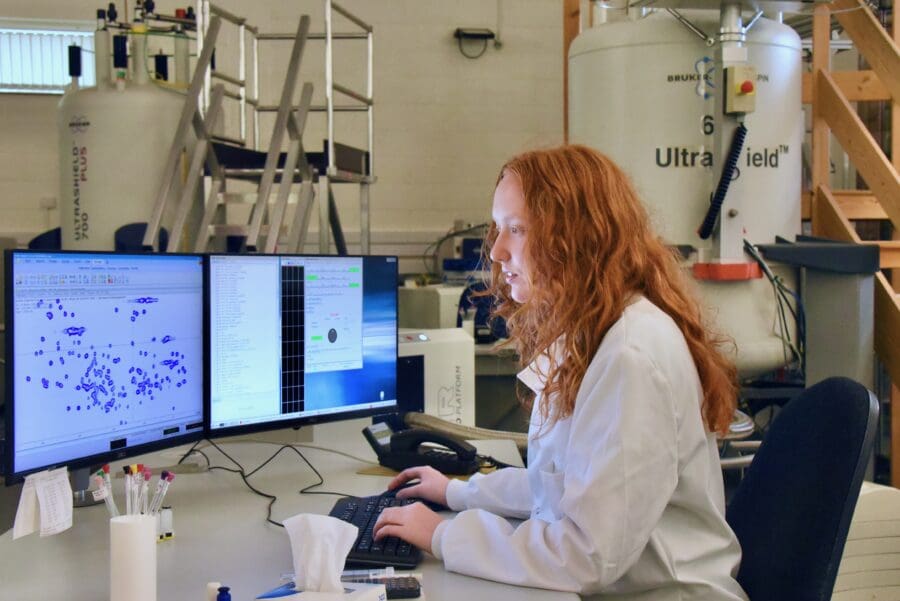
The NMR facility maintains Bruker 500, 600 and 700 MHz spectrometers, equipped with state-of-the-art electronics and sensitivity-optimised cryoprobes for the detection of multiple nuclei (1H, 15N, 13C, 31P, 19F) for the analysis of complex isotopically labelled biological samples. The LMB has access to the Crick National NMR facility (800 and 950 MHz) for higher field data collection. The NMR facility team works to ensure that all current methodologies are implemented and available to the non-expert user.