
VisLab

VisLab is dedicated to meeting the visual needs of the LMB. The facility provides photography, videography, printing and web development services, and has a scientifically trained graphics team.

The graphics team collaborates with scientists to create compelling illustrations, animations and designs that enhance scientific communication and dialogue with diverse audiences, including researchers, trainees and the public. These collaborations can lead to unique visual representations and even new research insights.
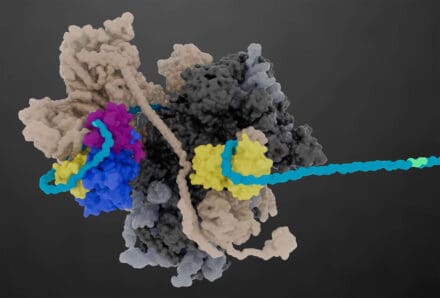
A still from an animation of eukaryotic translation initiation. The still shows the mRNA in blue, reeled in by the yellow initiation factor eIF4A-1 in the large 48S ribosomal initiation complex.
A still from an animation of eukaryotic translation initiation created by Konstantinos Alexandrou in collaboration with Irene Diaz Lopez and Venki Ramakrishnan. The still shows the mRNA in blue, reeled in by the yellow initiation factor eIF4A-1 in the large 48S ribosomal initiation complex.

Scientists frequently approach VisLab for help with summary/model figures for publications and presentations, unique paper or review figures, animations explaining molecular processes, graphical abstracts and journal covers and press release images.
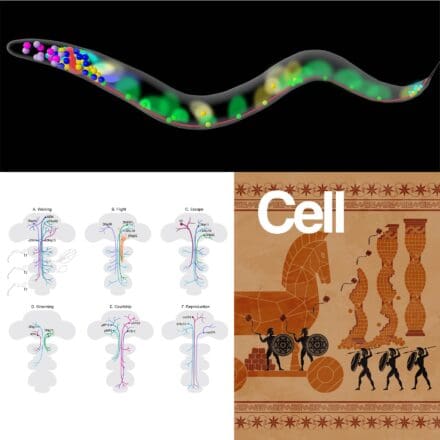
A few representative works from VisLab. (top) A press release image. (left) A paper figure. (right) A journal cover.
A few representative works from VisLab. (top) A press release image created by Konstantinos Alexandrou with Lidia Ripoll-Sanchez and Bill Schafer, for their study that unveiled a draft connectome of neuropeptide signalling in C. elegans. (left) A paper figure developed by Elfy Chiang with Julie Simpson and Marta Zlatic to depict neural circuits that control useful behaviours in fruit flies. (right) A journal cover created by Elfy Chiang with Lauren Miller and Leo James, for their work that tackles neurodegeneration by prevention and removal of tau aggregation.

The team is developing workshops and training sessions to enable researchers to incorporate visual strategies into their work. Additionally, VisLab provides consultations and feedback to support scientists in creating their own visuals, so they benefit from the process of visualisation itself.

While Adobe Creative Cloud is primarily used for design and Autodesk Maya for scientific animations, VisLab is transitioning toward open-source tools like Blender to make scientific visualisation more accessible.

An animation visualising microbial surface layers (S-layers) created by Konstantinos Alexandrou in collaboration with Buse Isbilir, Andriko von Kügelgen and Tanmay Bharat.

Selected Publications

Using 3D Animation to Visualize Hypotheses.Nayak S, Liu H, Hsu GI, Iwasa JHTrends Biochem Sci 45(7): 633-634 (2021)