Richard Henderson
High-resolution 3D structures by electron cryomicroscopy
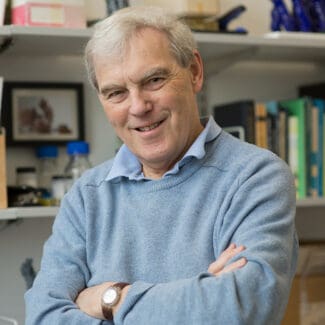
I am a structural biologist with a background in physics. My research began in the 1960s, using X-ray crystallography to help determine the structure and mechanism of chymotrypsin. Then, with an interest in the structure of membrane proteins and an early collaboration with Nigel Unwin, I switched to electron crystallography of two-dimensional crystals to work on the structure and mechanism of the light-driven proton pump bacteriorhodopsin. Over the last 30 years, I have concentrated mainly on single particle cryo-EM, in which electron images of a thin film containing the macromolecules of interest are obtained without the need for crystals, using the plunge-freeze method developed by Jacques Dubochet’s group at the European Molecular Biology Laboratory. I shared the 2017 Nobel Prize in chemistry with Dubochet and Joachim Frank.
My current interest is to improve cryo-EM to get closer to the theoretical performance that is predicted by quantitative analysis. There are still many improvements that can be made, although cryo-EM has already become the most efficient way to determine biological structures. There are many biological structures that have resisted experimental structure determination, so there is a need for innovation.