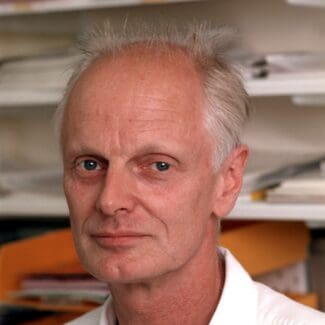
Terry Rabbitts studied for his PhD at the MRC National Institute for Medical Research, Mill Hill, London, working on mitochondrial nucleic acids. While there he became interested in antibody diversity, stimulated by Peter Medawar’s immunology work. In 1971, he became a Research Fellow in the Department of Genetics, University of Edinburgh, starting his work on antibody genes, before moving to the LMB in 1973 to join César Milstein’s group. In 1976, Terry became a Group Leader in the LMB’s PNAC Division.
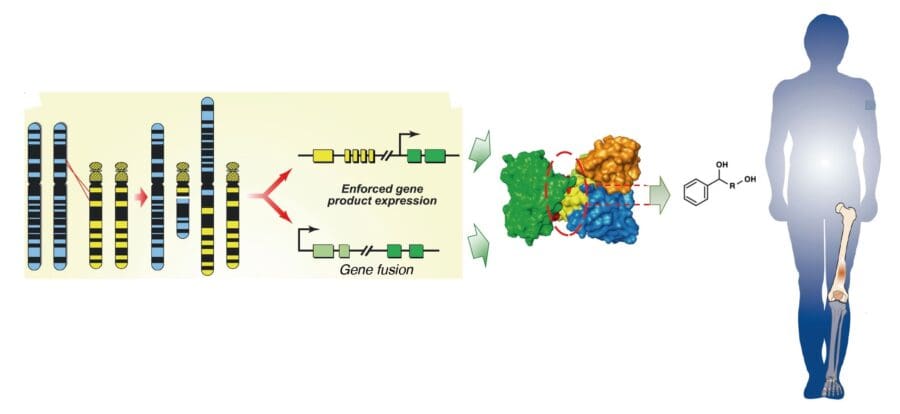
At the LMB, his early work on antibody genes demonstrated that variable and constant region genes are separate in germline DNA, are rearranged in B cell DNA and joined in mRNA. He demonstrated that heavy chain class switching occurs by gene deletion and found the heavy chain constant region gene duplication, explaining some inherited human immuno-deficiencies. Defining the diversity of human antibody genes established the building blocks essential for the construction of antibody repertoires in phage display libraries, while mapping the heavy chain and kappa light chain genes to the breakpoints of Burkitt’s lymphoma chromosomal translocations, lead to the discovery of the CMYC gene translocations. He discovered somatic mutations in the translocated CMYC gene, providing evidence that somatic hypermutation occurs in genes associated with the immunoglobulin locus. By analogy, he discovered T cell leukaemia translocations and the first gene fusion in a solid tumour demonstrating the universality of chromosomal translocation gene fusion in human cancer.
During this work, he developed several methods including cDNA cloning (an approach still widely used in biomedical research today); chimaeric antibody technology (with Michael Neuberger); and the gene targeting knock-in method (now widely used for gene editing in biological research). Since moving from the LMB to Leeds and Oxford then ICR, he has worked on new technologies for cancer therapy using antibody fragments inside cells and developed novel methods using intracellular antibodies for small molecule drug discovery isolating the first compounds binding the hard-to-drug proteins RAS and LMO2.
Terry was Joint Head of the PNAC Division from 1988 to 2002, first with César Milstein and later with Greg Winter. During his time as Head of the PNAC Division, Terry was a major influence on LMB development. He initiated transgenic mouse work at the LMB and was subsequently centrally involved in its growth, first at SABU and then the Biological Services Group. He was also part of the early planning of the new LMB building.
Terry was Chair of the Scientific Advisory Board of Cambridge Antibody Technology (CAT) and a member of the Domantis Scientific Advisory Board, helping the LMB to develop its strong translational record.
In 2007, Terry moved to become Director of the Leeds Institute of Molecular Medicine to establish a translational research initiative, before becoming Professor of Molecular Biology at the Weatherall Institute of Molecular Medicine, MRC Molecular Haematology Unit at the University of Oxford where he established methods for drug discovery using intracellular antibodies. He joined the Institute of Cancer Research, London as Professor of Molecular Immunology in March 2020 where he continues to work on establishing new technologies to target oncogenic proteins cancer, especially proteins made after chromosomal translocations. Recent success includes antibody-derived compounds inhibiting the so-called undruggable targets RAS and LMO2. He hopes that these methods can be applied to other diseases, such as infections, neuropathies and auto‑immunity.
For his contributions in the area of molecular immunology, Terry has received several honours and awards, including The Biochemical Society Colworth Medal, 1981, the Ciba Medal and Prize in 1993 and the 2015 Clotten Foundation Prize, for discoveries on human antibody genes leading to therapeutic antibodies, and discoveries on chromosomal translocations in cancer leading to novel therapeutic approaches. He has been a Member of EMBO since 1981, a Fellow of the Royal Society since 1987, a Fellow of the Academy of Medical Sciences since 1998 and a Fellow of the American Association for Cancer Research Academy since 2022.