Group Leader

Radu Aricescu

The structural biology of neuronal connectivity

Radu Aricescu
Group Members
  • Veronica Chang
  • Vikram Kasaragod
  • Nicolas Kjaer‑Jensen
  • Christos Papantoniou
  • Milena Timcenko
  • Carys Williams

Neuronal circuits are fundamentally important for all aspects of animal physiology, from motion, vision and sensations to higher cognitive functions such as learning, memory, thought, speech and consciousness. The synapses – connecting points between neurons are continuously remodelled in response to novel experiences and hold the key to understanding how nervous systems work.

Little is known, however, about the fine structure of synapses. Increasingly long lists of molecular components are available, and we know how some of these look in atomic detail, typically in isolation. However, these players do not work alone. They must come together and coordinate to make a functional synapse.

We employ a combination of structural biology methods, including cryogenic electron microscopy and tomography, to define in high resolution the architecture of neurotransmitter receptors, their supramolecular assemblies and whole synapses. We then link structural work with neuronal physiology to provide fundamental mechanistic insights in neuroscience.
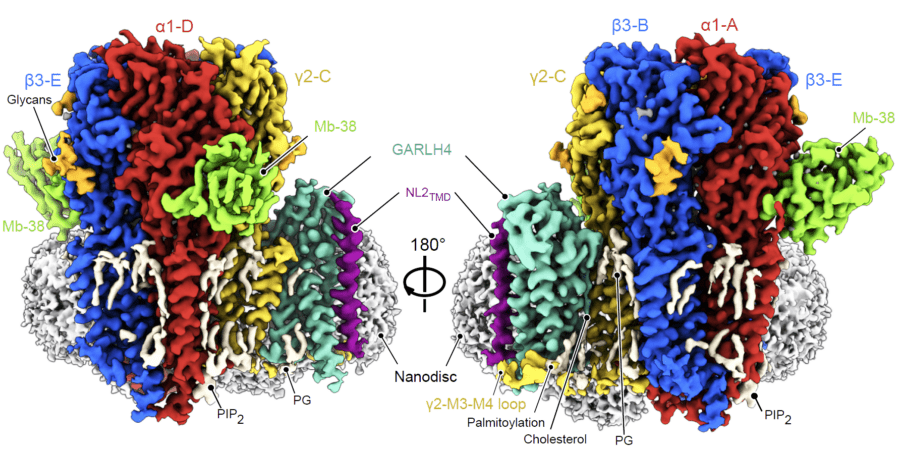
Surface representation of a multi-subunit receptor complex bound to accessory proteins GARLH4, NL2_TMD, and Mb-38 within a nanodisc.
Structure of a synaptic GABAA receptor complex (Kasaragod et al., 2025).

We apply structural knowledge to design novel molecular tools that help rebuild neuronal connections, modulate their function and repair damaged neuronal circuits. The majority of psychiatric and neurological disorders, from intellectual disability to Alzheimer’s disease, depression and addiction, as well as age-related cognitive decline and many debilitating injuries stem from impaired neuronal connectivity and errors in synaptic signalling. We help translate our discoveries to novel therapeutic approaches, in close collaboration with industry.

Gating cycle of the human GABAA receptor α1β3γ2 (Mihaylov et al., 2025).

Selected Publications

Differential assembly diversifies GABAA receptor structures and signalling.Sente A, Desai R, Naydenova K, Malinauskas T, Jounaidi Y, Miehling J, Zhou X, Masiulis S, Hardwick SW, Chirgadze DY, Miller KW, Aricescu ARNature 604(7904): 190-194 (2022)
A synthetic synaptic organizer protein restores glutamatergic neuronal circuits.Suzuki K, Elegheert J, Song I, Sasakura H, Senkov O, Matsuda K, Kakegawa W, Clayton AJ, Chang VT, Ferrer-Ferrer M, Miura E, Kaushik R, Ikeno M, Morioka Y, Takeuchi Y, Shimada T, Otsuka S, Stoyanov S, Watanabe M, Takeuchi K, Dityatev A, Aricescu AR, Yuzaki MScience 369(6507): (2020)
GABAA receptor signalling mechanisms revealed by structural pharmacology.Masiulis S, Desai R, Uchański T, Serna Martin I, Laverty D, Karia D, Malinauskas T, Zivanov J, Pardon E, Kotecha A, Steyaert J, Miller KW, Aricescu ARNature 565(7740): 454-459 (2019)
Cryo-EM structure of the human α1β3γ2 GABAA receptor in a lipid bilayer.Laverty D, Desai R, Uchański T, Masiulis S, Stec WJ, Malinauskas T, Zivanov J, Pardon E, Steyaert J, Miller KW, Aricescu ARNature 565(7740): 516-520 (2019)