Marco Tripodi
Neural circuits for goal-oriented actions

From grasping a cup of coffee to reorienting toward a loud sound, our daily lives rely on the ability to generate spatially appropriate movements. Our team’s long-term goal is to understand, at both the circuit and genetic levels, how animals construct spatial representations and use them to guide goal-directed actions.
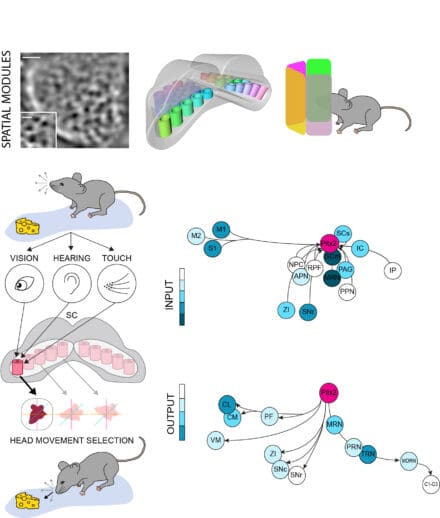
We have uncovered the organisational principles of spatial-motor representations in the brain and the logic governing sensory-motor alignment. Our work has identified specialised ‘spatial modules’ formed by genetically defined neuronal populations responsible for executing precise spatial movements. We have also revealed the organisational logic that links these modules to specific sensory channels, thereby beginning to uncover the circuit and genetic mechanisms underlying sensory-motor integration. More broadly, our research is highlighting the integral role of motor circuits in shaping perceptual and cognitive processes and defining the molecular identity of the relevant neural populations.
Beyond basic neuroscience, we have made significant methodological contributions by developing non-toxic transsynaptic viral vectors capable of delivering molecular compounds to specific neural circuits, tools that open the door to circuit-specific therapeutic interventions.
Moving forward, we aim to define the genetic and circuit mechanisms controlling spatially-tuned behaviours and investigate whether these same circuits contribute to cognitive functions such as attention and spatial decision-making. We also seek to explore whether their dysfunction may underlie common cognitive impairments.
Ultimately, we hope to uncover the fundamental principles of brain function that bridge movement, perception and cognition.