Joergen Kornfeld
Connectomics of learned behaviour

How do animals store learned behaviours in their neuronal networks and retrieve them when performing those behaviours? It is widely believed that the connections between neurons, or synapses, are the memory substrate. The sum total of all these synaptic connections is the connectome.
Using the zebra finch songbird as a model, we investigate how song memories are stored and retrieved from the underlying brain circuits. These birds can perform, as adults, songs they practised as juveniles, similar to how humans learn language.
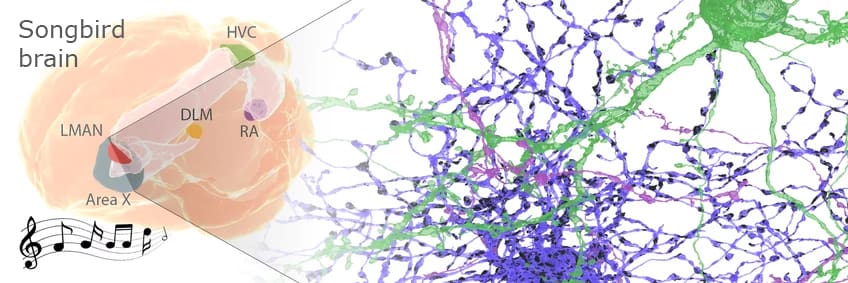
To map these brain circuits at sufficient resolution to see synapses, we employ high-throughput 3D electron microscopy. This process generates vast amounts of image data, far more than someone could inspect manually. We therefore employ state-of-the-art deep learning techniques to infer the connectomic map and let the artificial neural networks reconstruct the real ones.
Method development is central to this effort. We collaborated with Google Research to develop flood-filling networks for automated neuron reconstruction based on our data. We also developed the first dense synaptic connectivity inference pipeline, SyConn2. These tools allow us to collect larger datasets and analyse them efficiently, making previously intractable biological questions accessible.
Our long-term goal is to mechanistically understand how a learned behaviour, the zebra finch song, is encoded in the underlying synaptic wiring patterns, and create a link between the specific behaviour of an individual and its underlying connectome.