Jing Ren
Developmental assembly of the serotonin system

The serotonin system is one of the brain’s most expansive neural systems, influencing mood, cognition, emotion and sleep. It is strongly linked to mental disorders like depression and anxiety and is the primary target of many psychiatric medications. Despite its importance, how this system forms during development and how disruptions contribute to mental illness remain unclear.
Recent research from our group has shown that the serotonin system is not a single, uniform network but is instead made up of distinct subsystems, each targeting specific areas of the brain and affecting different behaviours.
We are investigating the behavioural functions of long-range and local connections within the forebrain-projecting serotonin system. Our work will help reveal how serotonin wiring is established, how it can go awry in psychiatric disorders and how we might better target it for treatment.
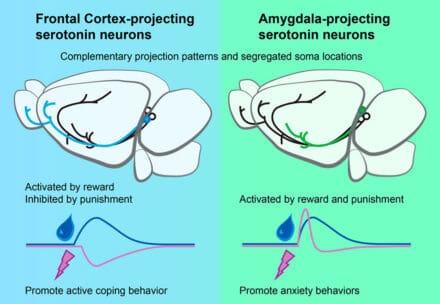
We also aim to uncover how these sub-systems form. Using machine learning tools, we created a 3D whole-brain map that tracks serotonin connectivity over time. Combined with single-cell genetic profiling, this allowed us to trace serotonin neuron subtypes from the embryonic stage to adulthood. We found that diversity emerges early, with each subtype following a genetically programmed wiring pattern.
To enhance brain mapping, we developed D-LMBmap, a deep-learning tool that automates whole-brain connectivity analysis and eliminates the need for tedious manual work. Building on this, D-LMBmapX enables high-resolution tracking of brain circuit development across postnatal stages, providing new insights into serotonin and other neural systems.