Emmanuel Derivery
Molecular basis of cell polarisation and asymmetry

Asymmetric cell division is the process by which one cell divides into two daughter cells that have different fates. Asymmetric division is the hallmark of stem cells: one daughter cell specialises to perform a specific function in the organism, while the other becomes another stem cell that keeps the ability to divide. We are interested in understanding how cell fate determinants segregate during asymmetric division. Specifically, we focus on understanding the molecular and physical mechanisms by which cytoskeleton tracks can be polarised by cortical polarity cues, and how, in turn, this polarised network of tracks are ‘read’ by molecular motors to carry endosomes containing the right cell fate determinants into only one daughter cell. Our long-term vision is to capitalise on this work in asymmetric cell division to establish the rules of polarised transport, which could apply to other polarised cells, such as neurons.
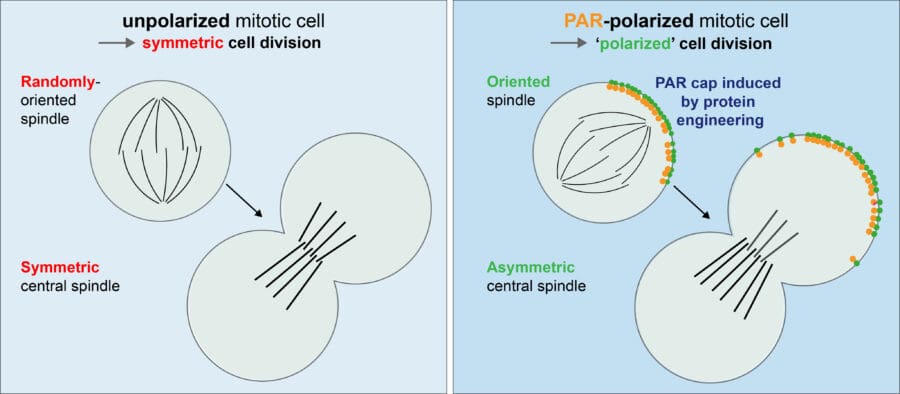
Our approach is multidisciplinary: we combine quantitative imaging, developmental cell biology, synthetic biology, in vitro reconstitution and structural biology. We also invest in technology development to overcome technical bottlenecks that currently hold back our understanding. For instance, we have developed techniques to induce polarity in unpolarised cells, using micropatterning and protein design. This allows us to decipher the molecular mechanisms underpinning cytoskeleton polarisation. In collaboration with James Manton, we also develop novel imaging technologies specifically designed to dissect the molecular interactome of fast cellular processes, such as the sorting of specific signalling cargoes into endosomes.