Group Leader

Buzz Baum

The generation and evolution of biological form: from archaea to eukaryotes
Buzz Baum
Group Members
  • Alice Cezanne
  • Tom Dubois
  • Sherman Foo
  • Yin-Wei (Kris) Kuo
  • Magda Lechowska
  • Fraser MacLeod
  • Darcy Mishkind
  • Joe Parham
  • Arthur Radoux
  • Iain Richard

We are interested in the generation and evolution of cell shape and use archaea as model systems for our research. Specifically, we study Sulfolobus cells from hot springs in Yellowstone National Park to investigate how cell organisation changes as archaea grow and divide. Additionally, we use Asgard archaea from stromatolites in Shark Bay, Australia – our closest prokaryotic relatives – to understand how complex cell organisation arises within microbial communities.

A major focus of our group is cell division – the process by which one cell becomes two. This remarkable event requires all cellular components to be duplicated, physically separated and then rapidly partitioned into two daughter cells. To achieve this, cells rely on cytoskeletal filaments that convert chemical energy into force to drive shape changes, a regulatory system that ensures the precise choreography of events and membrane remodelling to complete the final separation.
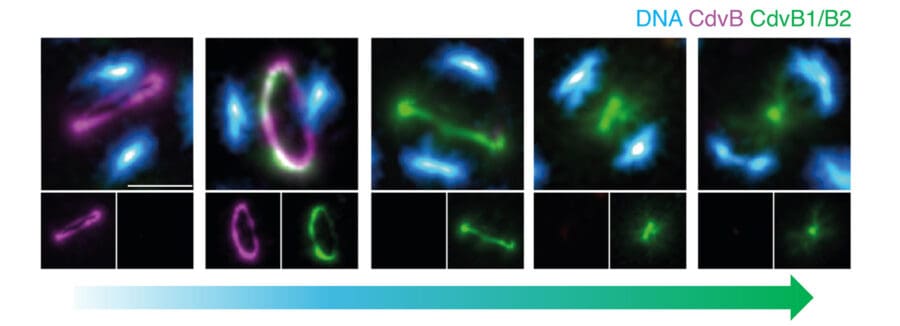
The images of fixed, labelled Sulfolobus cells illustrate 5 stages in the process of archaeal cell division from composite ESCRT-III ring assembly to constriction. Below three stills from computational model of Sulfolobus cell division demonstrate that a change in the preferred curvature of the ESCRT-III polymers and their disassembly would be sufficient to induce cell constriction and scission.
ESCRT-III dependent cell division in Sulfolobus (fluorescent images of ESCRT-III polymers and stills from a computational model).

By studying the cell biology of these extraordinary organisms, we aim to uncover fundamental aspects of cellular processes that eukaryotes inherited from archaea. Archaea also provide a unique window into some of the more remarkable features of life – for example, the ability to thrive at 75 °C, to engage in symbiotic partnerships and to grow in the absence of oxygen. Finally, this research promises to shed new light on the origins of eukaryotes – one of the greatest mysteries in the history of life on Earth.
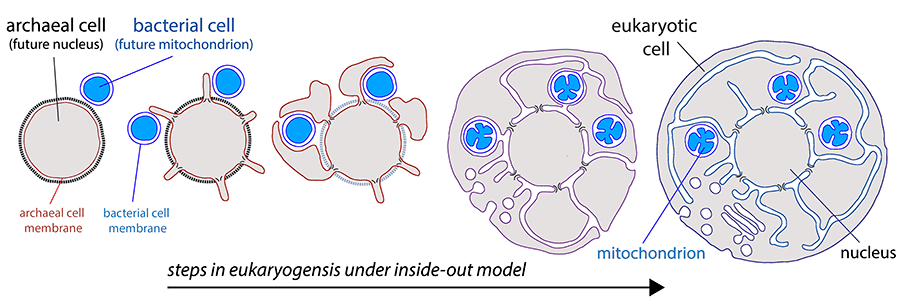
Inside-out model of eukaryogenesis shows an archaeal cell extending membranes to envelop bacteria, forming a eukaryotic cell with a nucleus and mitochondria.
A model for the evolution of eukaryotes from a bacterial and archaeal partner.

Selected Publications

Asgard archaea reveal the conserved principles of ESCRT-III membrane remodeling.Souza DP, Espadas J, Chaaban S, Moody ERR, Hatano T, Balasubramanian M, Williams TA, Roux A, Baum BSci Adv 11(6): eads5255 (2025)
Bacterial Vipp1 and PspA are members of the ancient ESCRT-III membrane-remodeling superfamily.Liu J, Tassinari M, Souza DP, Naskar S, Noel JK, Bohuszewicz O, Buck M, Williams TA, Baum B, Low HHCell 184(14): 3660-3673.e18 (2022)
The proteasome controls ESCRT-III-mediated cell division in an archaeon.Tarrason Risa G, Hurtig F, Bray S, Hafner AE, Harker-Kirschneck L, Faull P, Davis C, Papatziamou D, Mutavchiev DR, Fan C, Meneguello L, Arashiro Pulschen A, Dey G, Culley S, Kilkenny M, Souza DP, Pellegrini L, de Bruin RAM, Henriques R, Snijders AP, Šarić A, Lindås AC, Robinson NP, Baum BScience 369(6504): (2020)
An inside-out origin for the eukaryotic cell.Baum DA, Baum BBMC Biol 12: 76 (2015) Epub