
Group Leader

Ana Tufegdžić Vidaković

Molecular basis of gene transcription

Ana Tufegdžić Vidaković
Group Members
  • Pegah Abyaneh
  • Yu Bao
  • Roberta Cacioppo
  • Benjamin Haworth
  • Pei Qin (Sabrina) Ng

The complexity of eukaryotic life forms is driven by RNA polymerase II (Pol II), which transcribes all protein-coding genes and thousands of non-coding RNA loci in a context-specific manner. The Tufegdžić Vidaković group uses a combination of genome-wide, biochemical and cell biology tools to study the transcription process.
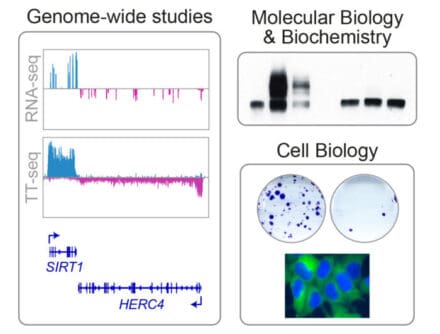
Examples of the tools we use to study the transcription process
A snapshot of genomic data (left), biochemical experiment assaying Pol II ubiquitylation (top right) and analyses of fixed cells (bottom right).

For decades it was believed that Pol II activity was strictly regulated at the first steps of gene expression: transcription initiation and pausing. Recent studies demonstrate that additional checkpoints exist and control gene expression output in a rate-limiting way. Our group recently discovered one such checkpoint, whereby CRL3ARMC5 ubiquitin ligase and Integrator phosphatase work in parallel to survey the quality and quantity of Pol II molecules at the beginnings of genes, before they are licensed to proceed into the gene body. Our work sheds light on the power of ubiquitin-mediated Pol II regulation and we are now focussing on discovering other ubiquitylation pathways that regulate Pol II.

Many human genes are very long, and transcribing a single RNA copy takes Pol II hours. How elongating Pol II is regulated on its journey across the genes remains poorly understood. Obstacles such as DNA damage cause elongating Pol II to stall and block gene expression. We investigate the mechanisms that regulate elongating Pol II and resolve transcription when Pol II stalls.
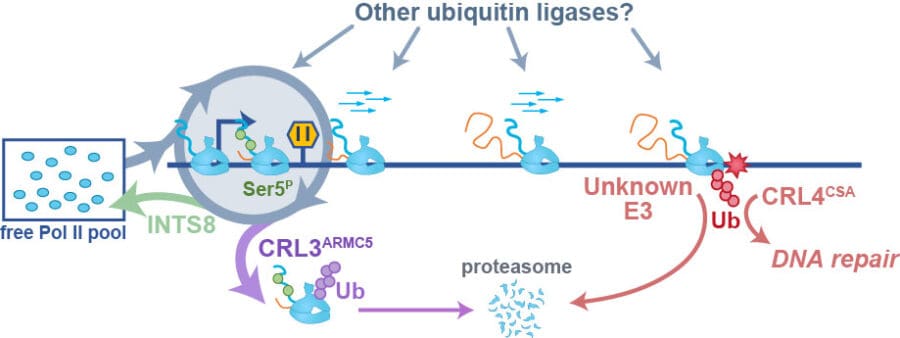
Pol II transcription cycle
Transcription proceeds through a series of steps, many of which are profoundly regulated by ubiquitin (Tufegdžić Vidaković et al., Cell, 2020; Cacioppo, Gillis, Shlamovitz, Zeller et al., Mol Cell, 2024). We are investigating novel ubiquitin pathways that control Pol II.

Selected Publications

CRL3ARMC5 ubiquitin ligase and Integrator phosphatase form parallel mechanisms to control early stages of RNA Pol II transcription.Cacioppo R, Gillis A, Shlamovitz I, Zeller A, Castiblanco D, Crisp A, Haworth B, Arabiotorre A, Abyaneh P, Bao Y, Sale JE, Berry S, Tufegdžić Vidaković AMol Cell 84(24): 4808-4823.e13 (2024)
Regulation of the RNAPII Pool Is Integral to the DNA Damage Response.Tufegdžić Vidaković A, Mitter R, Kelly GP, Neumann M, Harreman M, Rodríguez-Martínez M, Herlihy A, Weems JC, Boeing S, Encheva V, Gaul L, Milligan L, Tollervey D, Conaway RC, Conaway JW, Snijders AP, Stewart A, Svejstrup JQCell 180(6): 1245-1261.e21 (2020)
Analysis of RNA polymerase II ubiquitylation and proteasomal degradation.Tufegdzic Vidakovic A, Harreman M, Dirac-Svejstrup AB, Boeing S, Roy A, Encheva V, Neumann M, Wilson M, Snijders AP, Svejstrup JQMethods 159-160: 146-156 (2020)
Context-Specific Effects of TGF-β/SMAD3 in Cancer Are Modulated by the Epigenome.Tufegdzic Vidakovic A, Rueda OM, Vervoort SJ, Sati Batra A, Goldgraben MA, Uribe-Lewis S, Greenwood W, Coffer PJ, Bruna A, Caldas CCell Rep 13(11): 2480-2490 (2016)