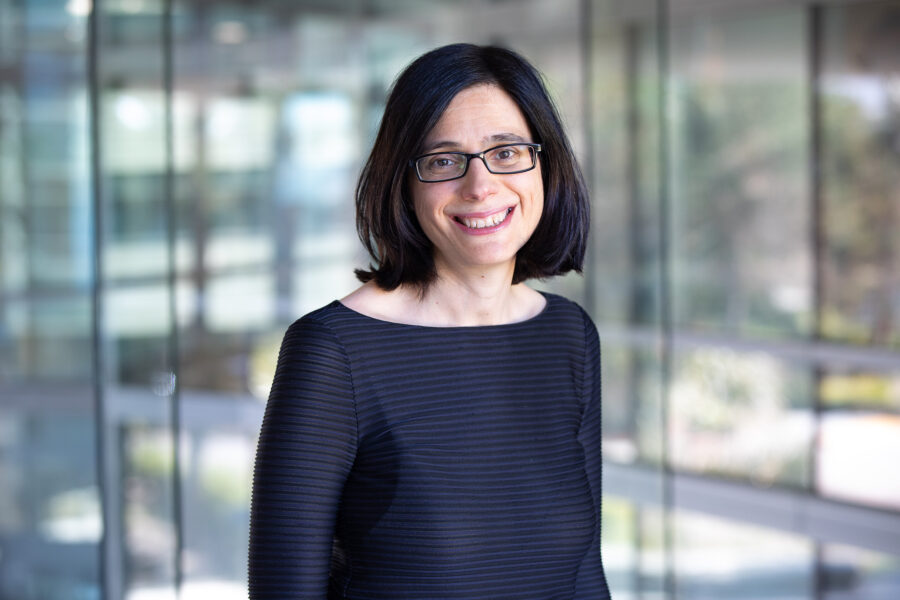
The LMB is delighted to welcome Aviv Regev to deliver the 2026 Francis Crick Lecture on Monday 9th March at 11am (GMT). The talk, titled ‘From Cell Atlases to Medicines, with AI’ will be given in the LMB’s Max Perutz Lecture Theatre. All those interested are warmly invited to attend. External attendees are advised to arrive at least ten minutes before the talk to register at LMB Reception.
Aviv Regev is Head and Executive Vice President at Genentech Research and Early Development, where she oversees drug discovery and development programmes. She also leads a research group focused on understanding the molecular circuits in cells, tissues and organs, including how their malfunction can contribute to disease. To that end, her group has pioneered novel experimental and computational methods in single-cell genomics to better decipher these circuits. This has allowed analysis of healthy cellular and tissue circuits, and those in diseases including cancers, COVID-19, inflammation and autoimmune diseases. At Genentech, Aviv’s AI-driven approach has transformed their R&D pipeline, reinvigorating and complementing more traditional wet-lab methods.
Prior to joining Genentech, Aviv was Chair of the Faculty and Core Institute Member at the Broad Institute of MIT and Harvard, Professor of Biology at MIT and a Howard Hughes Medical Institute Investigator. Notably, she is a founding co-chair of the Human Cell Atlas, helping to lead a global effort to create comprehensive reference maps for all human cells as a foundation for understanding human health and disease.
Aviv’s work in the field of computational biology has been recognised with several awards and fellowships. She is a member of the US National Academy of Sciences, the US National Academy of Medicine and the American Academy of Arts and Sciences, and a Fellow of the International Society of Computational Biology (ISCB) and the American Association of Cancer Research. She is a Foreign Member of the Royal Society and an Associate Member of EMBO. She has received the Overton and Innovator Awards from ISCB, the Lurie Prize, the Keio Medical Prize, the Dickson Prize in Medicine, the L’Oréal-UNESCO For Women in Science Award, the Ernst Schering Prize, the James Prize, and the Vanderbilt Prize in Biomedical Science.
Lecture abstract
Single-cell and spatial genomics atlases in health and disease have provided a powerful new tool for the interpretation of the human genetics of disease by placing risk alleles in their cellular and tissue context. Yet even as atlases continue to grow in scale, there is an enormous space of genetic and therapeutic possibilities, which exceeds by many orders of magnitude what can ever be tested in a lab, clinical trial, or even an entire population.
Historically, this challenge was tackled by restricting the search space by prior knowledge, a practical approach which nevertheless severely limited our ability to make new discoveries and effective predictions. Instead, to augment these atlases, generative AI can make testable predictions of missing or nonexistent information, for example bridging different layers of biology, such as H&E and molecular information, helping to predict disease progression, and generating therapeutic molecules de novo or through optimization. Key to the success of this approach is an integrated interplay between experiments, data and algorithms, or a “Lab in a Loop,” where scientists use experimental or clinical data to train models, the models are used to predict the next set of experiments, and the process is iterated, at scale, both to yield key predictions in any specific project and improve the model for all projects.
In this talk, I will describe the journey from cell and tissue atlases to therapeutic applications, the scientific basis of this approach, and how we built such a Lab in a Loop of experiments and AI in Genentech across our target discovery, drug discovery and drug development efforts to serve patients across therapeutic areas.
Background information
The Francis Crick Lecture is given in honour of LMB alumnus and Nobel Laureate Francis Crick. It is one of a series of named lectures organised by the LMB given by prominent scientists from around the world. These talks are supported by AstraZeneca and the Max Perutz Fund.
Francis Crick was born in Northampton in 1916. He received a B.Sc. in Physics from University College London in 1937. His subsequent Ph.D. studies were interrupted by World War II, during which he worked on the design of acoustic and magnetic mines for the British Admiralty. In 1948 he joined Max Perutz’s MRC Unit for Research on the Molecular Structure of Biological Systems (renamed the MRC Laboratory of Molecular Biology in 1962). It was here that he helped solve the structure of DNA and initiated work on the genetic code. In 1976 he moved to the Salk Institute in California where he immersed himself in trying to define how we are aware of things, looking to find a neuronal correlate of consciousness. He continued with this until his death in San Diego on 28 July 2004.