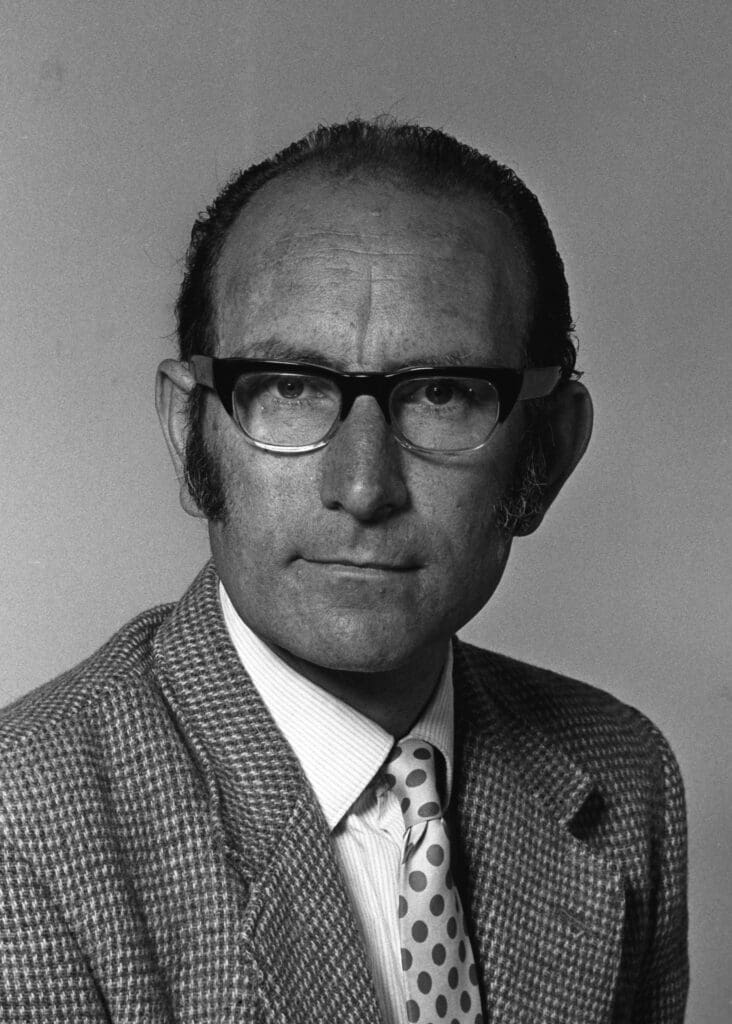
César Milstein was an integral figure to the development of the LMB, from joining the newly formed MRC Laboratory of Molecular Biology in 1963, to generating key discoveries which contributed to the institute’s ongoing success. Specifically, his work transformed the field of immunology, providing previously unknown insights into the structure, function and diversity of antibodies.
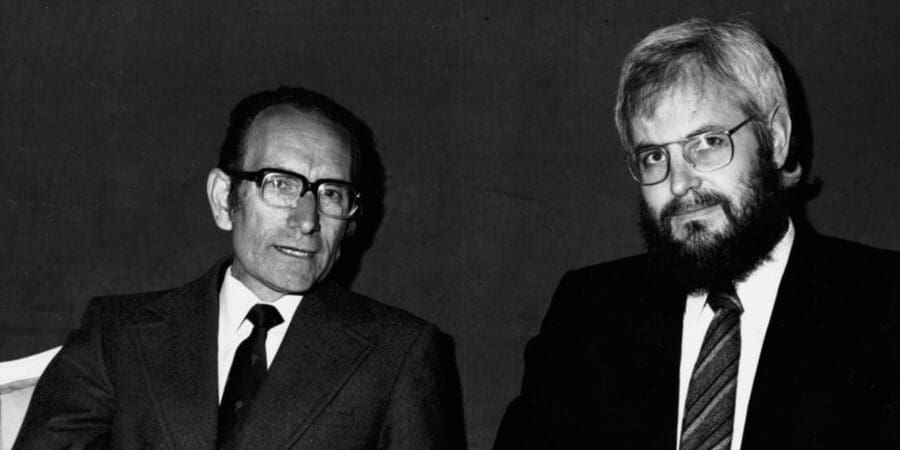
Most notably, together with Georges Köhler, César pioneered a method to produce monoclonal antibodies; a technique which transformed future research and the development of diagnostic and therapeutic treatments for many diseases. For this accomplishment, César and Georges shared the 1984 Nobel Prize in physiology or medicine with Niels Kaj Jerne.
César was born in Bahia Blanca, Argentina, in 1927. His research career began at the University of Buenos Aires where he completed his undergraduate degree and then a PhD studying the enzyme aldehyde dehydrogenase. His aptitude for research was obvious, and his dissertation was awarded ‘best thesis of the year’ from the Argentine Chemical Society.
In 1958, César travelled to the UK to work in the University of Cambridge Biochemistry Department with leading enzymologist Malcolm Dixwell. Here, he obtained his second doctorate, studying the activation of the enzyme phosphoglucomutase. During this period he met Fred Sanger for the first time, and, with César’s short-term Medical Research Council appointment, the pair determined the amino acid sequence of the active site of phosphoglucomutase. César returned to Argentina in 1961, but outbreaks of political disruption hindered his research, so in 1963, he accepted Fred’s offer to return to Cambridge working in the Division of Protein Chemistry at the newly formed LMB.
Fred’s influence led César to pivot his research focus from enzymes to antibodies. Assisted by John Jarvis, with whom he worked with for the rest of his research career, César’s first foray into antibodies was an examination of the disulphide bridges in immunoglobulin light chains within the Bence-Jones protein. This work, taken with other significant papers in 1965 and 1966, revealed that sequence diversity in antibody polypeptide chains was mostly limited to the amino-terminal portions.
César continued his work on antibodies, collaborating with several people across the LMB, including Sydney Brenner, George Brownlee, Terry Rabbitts, David Sacher and Richard Cotton. Much of this work utilised mouse myeloma cell lines (B-cell tumours) cultured in vivo. With Richard, César began his investigations into cell fusion, looking at what happened to immunoglobulin production when two myeloma cells were fused together.
César discussed the results of this work on myeloma fusions in a seminar at the Basel Institute of Immunology. One member of the audience, a PhD student named Georges Kӧhler, was impressed by this work and asked César if he could come and join his group at the LMB. Georges arrived in Cambridge in 1974 and, working closely with César, the pair sought to use cell fusion to produce their own antibody-secreting cell line.
They found quick success by fusing spleen cells from immunised mice (a source of B-lymphocytes which produced antibodies but struggled to survive for long periods in cell culture) and a mouse myeloma line (which were so stable in culture they were referred to as ‘immortal’). The fused cells, which were later named hybridomas, were collected and cloned. These clones could be maintained in culture and represented a significant scientific advancement – the first production of individual, or monoclonal, antibodies with predetermined specificities. This meant that, for the first time, antibody research could be reliably replicated to verify measurements and results. Moreover, the technique provided a route to generate a supply of defined antibodies to use as probes – expanding the toolkit of fundamental biological research. César and Georges’ paper describing this technique was published in Nature in 1975 and, nine years later, the pair were awarded the Nobel Prize in Physiology or Medicine, alongside the theoretical immunologist Niels Jerne.
Following publication, Georges returned to Basel and César spent the next few years working with Giovanni Galfré to demonstrate the applicability of monoclonal antibodies. Giovanni optimised the hybridisation process and increased its reliability by introducing Sendai virus as the fusing agent. The technique quickly spread to research institutes across the world and proved integral to a wide variety of applications including grouping blood types, identifying viruses and testing for pregnancy, cancers, blood clots and heart disease.
Though quickly effective in clinical diagnostics, therapeutic uses of monoclonal antibodies were limited as they inspired a cross-species immune response. This was addressed in the 1980s when, following a suggestion from César to turn his attention to antibodies, Greg Winter developed the technique of phage display to produce humanised antibodies, for which he received a share of the 2018 Nobel Prize in Chemistry.
Further research to develop a method for making fully human antibodies was later used by the MRC spin-out company Cambridge Antibody Technology to develop Humira®, the first fully human monoclonal antibody drug, which was launched in 2003 to treat rheumatoid arthritis. Michael Neuberger, working in the LMB’s PNAC Division, further developed an alternative method for making human antibodies, utilising transgenic mice with human antibody genes. Today, monoclonal antibodies account for at least a third of all new treatments against a range of conditions.
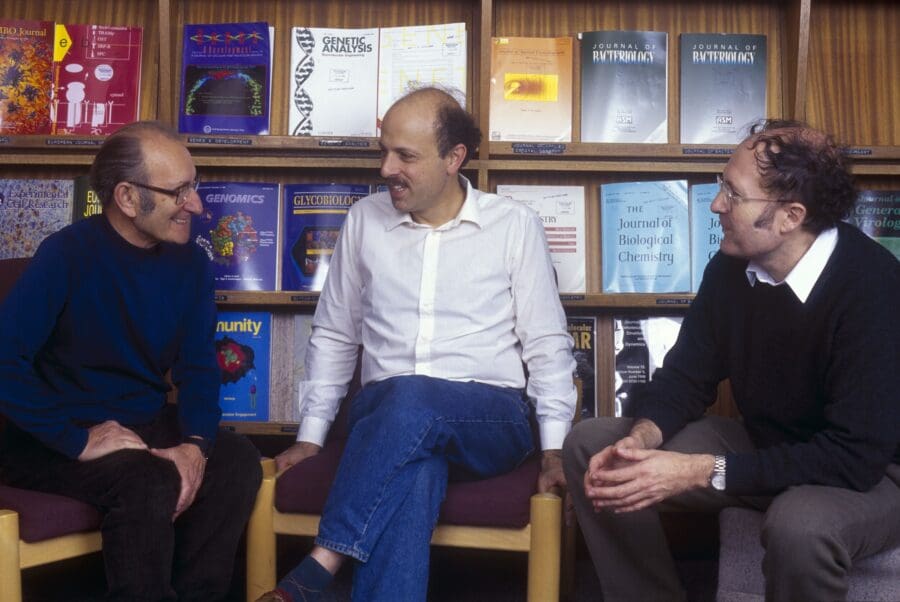
César continued actively researching several aspects of antibodies for the rest of his career, making several key breakthroughs, including solving the puzzle of affinity maturation, the process by which antibodies adapt their sequences to improve their efficacy. In 1981, he became Joint Head of the LMB’s PNAC Division alongside Fred Sanger. He kept this position until 1994, later serving on his own after Fred retired, and then alongside Terry Rabbitts. He also acted as Deputy Director of the LMB from 1987-1995. He officially retired in 1994, though he maintained an active interest in the LMB’s research, continuing to study the mechanism of the immune response and providing insight and guidance to other research groups, particularly Greg Winter’s biotechnological work.
César was elected a Fellow of the Royal Society in 1975, and received the Royal Society Copley Medal in 1989. In 1995, César became a Companion of Honour and in 2000 received the Presidential Medal of Merit for Scientific Excellence from Argentina and the inaugural MRC Millennium Medal.
César died in March 2002, following several years of dealing with heart disease. He was fondly remembered by colleagues at the LMB – aside from his scientific accomplishments, many recalled his aptitude as a chef and his close relationship with his wife Celia Milstein. In 2003, the LMB celebrated his impact by hosting the Milstein Memorial Meeting, where several eminent researchers spoke on how he had impacted their careers. Today César’s legacy is still felt at the LMB, with a Named Lecture given in his honour each year, and through the Milstein Studentship which provides funding for Argentinian Ph.D. students to complete their studies at the LMB.
Further references
1984 Nobel Prize in Physiology or Medicine
From Bench to Blockbuster: The Story of Humira® – Best-Selling Drug in the World
Gillian Griffiths: A PhD with César Milstein
Celia Milstein