Behind the Scenes: Cristina Rada training the next generation of scientists
Cristina Rada joined the LMB in 1989 to pursue a PhD in the PNAC Division with César Milstein after completing a degree in medicine at the Autonomous University in Madrid. She continued at the LMB as a postdoc with César, studying the molecular basis of Somatic Hypermutation in Antibodies. From 2002 Cristina joined Michael Neuberger’s group at the LMB focusing on mechanisms of immunity in the cell nucleus. After Micheal passed away Cristina led an off shoot of his group before transitioning to Director of Studies in 2018. In the latter role, Cristina oversees students joining and working in the LMB.
Here she reflects on her evolving career at the LMB, from her studies in immunology into helping young students find their way in science.
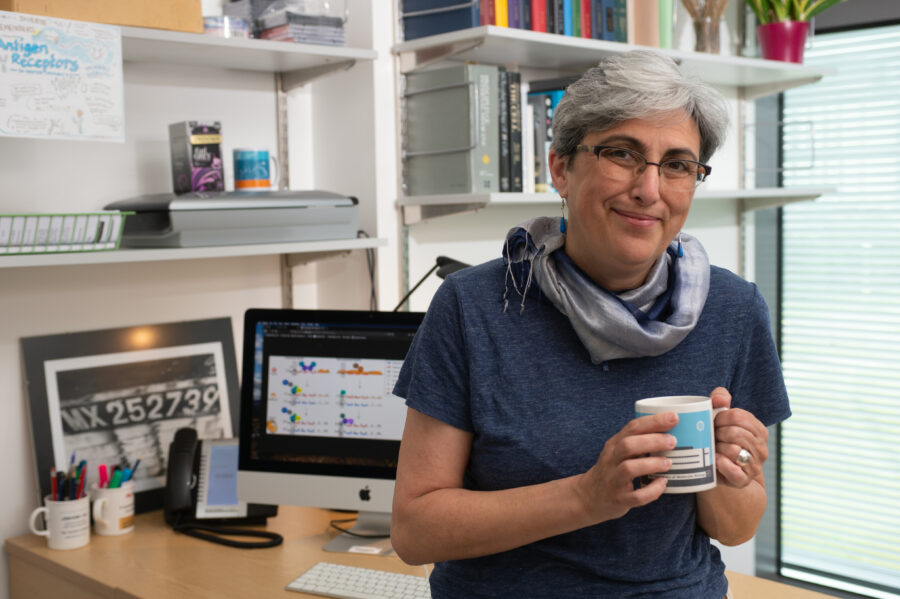
Before the LMB: medical training to PhD
As an undergraduate I spent a couple of summers as a summer student at the Babraham Institute in Cambridge. This is where I started to learn more about science in the UK, and science in Cambridge in particular. It hooked me and after I finished my medical degree in 1986, I quickly became interested in pursuing a PhD instead of doing further medical training.
I worked for a year as a research assistant in Babraham, then I applied to all kinds of scholarships and fellowships to fund the PhD. I started my PhD with the LMB in 1989 because it took some time to get my own funding.
I was really excited to be part of César Milstein’s group when I joined the LMB, it was life changing for me. By the time I came he already had his Nobel Prize, but he was very approachable. He was fun and rather informal; during discussions, he made you think that it was your idea …and that worked in reverse as well. When you wanted something, you just took to it to him and made him think that it was his idea and then he will get excited about it; we had this constant dialogue.
Discovering the process of antibody somatic hypermutation
I became fascinated by immunology after attending the 1989 Cold Spring Harbor symposium, which gave me a broad insight into the field. My PhD project was working on antibody diversity, trying to understand somatic hypermutation and the maturation of immune responses. The project was moving fast, with many groups around the world trying to figure out what the molecular basis of somatic hypermutation was, which I found stimulating.
After finishing my PhD in 1993 I continued to work on understanding the molecular basis of somatic hypermutation; this became an ongoing project that took approximately 20 years. However, by the end of it, we got a neat answer explaining that the process of somatic mutation involves a specific enzyme, and it also involves recruiting the repair mechanisms of the cell. It was about 2002 that Michael Neuberger’s team, and me with it, hit the nail on the head and finally managed to figure how it works. Having been a part of that discovery was really fun.
Family life at the LMB
I had my daughter in the middle of writing my thesis. After the PhD I was trying to decide what my next step would be. That’s where career and family become complicated. I was lucky that César asked me if I wanted to stay for a couple of years for a postdoc, so I took the opportunity. After I made the decision to stay, I realised this is the best place to do science.
One of the things that I found most frustrating was having to rush from the lab and then to the nursery whilst juggling experiments which often made you late. Back then there wasn’t any maternity leave, but now our students get maternity cover which is much more generous than it was previously – it considers that people have lives outside of work.
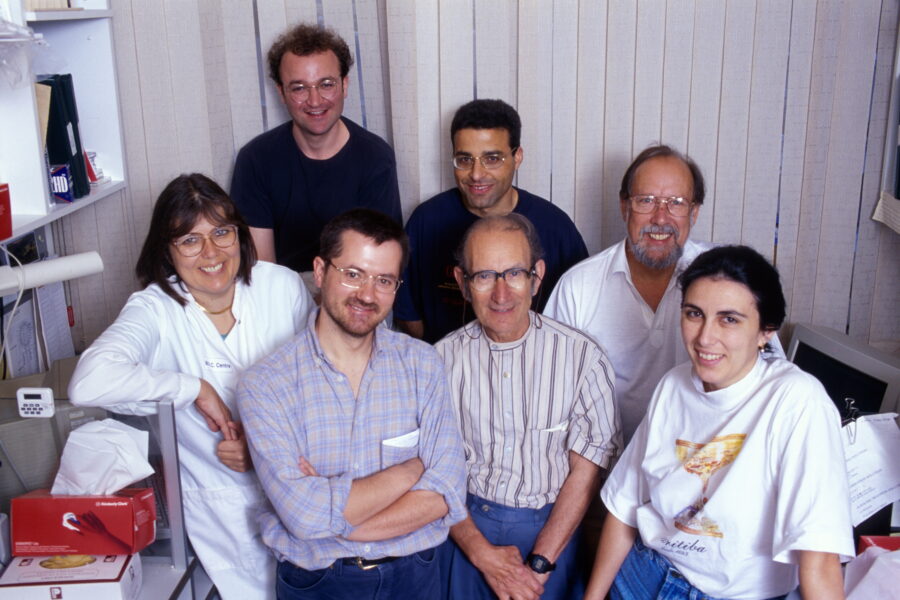
Back L-R: Adrian Woolfson, Said Aoufouchi and John Jarvis.
Front L-R: Caroline Napper, José Yélamos, César Milstein and Cristina Rada
Stand out discoveries – ‘A kind of eureka moment’
I’m very proud of a couple of things. When we were looking at somatic mutation, we were really puzzled by the fact that there were all these cellular repair systems that normally prevent mutations. One of the discoveries that I made as a postdoc is that if you suppress the DNA repair system, you also reduce the mutation. So that implies that DNA repair, the mismatch repair in this case, was required to generate the mutations rather than suppress them. And that was a huge surprise.
One of the other exciting discoveries from looking at the pattern of mutations, was that there were two types of processes; one that was targeting GC pairs and one that was targeting AT pairs. We had this “mutator factor” that was initiating the whole process, but it was clear that one type of mutations was happening first, and the other one was an amplification of that one. So that gave us a lot of insights about the mechanism. When I first came up with that idea for a “two phase mutation” process, I went to talk to César and Michael who asked if I was sure about it. I was certain about the theory. Those that are the exciting moments that keep you going for another ten years. It was a kind of eureka moment where you think, ‘ah I did that!’.
Keep going… ‘people are quite generous with their brains’
In research, there are long periods where nothing happens. We spent five or six years, where everybody was trying to get a new way of discovering this mutator. Scientists from around the world were trying to get it, and the approaches that we were using were very similar, and it just didn’t work, until somebody else found out the actual enzyme. So, when you overcome the initial disappointment, you think, keep going! There are so many more questions that we can ask!
I’m privileged because I managed to follow up this one scientific question for almost all my scientific career. That’s not very common. And I was able to do that in a place like the LMB, which has amazing resources and great people. The whole scientific culture is great, it has this kind of non-hierarchical structure, so that people are quite generous with their time and brains.
You don’t do science in your shed with all your little toys. You do science with other people. And I think that’s why this place is so successful, because it’s very easy to interact. People at the LMB love discussing science, and because the funding is shared people are quite happy to share, which is unique to this place. I think that’s what they mean with a shared scientific culture. This is one of the things I’m trying to communicate to the students that come here in my current job. If you want to really do serious, difficult science, having an environment that facilitates that is important.
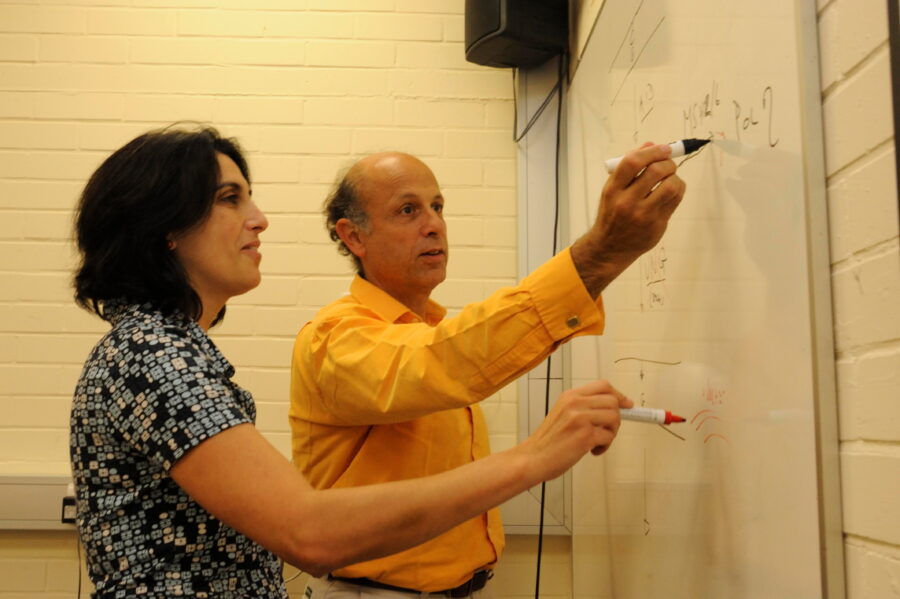
Becoming the Director of Studies and training the next generation of scientists
Becoming the Director of Studies in 2018 has probably been the most rewarding job in my whole career. I started doing the job part time whilst I was still running my group, but the problem was that we have quite a lot of students. When I first came for my PhD, there were nine students in the whole building. Now we have more than 110 and looking after them has become a full-time job. Young people really keep you on your toes, and the role feels more impactful because it’s training the next generation of scientists. I have made my contribution to my little portion of science, but now I’m able to help people start their careers as scientists which I think is quite rewarding.
Selecting the students – ‘It’s almost like matchmaking’
LMB students are registered with the University of Cambridge. They get the best of both worlds, because they get all the facilities from the university and they’re based at one of the top research institutes in the world. It’s like a playground for students.
The students that come here are expected to learn on the job. When they apply, they’re already selecting which topics they’re interested in and which groups they want to join. They come in and from their first day they’re doing research, they are treated like scientists from day one.
We receive more than 400 applications per year, from all over the world. We shortlist candidates, and then we invite them to visit the LMB and have interviews. They get to know the other students that are here already and then they get to meet the group, and it’s almost like matchmaking. At the end of the process, we will get about 20 to 25 students to join.
After having been a full-time scientist and a group leader for many years I was a little bit ambivalent about the next phase of my career. However, the job as Director of Studies quickly became all engaging. I’m very privileged to help other people with their discoveries. I read all the students first year reports, and I chair their first-year talks, so I know what all the students are doing.
My job is to make sure they’re successful and to help enable them to do whatever is best for their project and their careers, which is quite satisfying. You can’t always solve all the problems but most of the time it just means that you’re helping the next young person on the next stage.
Students are fearless
Having new students is great, because they’re fearless. They have crazy ideas – they are unencumbered by experience and failure. They’re optimistic and say, ‘yes this is going to work.’ It is that determination you sometimes need to make progress. You also need to be creative and dedicated as well. Sometimes it can be all consuming. Finding ways of dealing with that intensity and to not let it take over your life is also quite important because you may need to step away and take a break, so your brain is fresh.
Student placement schemes
One of the things I feel strongest and most passionate about here as Director of Studies is the student placement schemes, including widening participation schemes. It is life changing if you get into science early on and you get the opportunity to see good science as an undergraduate. We get 12 to 16 summer student interns every year and most of them go on to do science.
I’m also very happy to be involved with the César Milstein studentship, which is directed to Argentinian students. We have one every year and I love being involved, making sure that this is publicised and that the Milstein scholars are looked after because this is held in the PNAC Division where César did his work. I feel in some ways the Milstein scholars are shortchanged because they don’t get to interact with César directly like I did, but I’m quite happy to help the LMB keep that connection going.