Articles
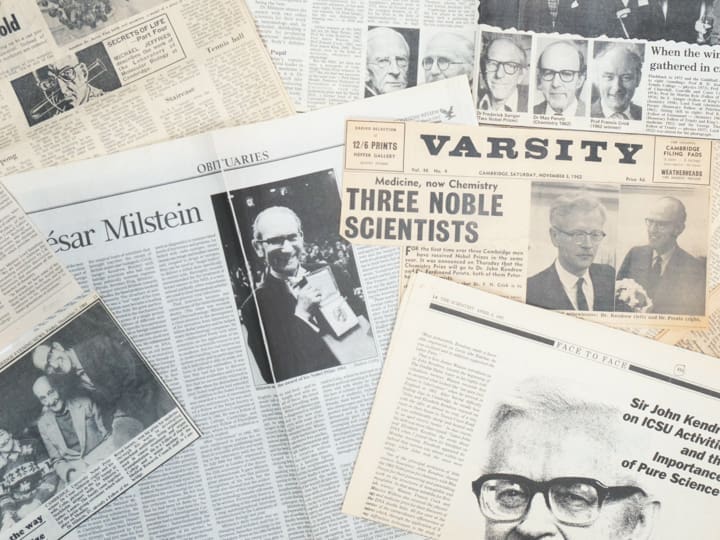
The LMB Archive collates scanned/digitised newspaper, magazine and web articles that relate to the activities of the LMB. This database lists the articles that have been catalogued so far.
These articles are the copyright of the originating organisation. They may be accessed for reference-only purposes at the LMB. Alternatively, you can contact the copyright holder for direct requests to access or use their articles.
For recent news stories from the LMB, please see our Latest News page.
Please contact the Archive if you have any questions about this database.
Search the Articles
Showing all articles.
-
Man-made cell that produces plastics and medicines hailed as revolutionary in biologyAuthors Blakely, Rhys Source The Times 4 June 2021 Year 2021
Details
Subject Jason Chin’s group have created a new type of cell capable of producing substances such as plastics and medicines in a way not seen in the natural world Keywords Jason Chin; biodegradable plastics; antibiotics; synthetic chemistry; polymers; codons; tRNA; monomers; polymers; genome; genetic code; amino acid; bacteria -
Maria LeptinAuthors European Research Council Source European Research Council 2 July 2021 Year 2021
Details
Subject Maria Leptin is the new President of the European Research Council. Since her postdoc position in Michael Wilcox’s group at the LMB, Maria has been a Group Leader at the Max Planck Institute for Developmental Biology, led a research group at EMBL and served as Director of EMBO Keywords Maria Leptin; President; European Research Council; Michael Wilcox; EMBO; alumni -
Mary Overton Fellowship: Worms the key to understanding brainsAuthors Flinders Foundation Source Flinders Foundation 8 July 2021 Year 2021
Details
Subject Yee Lian Chew is the recipient of the Flinders Foundation’s Mary Overton Senior Research Fellowship in Neuroscience. Keywords Yee Lian Chew; Finders Foundation; Mary Overton Senior Research Fellowship; Nematodes; worm; neurons; chronic pain; neurodegenerative disorders; award; alumni -
Mini-brains used to study development and diseaseAuthors Brackley, Paul Source Cambridge Independent 29 September 2021 Year 2021
Details
Subject Madeline Lancaster has earned a Vallee Scholarship for pioneering work using cerebral organoids, which are helping her group to answer fundamental questions Keywords Madeline Lancaster; ‘mini-brains’; Covid-19 virus; cerebral organoids; human stem cells; Petri dish; floating balls; SARS-CoV-2; Vallee Foundation; prize; neurons; “Great Apes’; Matrigel; neurological diseases -
‘Mini-brains’ research brings neural development breakthroughAuthors Cookson, Clive Source Financial Times 24 March 2021 Year 2021
Details
Subject Madeline Lancaster leads a team that have identified a key genetic switch that ensures humans develop much bigger brains than apes, an important step in the scientific understanding of neural development. Keywords Madeline Lancaster; mini-brains; cerebral organoids; apes; ZEB2; chimpanzee; neurons; human brain; radial glia; genetic switch; progenitor cells -
Next generation GM using synthetic bacteria paves way for materials revolutionAuthors Highfield, Roger Source Science Museum Blog 4 June 2021 Year 2021
Details
Subject Jason Chin team have found a way to create a synthetic bacterium to make proteins composed of novel amino acids, designed by scientists, that lie beyond the canonical 20 found in nature. Keywords Jason Chin; amino acids; synthetic bacterium; viruses; E. coli; genetic code; codon; Syn61; polymers; monomers; antibiotics; macrocycles; biodegradable plastics -
Scientists discover why the human brain is so bigAuthors Sample, Ian Source The Guardian 24 March 2021 Year 2021
Details
Subject Madeline Lancaster’s group have shed light on the why humans develop much bigger brains than apes, an important step in the scientific understanding of neural development. Keywords Madeline Lancaster; large brains; “brain organoids”; apes; ZEB2; human; chimp; progenitor cells; neural; switch -
Scientists reprogrammed bacteria to be immune to virusesAuthors Nicoletta Lanese Source Live Science 03 June 2021 Year 2021
Details
Subject Scientists created a synthetic genome for a bacterium by stringing together building blocks of DNA — and the new genome made the microbe immune to viral infection. Keywords E.coli Bacteria Wesley Robertson Amino Acids DNA Chromosones TCG TCA -
Scientists uncover circadian rhythm in heart cellsAuthors UKRI News Source UKRI News 15 October 2021 Year 2021
Details
Subject Study done by the LMB has shown how circadian rhythms in heart cells help to change heart function and may explain why shift workers are more vulnerable to heart problems Keywords Circadian rhythms; ions; AstraZeneca; Blue Sky Initiative; heart function; heart cells; internal clock; John O’Neill; cardiac; shift work; sleep patterns; heart rhythms -
Sir Dai Rees obituaryAuthors Winter, Greg Source The Guardian 25 July 2021 Year 2021
Details
Subject Sir Dai Rees who revolutionised the way the Medical Research Council (MRC) interacted with industry has died. Sir Greg Winter looks back on his life and career. Keywords Dai Rees; Keytruda antibody Humira; polysaccharide chemist; polymers; Unilever; Mr Whippy ice cream; LifeArc; MRC Collaborative Centre; NIMR; Centre for Protein Engineering; Cambridge Antibody Technology (CAT)