LMB Developed Software
Many LMB groups write or contribute to scientific software and, wherever possible, this work is released as open source for the benefit of the wider scientific community.
Bioinformatics
The Unknome (Sean Munro, Tim Stevens and Matthew Freeman)
The human genome encodes around 20,000 proteins, many of which are still uncharacterised. The Unknome database ranks proteins based on how little is known about them. It is intended to aid the selection of poorly characterised proteins from humans and model organisms so that they can be targeted for investigation.
Cellular Imaging & Neuroscience
NemaMod (Lidia Ripoll-Sánchez, Schafer group)
NemaMod is an interactive website used to visualise and explore the neuromodulatory connections of the worm Caenorhabditis elegans. Information about the development and construction of the website is available on GitHub.
Neuromodulatory brain networks toolbox (Lidia Ripoll-Sánchez, Schafer group)
This toolbox, available on GitHub, is a collection of MATLAB tools for the analysis of large dense brain networks. It includes functions for the construction of neuromodulatory networks combining expression (scRNAseq), structural (EM) and biochemical (deorphanisation of receptors) data, as well as other functions for the analysis of large complex brain networks.
Computational Morphometry Toolkit (CMTK) (Gregory Jefferis)
Gregory Jefferis’s group has contributed to the development of a simple front end for CMTK, a software toolkit for computational morphometry of biomedical images that comprises a selection of command line tools and a general-purpose library for processing and input/output.
Fiji (Albert Cardona)
Albert Cardona’s group has contributed to Fiji, an image processing package based on NIH’s ImageJ, targeting the tools towards 3D analysis of biological images, especially brains.
Natverse (Gregory Jefferis)
Natverse is a collection of interoperable R packages to import, visualise, analyse, manipulate and export 3D neuroanatomical data, including neurons, brains and brain regions. It has been used to study brain and circuit organisation in species from flies to fish and mice.
Structural Biology
Much of this software is distributed by CCP4 and/or CCP‑EM, and can be executed as standalone programmes or via a number of graphical interfaces including Coot, CCP4i, CCP4i2, CCP4 Cloud, CCP-EM and CCP4mg.
AceDRG (Fei Long)
AceDRG is a stereo-chemical description generator for monomers/ligands. It encapsulates information about local chemical and topological environments derived from the Crystallography Open Database and uses this information to derive ideal bond lengths, angles, etc. for an unknown monomer/ligand. AceDRG can also generate the same information on a covalent link between two monomers.
Coot (Paul Emsley)
The Crystallographic Object-Oriented Toolkit (Coot) can be used for macromolecular model building, model completion and validation and is particularly suitable for protein modelling using macromolecular crystallography and cryo-EM data. Coot displays maps and models and allows model manipulations such as idealisation, real space refinement, manual rotation/translation, rigid-body fitting, ligand search, solvation, mutations, rotamers, Ramachandran plots, skeletonisation, non-crystallographic symmetry and more.
cryoEF (Christopher Russo and Katerina Naydenova)
The orientation distribution of a single-particle cryo-EM specimen can limit the resolution of the reconstructed density map if the particles are not randomly oriented on the support surface. CryoEF can be used to analyse such data and describe the quality of an orientation distribution in terms of providing uniform resolution in all directions, by a single number – the efficiency. The cryoEF programme assists in determining to what extent this affects the resolution of a 3D reconstruction.
ModelAngelo (Kiarash Jamali and Sjors Scheres)
ModelAngelo is a machine learning approach for automated atomic model building in cryo-EM maps. By combining information from the cryo-EM map with information from protein sequence and structure in a single graph neural network, ModelAngelo builds atomic models for proteins that are of similar quality to those generated by human experts. For nucleotides, ModelAngelo builds backbones with similar accuracy to those built by humans. By using its predicted amino acid probabilities for each residue in hidden Markov model sequence searches, ModelAngelo outperforms human experts in the identification of proteins with unknown sequences.
MRC Image Processing Software (Richard Henderson)
This is a collection of around 80 computer programmes written by LMB members over the last 40 years in FORTRAN or C for processing 2D crystal and helical electron microscope images. The visualisation and manipulation programme Ximdisp is based on a home-written library of X-Windows subroutines. File reading/writing requirements for all the programmes are provided by a subset of CCP4 subroutines to maintain compatibility with CCP4 MAPFORMAT.
Progres (Joe Greener)
Progres, available as a web server and as software, uses a graph neural network to embed protein domains. This embedding is used to search against pre-embedded structural databases, including the AlphaFold database TED domains for fast protein structure searching. Searching typically takes 1-2 seconds and is much faster for multiple queries.
REFMAC5 (Garib Murshudov)
REFinement of MACromolecular Structures (REFMAC5) uses the maximum likelihood method and some elements of Bayesian statistics to perform full model refinement and map calculation. Originally designed for use with data from macromolecular crystallography, REFMAC5 has been adapted and extended to support data from other sources including cryo‑EM.
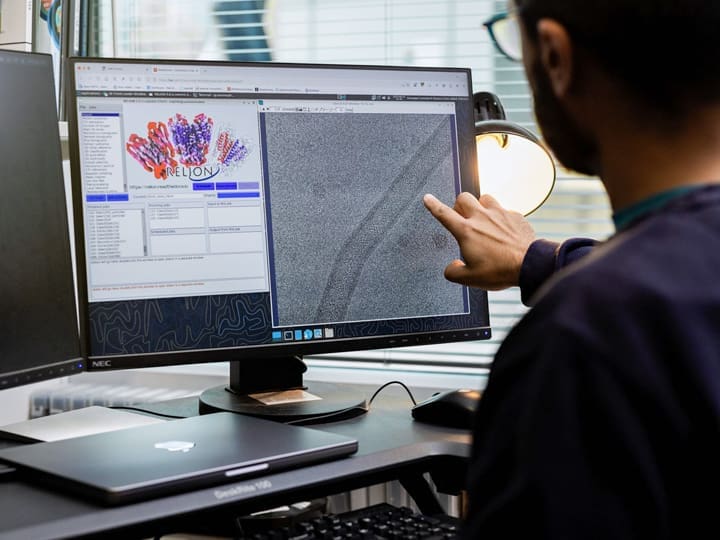
RELION (Sjors Scheres)
Regularised Likelihood OptimisatioN (RELION) is a standalone computer programme for Maximum A Posteriori (MAP) refinement of (multiple) 3D reconstructions or 2D class averages in cryo-EM. Briefly, the ill-posed problem of 3D reconstruction is regularised by incorporating prior knowledge: the fact that macromolecular structures are smooth, i.e. they have limited power in the Fourier domain. In the corresponding Bayesian framework, many parameters of a statistical model are learned from the data, which leads to objective and high-quality results without the need for user expertise.
Servalcat (Keitaro Yamashita)
StructurE Refinement and VALidation for Crystallography and single pArTicle analysis (servalcat), the successor to REFMAC, is developed by Keitaro Yamashita at the University of Tokyo in Japan.