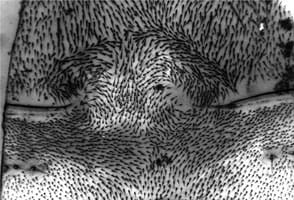
I did my PhD (1962-65) with the great insect physiologist Vincent Wigglesworth. I chose a large problem and worked on various aspects of it full time for almost exactly 60 years: how are animals designed and built?
In 1969, I was invited by Sydney Brenner and Francis Crick to the LMB Cell Biology Division. I made contributions to developmental biology; I was a pioneer in analysing how morphogen gradients drive both pattern and polarity and a joint discoverer of compartments in development. Ginés Morata and I found evidence that homeotic genes build a binary genetic address used to specify the developmental fate of defined groups of embryonic cells.
I believe that genetics is the “master science of biology” (Brenner) and I used genetic mosaics to illuminate how a complex animal is designed and patterned.
From the early 1990s, José Casal and I continued to research mechanisms of animal design and pattern formation in Drosophila using both molecular and genetic techniques. We collaborated particularly with Struhl (Columbia, NY.)
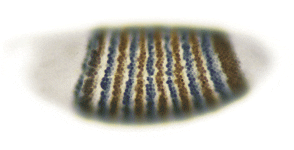
We made discoveries that changed the field of planar cell polarity (PCP). For example, we found that Flamingo (aka Stan) is a key molecule: exchange of polarity information occurs via homodimers of Flamingo that form bridges from cell to cell. There are two genetic systems responsible for PCP – the Stan system and the Dachsous system – and we showed that these can act independently.
Sixty years ago I proposed that the arrow of polarity in each cell is drawn by the orientation of a molecular gradient. It took many of those 60 years to build and test evidence for this hypothesis, to identify the molecules involved – Dachsous and Frizzled – and finally to demonstrate and measure the two pertinent gradients in vivo.
After my retirement in 2006, Casal and I left the LMB and moved to the University of Cambridge’s Zoology Department where, supported largely by the Wellcome Trust, we continued to unravel the mechanisms of PCP until 2023.
I am a critic of many aspects of modern science. I believe that the LMB was an experiment that worked brilliantly and that its success provides arguments to resist the current fashions and policies in scientific practice.