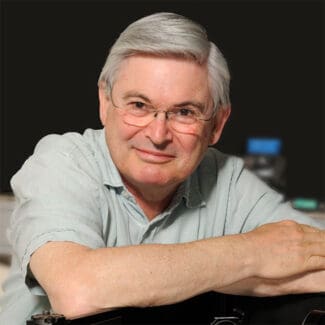
After my PhD in mechanistic chemistry in 1968 and a year’s postdoc, I joined the LMB as a Group Leader in 1969, where I worked on enzyme mechanisms and shared a lab with Max Perutz, who became my mentor. In 1977, I was appointed to succeed Dorothy Hodgkin as the Wolfson Research Professor of the Royal Society, held at Imperial College. In 1981, I began my long collaboration with Greg Winter in developing protein engineering. In 1988, I was invited back to the University of Cambridge as the Herchel Smith Professor of Organic Chemistry. The MRC, which had supported my work at Imperial College, set me up with the MRC Unit of Protein Function and Design, and created the MRC Centre for Protein Engineering (CPE), where I was Director and Greg was Deputy Director. After retiring in 2010, I rejoined the LMB, where I continued this work on protein folding, misfolding and disease, concentrating on the tumour suppressor p53 in laboratory work until the end of 2017.
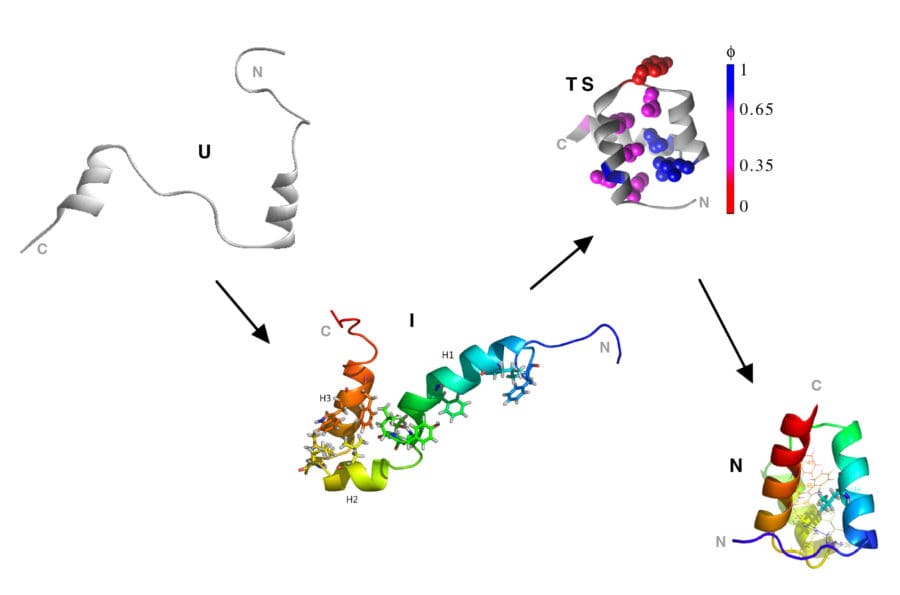
I pioneered protein engineering as a tool for quantitatively analysing the role of non-covalent interactions, first in mediating enzyme catalysis and specificity and then protein stability and determining protein folding pathways at atomic resolution. I was elected a member of EMBO, 1980; a Fellow of the Royal Society, 1983; an honorary foreign member of the American Academy of Arts and Sciences, 1993; Foreign Associate of the National Academy of Sciences (USA), 1993; Fellow of the Academy of Medical Sciences, 2007; Foreign Member of the American Philosophical Society, 2008; Foreign Member of the Accademia Nazionale dei Lincei, 2013. Among my prizes have been Medals of the Royal Society: Gabor (Interdisciplinary); Davy (Chemistry); Royal Medal (Physical Sciences); and Copley (Biological Sciences). In 1983, I was knighted for my services to protein science. I now maintain my interests in protein folding and misfolding.