Noe Rodriguez
Investigation of immunity and neuro-immune modulation in infection and cancer

The immune system requires precise fine-tuning and body-wide coordination to protect us against environmental challenges while preventing collateral damage to our organism and avoiding autoimmunity. The nervous system represents the ideal network of connections that can coordinate and regulate immune responses, and evidence in recent years indicates neuro-immune interactions impact immune homeostasis.
Our group aims to deepen our understanding of neuro-immune crosstalk and determine its relevance in immunity against pathogens and cancer. We would like to dissect which cellular and molecular elements are central to the communications of neurons with immune cells and how neuronal cues impact innate and adaptive immunity.
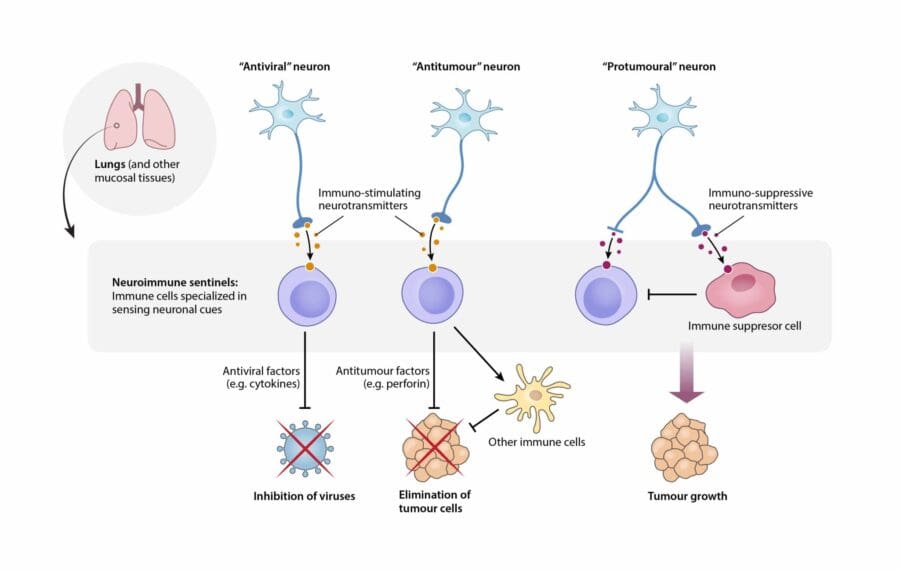
Applying interdisciplinary methodologies from the fields of neuroscience and immunology, such as optogenetics and flow cytometry, we are exploring at a granular level how different subsets of neurons modulate immune reactions at barrier tissues. Our approach focusses on precisely targeting neurons with diverse molecular strategies and identifying the immune cells specialised in sensing neuronal signalling. In addition to applying cutting-edge light microscopy and high-dimensional techniques such as spectral cytometry or single-cell RNA sequencing to answer these questions, we are developing new in vitro models to study chemical and physical interactions between neurons and immune cells.
By implementing preclinical models and in vivo and in vitro screenings, we hope to unravel how the two most fascinating and intricate systems in our bodies, the immune and the nervous systems, work in harmony to promote homeostasis and protection against internal and environmental challenges.