
Group Leader

Felix Randow

Cell-autonomous and innate immunity

Felix Randow
Group Members
  • Keith Boyle
  • Alexander Heatley
  • Briac Lemetais
  • Thomas Mund
  • Prathyush Pothukuchi
  • Marcel Rühling
  • Felix Scharte
  • Emily Schierig
  • George Winder
  • Chi Jie Matthew Yip

Our group investigates how individual human cells defend themselves against pathogens. We are inspired by the remarkable ability of unicellular organisms to resist infections entirely through cell-autonomous defences. Our goal is to identify principles of cell-autonomous immunity in mammals and how these synergise with professional immune cells. Through an understanding of cell-autonomous immunity, we intend to develop novel strategies against infectious diseases.

While investigating how human cells protect themselves against cytosol-invading bacteria, we identified two layers of cellular defence. The first involves anti-bacterial autophagy, activated when bacteria damage phagosomal membranes upon entering the host cytosol. This damage exposes sphingomyelin and glycans — molecules normally hidden inside intact phagosomes — for detection by TECPR1 and galectin-8, respectively. We are currently investigating both how sphingomyelin is gradually exposed on stressed but otherwise intact membranes and how its detection by the TECPR1/ATG5/ATG12 complex results in conjugation of mammalian ATG8 to target membranes.
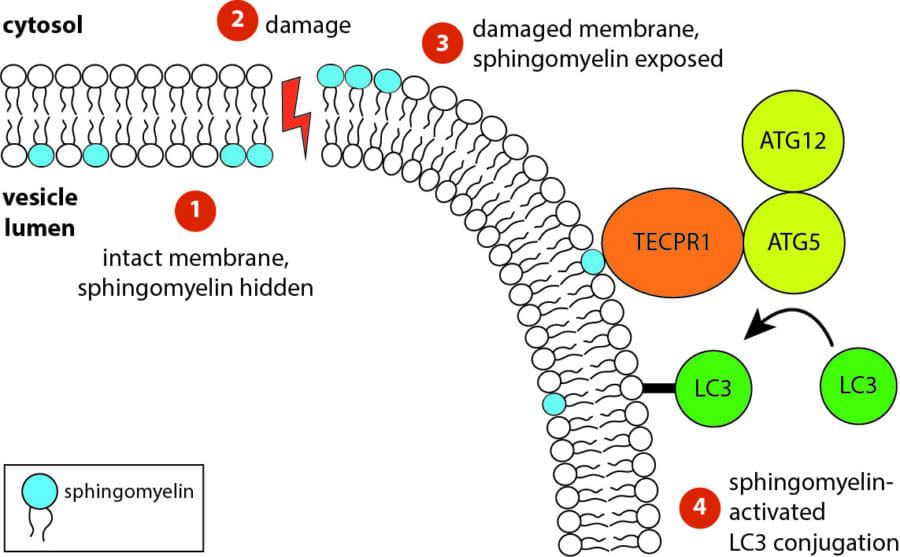
A scientific diagram illustrating the process of sphingomyelin-activated LC3 conjugation in response to membrane damage. The diagram shows a sequence of four labelled steps, depicting intact and damaged membranes with sphingomyelin exposure. Key proteins involved, such as ATG5, ATG12, TECPR1, and LC3, are labelled, highlighting their roles in the vesicle lumen and cytosol. The damaged membrane is characterised by exposed sphingomyelin, which triggers the conjugation process
Sphingomyelin exposed on damaged phagosomes is sensed by TECPR1 for conjugation of LC3 to single membranes (CASM) (Boyle et al., EMBO J, 2023).

The second line of defence targets bacteria no longer in contact with damaged membranes. These bacteria are transformed into pro-inflammatory and anti-bacterial signalling platforms through cytosolic sensor proteins that trigger the deposition of polyvalent protein coats onto the bacterial surface. Of particular interest to us are the formation of non-canonical inflammasomes triggered by GBP1 and the ubiquitylation of bacterial lipopolysaccharide by RNF213, the first E3 ubiquitin ligase known to target a non-proteinaceous substrate. Ongoing efforts are aimed at understanding how RNF213 restricts pathogens that lack lipopolysaccharide and the identification of RNF213 substrates in non-infected cells.
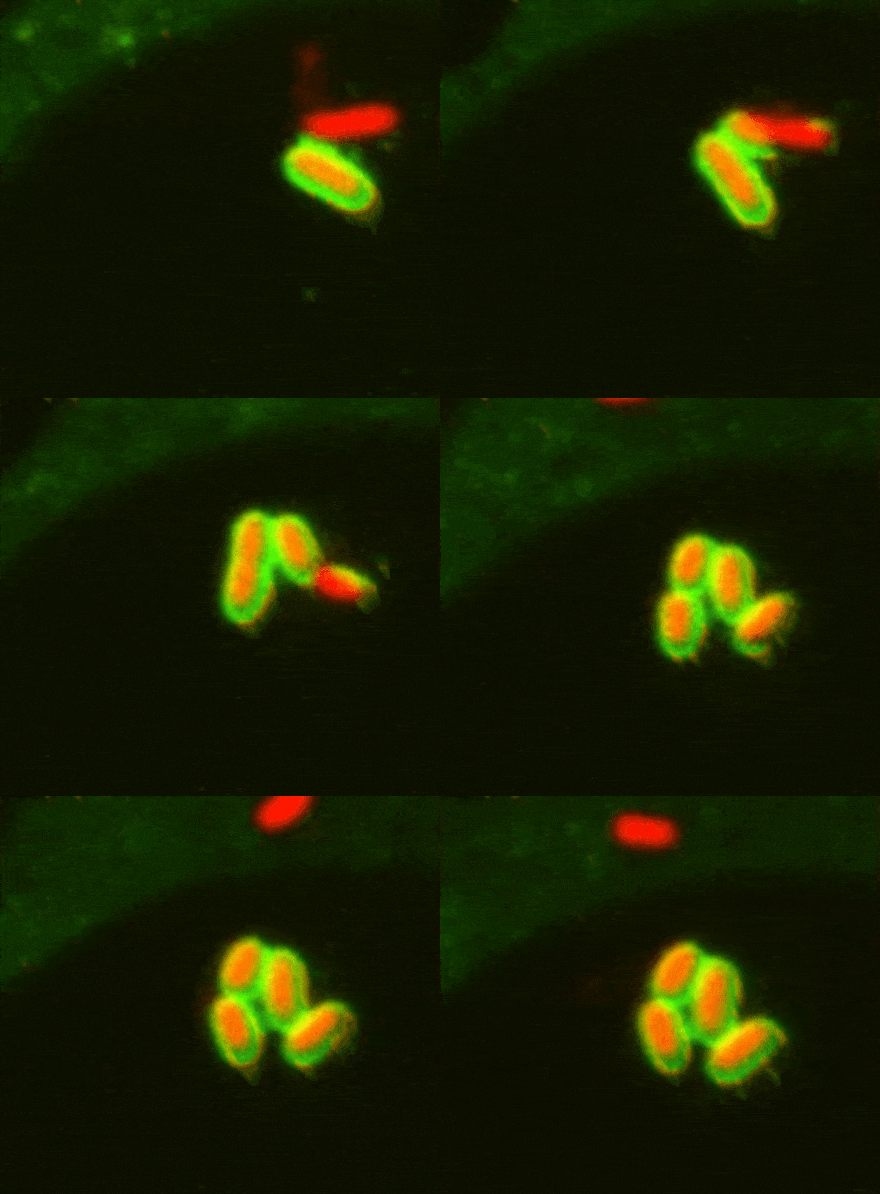
Fluorescent micrograph showing rod-shaped bacteria: one red, and another green with central yellow fluorescence.
The E3 ligase RNF213 (green) attacks Salmonella (red), resulting in ubiquitylation of lipopolysaccharide (Otten et al., Nature, 2021).

Selected Publications

Shigella flexneri evades LPS ubiquitylation through IpaH1.4-mediated degradation of RNF213.Naydenova K, Boyle KB, Pathe C, Pothukuchi P, Crespillo-Casado A, Scharte F, Hammoudi PM, Otten EG, Alto NM, Randow FNat Struct Mol Biol 32(9): 1741-1751 (2025)
TECPR1 conjugates LC3 to damaged endomembranes upon detection of sphingomyelin exposure.Boyle KB, Ellison CJ, Elliott PR, Schuschnig M, Grimes K, Dionne MS, Sasakawa C, Munro S, Martens S, Randow FEMBO J 42(17): e113012 (2023)
Ubiquitylation of lipopolysaccharide by RNF213 during bacterial infection.Otten EG, Werner E, Crespillo-Casado A, Boyle KB, Dharamdasani V, Pathe C, Santhanam B, Randow FNature 594(7861): 111-116 (2021)
Galectin 8 targets damaged vesicles for autophagy to defend cells against bacterial invasion.Thurston TL, Wandel MP, von Muhlinen N, Foeglein A, Randow FNature 482(7385): 414-8 (2012) Epub