Sean Munro
Functional organisation of the Golgi apparatus

A defining feature of eukaryotic cells is a system of cytoplasmic organelles connected by membrane trafficking pathways. Central to this system is the Golgi apparatus, a stack of flattened compartments or cisternae that receives newly-made lipids and secretory and membrane proteins, adds glycosylation to many and then sorts them to their final destinations. Transport vesicles continuously arrive and depart from the Golgi, while the Golgi resident membrane proteins that are crucial for protein and lipid glycosylation remain in place despite a constant flow of secretory cargo.
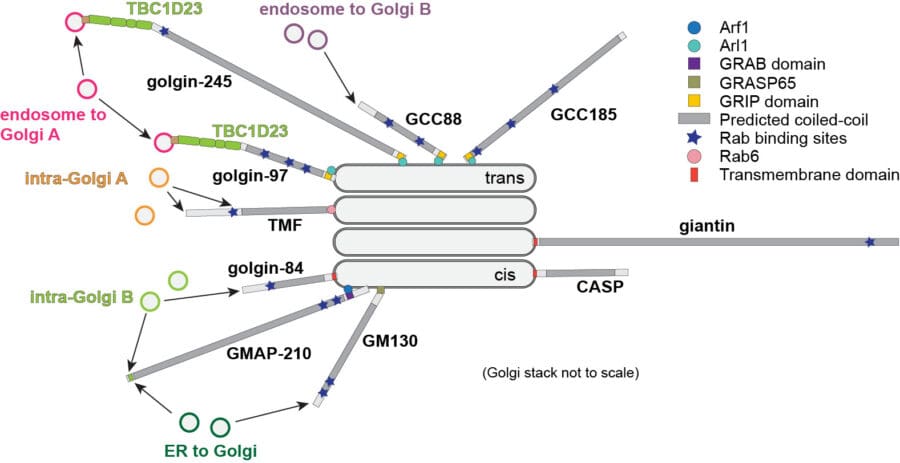
Our group focusses on understanding these processes. We examine how vesicles arriving at the Golgi are captured by the golgins, a family of long coiled-coil proteins that project from the surface of the Golgi to capture specific classes of vesicle that are destined for individual cisternae. One class of such vesicles are those that recycle Golgi residents within the stack while the cisternae progress forwards to transport the secretory cargo. We also examine how Golgi residents are recruited specifically into these vesicles so that they can recycle while the secretory cargo remains in the progressing cisternae. By understanding how the content and destination of vesicles are determined, we aim to reveal the principles by which the Golgi is organised.