
Group Leader

Andrew McKenzie

Investigation of immune and haematopoietic disorders

Andrew McKenzie
Group Members
  • Pratiksha Bhat
  • Michael Chavanga
  • Paula Clark
  • Ana Carolina Ferreira
  • Mayuri Gogoi
  • Emma Griffiths
  • Helen Jolin
  • Michelle Ko
  • Julia Komorowska
  • Shi Lu Luan
  • Ntombizodwa (Tombi) Makuyana
  • Molly Stevenson

The immune system is fundamental to protecting the host from infection whilst constraining autoimmunity, inflammation (e.g. asthma and allergy) and immunopathology. This is achieved via innate mechanisms and immune memory which are often localised in specific tissue microenvironments or lymphatic organs but can act throughout the body. We focus on understanding and characterising the intercellular molecular messengers and intracellular transcriptional pathways that regulate innate and adaptive lymphocyte differentiation, commitment and function in health and disease.
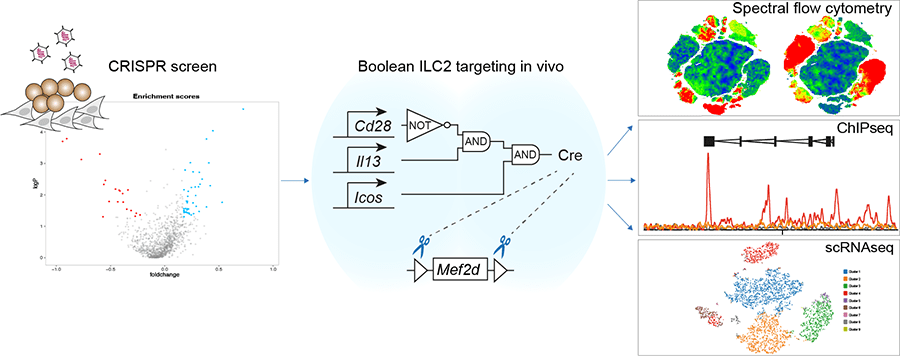
Integrated workflow showing CRISPR screening, Boolean ILC2 genetic targeting, and multi-omics analysis including flow cytometry, ChIP-seq, and scRNA-seq.
Discovery pipeline for regulators of lymphocyte differentiation and function.

By creating innovative genetically modified mouse models (e.g. gene reporter and Boolean mice) and combining them with functional CRISPR screening, single cell gene expression analysis and fluorescence imaging, we have identified and characterised previously unappreciated roles for immunoregulatory molecules and pathways. These include factors that foster immune cell/cell interaction (integrin αvβ3 in Th2 cells), promote epigenetic modification to enhance immune gene expression (ADNP) and act in feedback loops to enhance or counterregulate inflammation (Mef2d and LIF). Our studies aim to provide mechanistic insight into how these molecules regulate immunity at the cellular and organismal level during homeostasis, inflammation, infection and cancer, and whether they can be targeted therapeutically in humans.
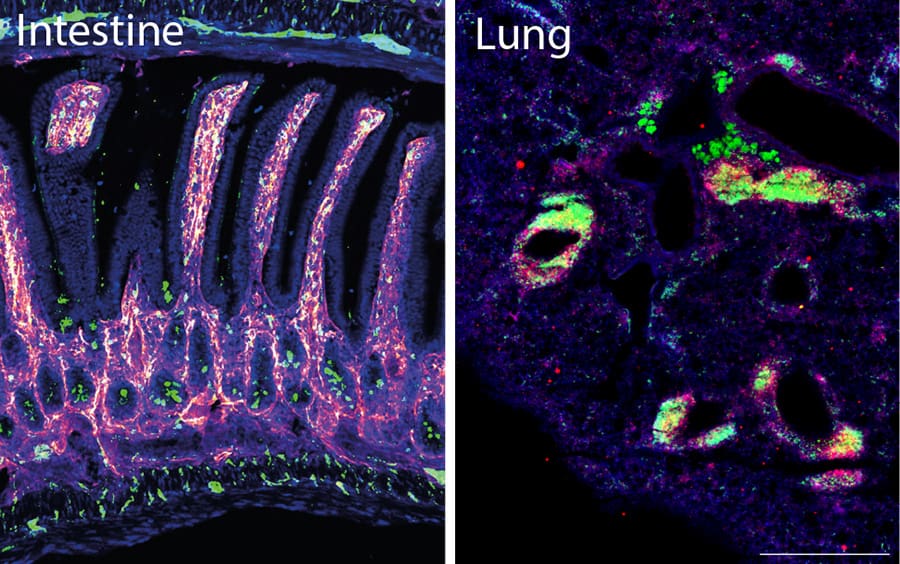
Immunofluorescence images of intestine and lung. Lymphatic vessels (purple) and neurons (green) in the mouse intestine. Ectopic tertiary lymphoid structure (iBALT) formation (B cells (green), T cells (red)) during chronic allergic lung inflammation in LIF-deficient mice
Lymphatic vessels and neurons in the mouse intestine, and inflammation in allergen-challenged mouse lung.

We recently extended our approach to investigate how lymphocytes interact with specific neurons and stromal cells in the intestine and lung to provide additional layers of immune regulation.

Selected Publications

ILC2-derived LIF licences progress from tissue to systemic immunity.Gogoi M, Clark PA, Ferreira ACF, Rodriguez Rodriguez N, Heycock M, Ko M, Murphy JE, Chen V, Luan SL, Jolin HE, McKenzie ANJNature 632(8026): 885-892 (2024)
Mef2d potentiates type-2 immune responses and allergic lung inflammation.Szeto ACH, Clark PA, Ferreira ACF, Heycock M, Griffiths EL, Jou E, Mannion J, Luan SL, Storrar S, Knolle MD, Kozik P, Jolin HE, Fallon PG, McKenzie ANJScience 384(6703): eadl0370 (2024)
Neuroprotective protein ADNP-dependent histone remodeling complex promotes T helper 2 immune cell differentiation.Ferreira ACF, Szeto ACH, Clark PA, Crisp A, Kozik P, Jolin HE, McKenzie ANJImmunity 56(7): 1468-1484.e7 (2023)
An αvβ3 integrin checkpoint is critical for efficient TH2 cell cytokine polarization and potentiation of antigen-specific immunity.Szeto ACH, Ferreira ACF, Mannion J, Clark PA, Sivasubramaniam M, Heycock MWD, Crisp A, Jolin HE, Kozik P, Knolle MD, McKenzie ANJNat Immunol 24(1): 123-135 (2023)