Madeline Lancaster
Human brain development and evolution

The human brain sets us apart as a species. Yet how its unique characteristics come about is still largely unknown because it has been impossible to access and study human brain tissue. Now, with the advent of organoids, miniature organ-like tissues made in the lab, we are beginning to shed light on the mechanisms that establish the unique features of the human brain.
Using cerebral organoids, which mimic the developing forebrain, including the neocortex, we are comparing human and non-human ape and other primate organoids to uncover what sets the human brain apart at a tissue, cellular, epigenetic and genetic level. We are specifically interested in the mechanisms that lead to the impressive enlargement of the human brain, which contains more than 50 billion more neurons than a chimpanzee brain.
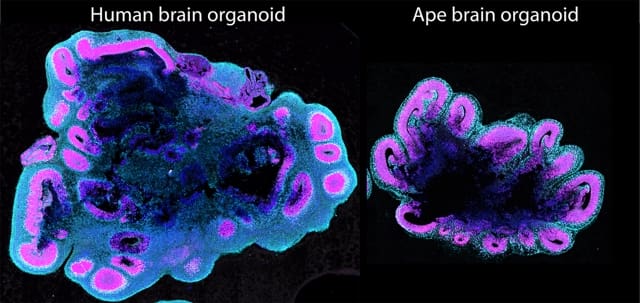
We have discovered key differences in the behaviour of the stem cells that give rise to neurons, leading to increased numbers, helping explain why we have such enlarged brains. We are now investigating the mechanisms that underlie these differences to identify the evolutionary genetic determinants. Along the way, we have discovered that many of the unique features seem to impact processes and genes that are relevant to human neurodevelopmental conditions like intellectual disability and autism.
Brain organoids are sometimes called “mini-brains” but it’s important to remember that they are not actual miniature brains, but rather minuscule clumps of tissue. Nevertheless, they can give us insight into how human neurons are made and how they function.