Group Leader

Emmanuel Derivery

Molecular basis of cell polarisation and asymmetry

Emmanuel Derivery
Group Members
  • Alice Bittleston
  • Megan Clapperton
  • Akaash Kumar
  • James Manton
  • Kerrie McNally
  • Julie Miesch
  • Patrick O’Donnell
  • Vicente Jose Planelles Herrero
  • Stephanus Steven

Asymmetric cell division is the process by which one cell divides into two daughter cells that have different fates. Asymmetric division is the hallmark of stem cells: one daughter cell specialises to perform a specific function in the organism, while the other becomes another stem cell that keeps the ability to divide. We are interested in understanding how cell fate determinants segregate during asymmetric division. Specifically, we focus on understanding the molecular and physical mechanisms by which cytoskeleton tracks can be polarised by cortical polarity cues, and how, in turn, this polarised network of tracks are ‘read’ by molecular motors to carry endosomes containing the right cell fate determinants into only one daughter cell. Our long-term vision is to capitalise on this work in asymmetric cell division to establish the rules of polarised transport, which could apply to other polarised cells, such as neurons.
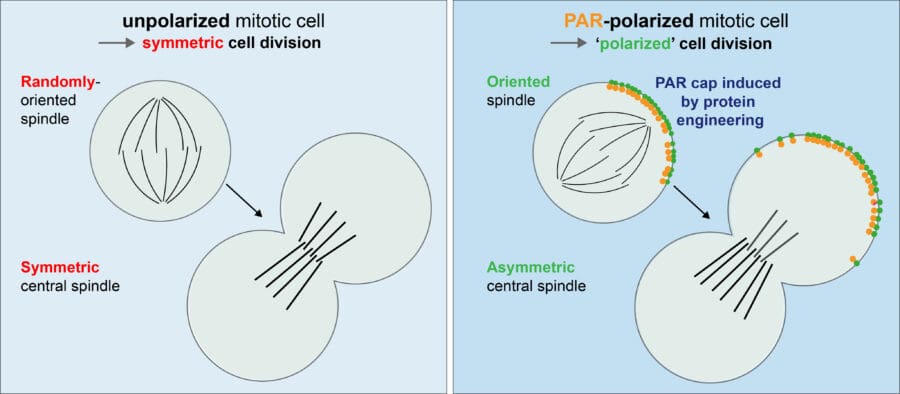
Mitotic cell division comparison: unpolarized cells divide symmetrically, while PAR-polarized cells, induced by protein engineering, exhibit asymmetric division due to oriented spindle.
A synthetic “cap” of the Par complex is sufficient to induce hallmarks of asymmetric cell division in unpolarised cells.

Our approach is multidisciplinary: we combine quantitative imaging, developmental cell biology, synthetic biology, in vitro reconstitution and structural biology. We also invest in technology development to overcome technical bottlenecks that currently hold back our understanding. For instance, we have developed techniques to induce polarity in unpolarised cells, using micropatterning and protein design. This allows us to decipher the molecular mechanisms underpinning cytoskeleton polarisation. In collaboration with James Manton, we also develop novel imaging technologies specifically designed to dissect the molecular interactome of fast cellular processes, such as the sorting of specific signalling cargoes into endosomes.

Simultaneous 7-color live cell imaging in human cells shedding light on inter-organelle interactions and material exchange.

Selected Publications

Synthetic Par polarity induces cytoskeleton asymmetry in unpolarized mammalian cells.Watson JL, Krüger LK, Ben-Sasson AJ, Bittleston A, Shahbazi MN, Planelles-Herrero VJ, Chambers JE, Manton JD, Baker D, Derivery ECell 186(21): 4710-4727.e35 (2023)
Macromolecular condensation buffers intracellular water potential.Watson JL, Seinkmane E, Styles CT, Mihut A, Krüger LK, McNally KE, Planelles-Herrero VJ, Dudek M, McCall PM, Barbiero S, Vanden Oever M, Peak-Chew SY, Porebski BT, Zeng A, Rzechorzek NM, Wong DCS, Beale AD, Stangherlin A, Riggi M, Iwasa J, Morf J, Miliotis C, Guna A, Inglis AJ, Brugués J, Voorhees RM, Chambers JE, Meng QJ, O’Neill JS, Edgar RS, Derivery ENature 623(7988): 842-852 (2023)
Elongator stabilizes microtubules to control central spindle asymmetry and polarized trafficking of cell fate determinants.Planelles-Herrero VJ, Bittleston A, Seum C, Daeden A, Gaitan MG, Derivery ENat Cell Biol 24(11): 1606-1616 (2022)
Design of biologically active binary protein 2D materials.Ben-Sasson AJ, Watson JL, Sheffler W, Johnson MC, Bittleston A, Somasundaram L, Decarreau J, Jiao F, Chen J, Mela I, Drabek AA, Jarrett SM, Blacklow SC, Kaminski CF, Hura GL, De Yoreo JJ, Kollman JM, Ruohola-Baker H, Derivery E, Baker DNature 589(7842): 468-473 (2021)