Group Leader

Simon Bullock

Molecular cell biology of cytoskeletal transport

Simon Bullock
Group Members
  • Lucas Albacete Albacete
  • Li Jin
  • Razina Kazi
  • Mark McClintock
  • Sankar Meenakshi Sundaram
  • Eve Mehtab
  • Kyle Nickel

Our overarching goal is to understand how the interior of cells is organised in space and time, and how this contributes to cellular function. We study this problem in the context of microtubule-based transport, which uses molecular motors to deliver organelles, vesicles and macromolecules to different locations within the cytoplasm. This research is timely as there is growing evidence that defective motor function can cause neurodevelopmental and neurodegenerative diseases. Moreover, several pathogenic viruses hijack microtubule motors to establish infection.

Multiplexed fluorescent imaging of cellular organisation in human cells Caption: Multiplexed fluorescent imaging of cellular organisation in human cells.
Multiplexed fluorescent imaging of cellular organisation in human cells.

We are studying transport mechanisms using two tractable model systems – subcellular mRNA localisation and membrane trafficking – both of which play a critical role in compartmentalising cellular activities. We work across scales to address our questions, combining single-molecule imaging of reconstituted transport complexes with identification of new transport regulators and genetics in human cells and Drosophila.
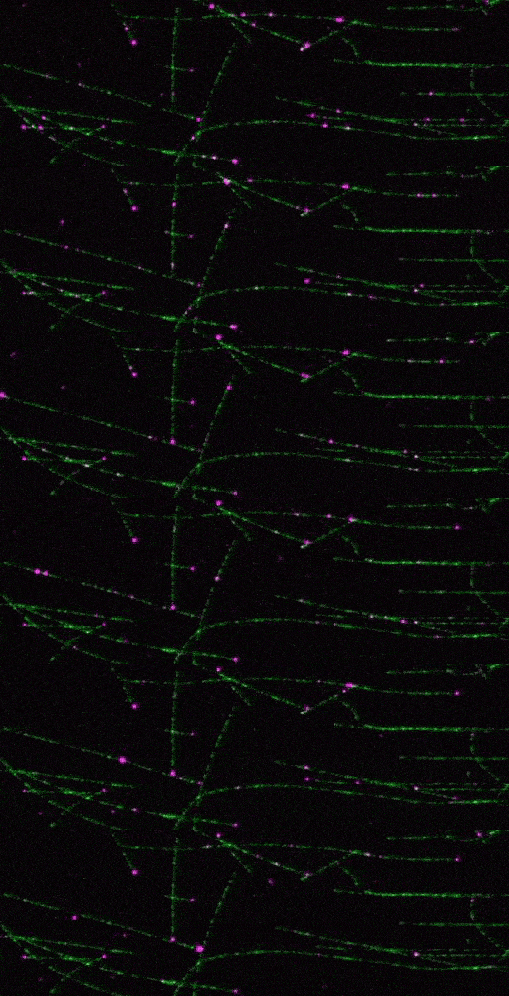
Magenta ribonucleoprotein complexes are seen localised along and associated with green cellular filaments in a fluorescence micrograph.
In vitro reconstitution of dynein-based mRNA transport with purified components (magenta, mRNA; green, microtubules).

The questions we are interested in include:

  • How do molecular motors recognise specific types of cargo and sort them to different parts of the cell?
  • How is mRNA transport coordinated with other post-transcriptional events such as translation?
  • How is the action of multiple motor types bound to a single cargo orchestrated?
  • How is trafficking regulated by stress, and how does this facilitate adaptation?
  • How does microtubule structure and organisation contribute to cargo sorting?

Selected Publications

A force-sensitive mutation reveals a non-canonical role for dynein in anaphase progression.Salvador-Garcia D, Jin L, Hensley A, Gölcük M, Gallaud E, Chaaban S, Port F, Vagnoni A, Planelles-Herrero VJ, McClintock MA, Derivery E, Carter AP, Giet R, Gür M, Yildiz A, Bullock SLJ Cell Biol 223(10): (2024)
Genome-scale requirements for dynein-based transport revealed by a high-content arrayed CRISPR screen.Wong CH, Wingett SW, Qian C, Hunter MR, Taliaferro JM, Ross-Thriepland D, Bullock SLJ Cell Biol 223(5): (2024)
Tropomyosin 1-I/C coordinates kinesin-1 and dynein motors during oskar mRNA transport.Heber S, McClintock MA, Simon B, Mehtab E, Lapouge K, Hennig J, Bullock SL, Ephrussi ANat Struct Mol Biol 31(3): 476-488 (2024)
HEATR5B associates with dynein-dynactin and promotes motility of AP1-bound endosomal membranes.Madan V, Albacete-Albacete L, Jin L, Scaturro P, Watson JL, Muschalik N, Begum F, Boulanger J, Bauer K, Kiebler MA, Derivery E, Bullock SLEMBO J 42(23): e114473 (2023)