Anne Bertolotti
Understanding and manipulating cellular resilience in health and disease

Life depends on the ability to survive challenges. Our work focusses on vital signalling pathways that evolved to ensure cell survival in the face of stressors.
We have pioneered strategies that harness these pathways to enhance cellular resilience, a modality broadly applicable to improve fitness in diverse diseases, including age-related neurodegenerative diseases.
Neurodegenerative diseases such as Alzheimer’s disease, Parkinson’s disease, Huntington’s disease and Amyotrophic Lateral Sclerosis (ALS) are clinically different yet share a common molecular aetiology. They are caused by the progressive dysfunction and death of nerve cells in selective regions of the brain due to the accumulation of certain proteins in the form of insoluble assemblies. Cells normally strive to ensure that proteins fold correctly, using powerful and sophisticated protein quality control systems to guard against potentially harmful proteins. The phosphorylation of translational initiation factor elF2 slows down protein synthesis, freeing up protein quality control components, such as chaperones and proteasomes, that can then manage the ‘bad’ proteins that accumulate in aged neurons.
We design powerful strategies that boost cellular resilience to misfolded proteins and protect from different neurodegenerative diseases. Some of the small molecules we reported are tested in human clinical trials: Guanabenz was found to be efficacious in a Phase 2 trial in ALS and Phase 2 trials are ongoing with Sephin1, after successful Phase 1 and Phase 2a trials.
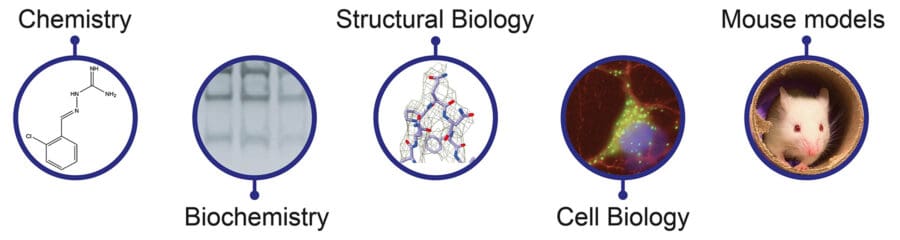
Our research embraces intellectual and technical challenges. Our work is pluridisciplinary by nature, combining chemistry, biochemistry, biophysics, structural biology and cell biology with mouse models of diseases. Our work is led by curiosity and is data-driven. Our goal is to solve big fundamental problems that will ultimately improve human health.