
Group Leader

Diana Arseni

Lysosomal TMEM106B in brain ageing and disease

Diana Arseni
Group Members
  • Jelle Biemans
  • Yuening Li

Our group studies mechanisms of brain health, ageing and disease focussing on the lysosomal protein transmembrane protein 106B (TMEM106B), which forms amyloids in the brain in an age-dependent manner. TMEM106B genetic variants have also been found to modulate healthy ageing and disease risk in frontotemporal lobar degeneration (FTLD) and Alzheimer’s disease. However, the underlying mechanisms behind TMEM106B and its implications for ageing and neurodegenerative disease are, as yet, unknown.

TMEM106B has been implicated in various lysosomal processes. Lysosomes are highly dynamic organelles, present at the crossroads of cell signalling, transcription, and metabolism. Their role was initially understood to be key to degrading cellular waste, though understanding of lysosomes has since expanded and it is now established that they are also intrinsic to ageing and neurodegeneration. We use multidisciplinary approaches to shed new insights into the role of lysosomal TMEM106B in ageing and neurodegeneration. Ultimately, this advanced understanding will open new avenues of research in lysosomal biology in the context of ageing and could lead to the development of new therapeutic strategies to slow the processes of ageing and neurodegeneration.
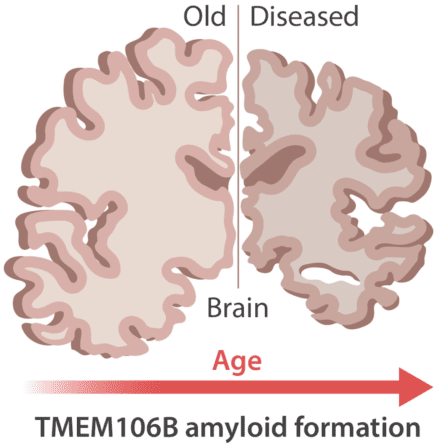
Diagram illustrating an old healthy brain next to a diseased brain. Below the diagram, there is an arrow depicting TMEM106B amyloid formation during ageing.


A graphic illustration of a characteristic healthy aged brain on the left side and a diseased brain on the right side (one hemisphere each). The gradient arrow below depicts TMEM106B amyloid formation with ageing.

Selected Publications

Heteromeric amyloid filaments of ANXA11 and TDP-43 in FTLD-TDP type C.Arseni D, Nonaka T, Jacobsen MH, Murzin AG, Cracco L, Peak-Chew SY, Garringer HJ, Kawakami I, Suzuki H, Onaya M, Saito Y, Murayama S, Geula C, Vidal R, Newell KL, Mesulam M, Ghetti B, Hasegawa M, Ryskeldi-Falcon BNature 634(8034): 662-668 (2024)
TDP-43 forms amyloid filaments with a distinct fold in type A FTLD‑TDP.Arseni D, Chen R, Murzin AG, Peak-Chew SY, Garringer HJ, Newell KL, Kametani F, Robinson AC, Vidal R, Ghetti B, Hasegawa M, Ryskeldi-Falcon BNature 620(7975): 898-903 (2023)
Age-dependent formation of TMEM106B amyloid filaments in human brains.Schweighauser M, Arseni D, Bacioglu M, Huang M, Lövestam S, Shi Y, Yang Y, Zhang W, Kotecha A, Garringer HJ, Vidal R, Hallinan GI, Newell KL, Tarutani A, Murayama S, Miyazaki M, Saito Y, Yoshida M, Hasegawa K, Lashley T, Revesz T, Kovacs GG, van Swieten J, Takao M, Hasegawa M, Ghetti B, Spillantini MG, Ryskeldi-Falcon B, Murzin AG, Goedert M, Scheres SHWNature 605(7909): 310-314 (2022)
Structure of pathological TDP-43 filaments from ALS with FTLD.Arseni D, Hasegawa M, Murzin AG, Kametani F, Arai M, Yoshida M, Ryskeldi-Falcon BNature 601(7891): 139-143 (2022)