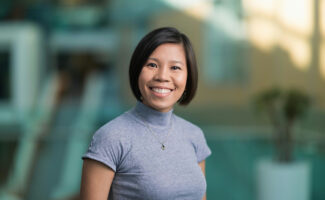
Just over two years ago, Shahana Ahmed hung up her lab coat after a career spent working at the lab bench. Her destination? The LMB Health & Safety team. She readily admits that she perhaps arrived at her new desk with a skewed perception of H&S, assuming, as many other researchers likely do, that their primary purpose is to impede experimental work.
Now, as the LMB’s specialist biological and chemical Health & Safety Advisor and having recently completed the NEBOSH (National Examination Board in Occupational Safety and Health) General Certificate in Occupational Health and Safety – a challenging course widely regarded as the international gold standard in health and safety qualifications – Shahana is a vocal champion of Health & Safety work.
Below she reflects on her NEBOSH qualification and the work she’s been doing to dispel notions that health and safety encumbers research.
What did completing the NEBOSH General Certificate entail?
There’s lots of ways you can do it. You can do it self-paced and online over whatever time frame you wish, but I chose to do a two-week intensive course in Cambridge. That’s two weeks of studying and then completing two assessments; a written exam and a comprehensive risk assessment of your workplace. The exam, which is a 24-hour, open-book assessment, is like a large risk assessment with questions on a particular scenario, drawing on all your health and safety knowledge and everything you’ve learnt during the course. My scenario covered people who got stuck in a lift, so I had to learn a lot about lift regulations, which I didn’t know anything about. It was a huge amount of work and very stressful, but I ended up with a really high mark.
What did you gain from completing the qualification?
The course gave me a lot more confidence. It armed me with the knowledge of lots of aspects of health and safety. But having that knowledge on its own isn’t going to get you very far – you need to experience putting it into practise in the right environment, which I can do at the LMB. So much of the NEBOSH qualification requires learning on the job, so I got a lot of support and advice from my colleagues in the Health and Safety team.
There were around 12 people on my course; some of them had been working in health and safety for years and were finally doing their NEBOSH certificate, some were embarking on career changes. It was really nice to interact with all these different people and learn about the different incidents they’ve handled in jobs like event planning, the armed forces and offshore drilling.
What’s your favourite thing about working in the Health & Safety team?
I really like the engagement part of health and safety, and I think that’s come from my experience as a scientist because I just didn’t know so much about it then. In part, that’s because so much of health and safety work is done behind the scenes. To counter this, we’re really encouraged to chat to people in the labs, rather than send an email. They’re more likely to come to you if they need something, or when something goes wrong, if they know who you are.
I also make the ‘Safety Matters’ internal newsletter, and that’s something I really enjoy doing. I’ve tried to make it more people-focussed, rather than a list of rules of what to do and what not to do. I want researchers to realise we don’t just say, ‘Oh no, this is too dangerous, you can’t do that,’ but we find ways to make their work happen.
Can you share an example of how health and safety has enabled scientific research rather than restricted it?
Last year, we organised the UK Biological Safety Advisers Meeting here at the LMB. In preparation for this, I started learning about how Sydney Brenner, Nobel Laureate and former Director of the LMB, became a big advocate for health and safety following a ruling in the 1970s which restricted all work with genetically modified organisms. Sydney Brenner got involved with the Asilomar Conference in California in 1975, where a large group of scientists discussed how they could restart the work safely, leading to the first voluntary biohazard safety guidelines for genetic engineering. People say that health and safety hinders science, but if you look back, it was people like Sydney Brenner who put in place the rules to let it happen again.
As it was the 50th anniversary of the Asilomar Conference, I dedicated an issue of the Safety Matters newsletter to the event and Sydney Brenner’s role. I did so much research for this that I was asked to present at the biosafety conference, and later at the Wellcome Sanger Institute. I gave a talk called ‘Bushy Eyebrows and Breakthroughs’ (because Sydney Brenner was renowned for his bushy eyebrows) where I explained how implementing new rules like containment enabled the science to happen in a safe manner. This is the kind of work we’re still doing in the LMB’s Health & Safety team, finding ways to make research happen safely.
Further references
Christy Russell received General Certificate in Occupational Health and Safety
LMB Support Services